


Impact of Interfering Substances on the Bactericidal Efficacy of Different Commercially Available Hypochlorous Acid-Based Wound Irrigation Solutions Commonly Found in South-East Asia
- PMID: 38666985
- PMCID: PMC11047473
- DOI: 10.3390/antibiotics13040309
Impact of Interfering Substances on the Bactericidal Efficacy of Different Commercially Available Hypochlorous Acid-Based Wound Irrigation Solutions Commonly Found in South-East Asia
Abstract
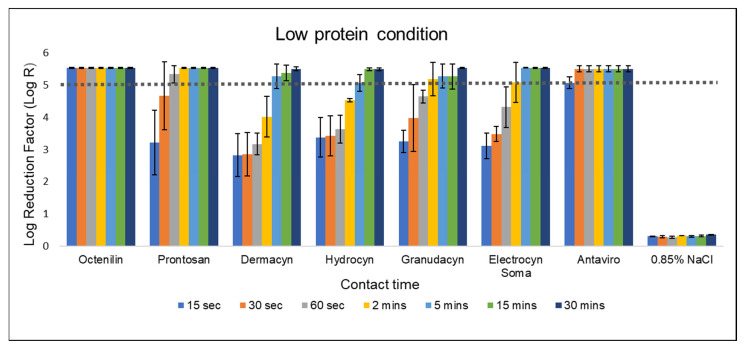
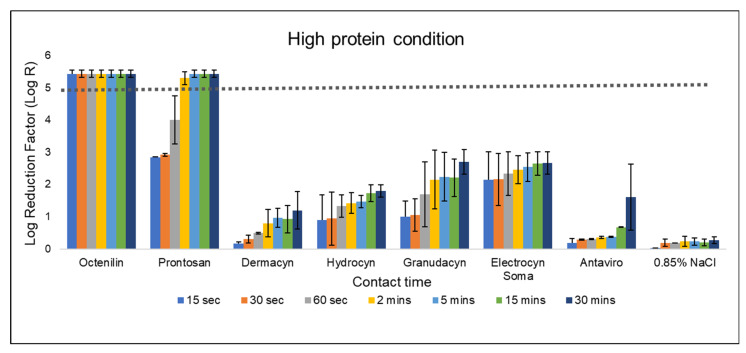
The high prevalence of chronic wounds is a growing concern. Recently, hypochlorous acid (HOCl)-based solutions were introduced as an alternative antimicrobial for wound cleansing. In this study, we assessed the in vitro bactericidal activities of seven commercially available wound irrigation products commonly found in South-East Asia. The evaluation was conducted using quantitative suspension method, EN 13727 in either low or high protein conditions. Under low protein conditions, four out of the five HOCl products achieved bactericidal activity (≥5 log10 reduction factor; RF) within 2-5 min, and only one product achieved 5 log10 RF at 15 s. None of the HOCl achieved 5 log10 RF under high protein, even after 30 min of exposure time. In contrast, protein interference on the antimicrobial activities of polyhexamethylene biguanide-based product is less pronounced (low protein: 60 s vs. high protein: 2 min to attain ≥5 log10 RF). Octenidine dihydrochloride is the only active not affected by protein interference achieving ≥5 log10 RF within 15 s in both low and high protein conditions. These findings warrant the need to screen antimicrobial wound care products, especially HOCl-based products, in high protein condition to better reflect the antimicrobial activities in wound care.
Keywords: antimicrobial; antimicrobial activity; commercial hypochlorous acid-based solutions; protein interference; quantitative suspension method; wound cleansing.
Conflict of interest statement
D.Y.O. is employed at Schülke & Mayr (Asia) Pte Ltd. but had no role in the collection, analyses, or interpretation of data, nor in the decision to publish the results. J.W.Y., N.I.I., C.S.L. declare no conflict of interest.
Figures
References
-
- Malone M., Bjarnsholt T., McBain A.J., James G.A., Stoodley P., Leaper D., Tachi M., Schultz G., Swanson T., Wolcott R.D. The Prevalence of Biofilms in Chronic Wounds: A Systematic Review and Meta-Analysis of Published Data. J. Wound Care. 2017;26:20–25. doi: 10.12968/jowc.2017.26.1.20. - DOI - PubMed
-
- Nair H., Mrozikiewicz-Rakowska B., Sanches Pinto D., Stuermer E., Matiasek J., Sander J., Lázaro-Martínez J., Ousey K., Assadian O., Kim P., et al. Wounds International; London, UK: 2023. [(accessed on 12 December 2023)]. International Consensus Document: Use of Wound Antiseptics in Practice; pp. 1–28. Available online: https://www.woundsinternational.com.
LinkOut - more resources
Full Text Sources
Molecular Biology Databases
Research Materials
