. 2024 Apr 8;15(4):254.
doi: 10.3390/insects15040254.

Integrated Omics Analysis Reveals Key Pathways in Cotton Defense against Mirid Bug (Adelphocoris suturalis Jakovlev) Feeding

Affiliations

Integrated Omics Analysis Reveals Key Pathways in Cotton Defense against Mirid Bug (Adelphocoris suturalis Jakovlev) Feeding

Hui Lu et al. Insects. .

Abstract

The recent dominance of Adelphocoris suturalis Jakovlev as the primary cotton field pest in Bt-cotton-cultivated areas has generated significant interest in cotton pest control research. This study addresses the limited understanding of cotton defense mechanisms triggered by A. suturalis feeding. Utilizing LC-QTOF-MS, we analyzed cotton metabolomic changes induced by A. suturalis, and identified 496 differential positive ions (374 upregulated, 122 downregulated) across 11 categories, such as terpenoids, alkaloids, phenylpropanoids, flavonoids, isoflavones, etc. Subsequent iTRAQ-LC-MS/MS analysis of the cotton proteome revealed 1569 differential proteins enriched in 35 metabolic pathways. Integrated metabolome and proteome analysis highlighted significant upregulation of 17 (89%) proteases in the α-linolenic acid (ALA) metabolism pathway, concomitant with a significant increase in 14 (88%) associated metabolites. Conversely, 19 (73%) proteases in the fructose and mannose biosynthesis pathway were downregulated, with 7 (27%) upregulated proteases corresponding to the downregulation of 8 pathway-associated metabolites. Expression analysis of key regulators in the ALA pathway, including allene oxidase synthase (AOS), phospholipase A (PLA), allene oxidative cyclase (AOC), and 12-oxophytodienoate reductase3 (OPR3), demonstrated significant responses to A. suturalis feeding. Finally, this study pioneers the exploration of molecular mechanisms in the plant-insect relationship, thereby offering insights into potential novel control strategies against this cotton pest.

Keywords: Adelphocoris suturalis Jakovlev; cotton plant defense; fructose and mannose biosynthesis pathway; key regulators; α-linolenic acid metabolism pathway.


Conflict of interest statement

The authors declare no conflicts of interest.

Figures
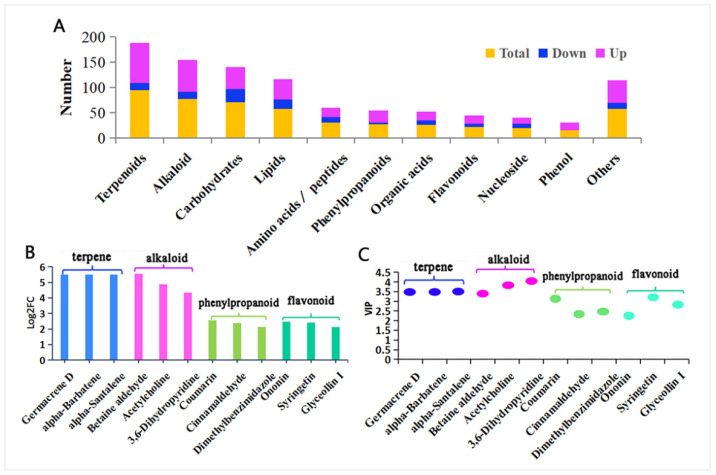
Figure 1
Figure 1
Differentially expressed metabolites in cotton. (A) Category of differentially expressed metabolites. (B) FC analysis of differentially expressed secondary metabolites related to cotton defense. (C) VIP analysis of differentially expressed secondary metabolites related to cotton defense.
Figure 2
Figure 2
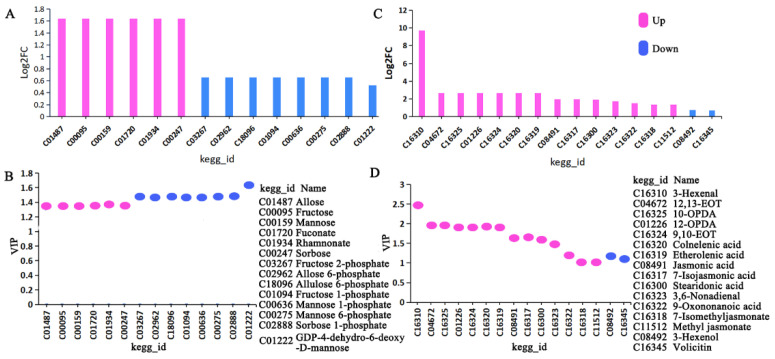
FC and VIP analysis of metabolism pathway. (A) FC and (B) VIP of fructose and mannose metabolism pathway. (C) FC and (D) VIP of ALA metabolism pathway.
Figure 3
Figure 3
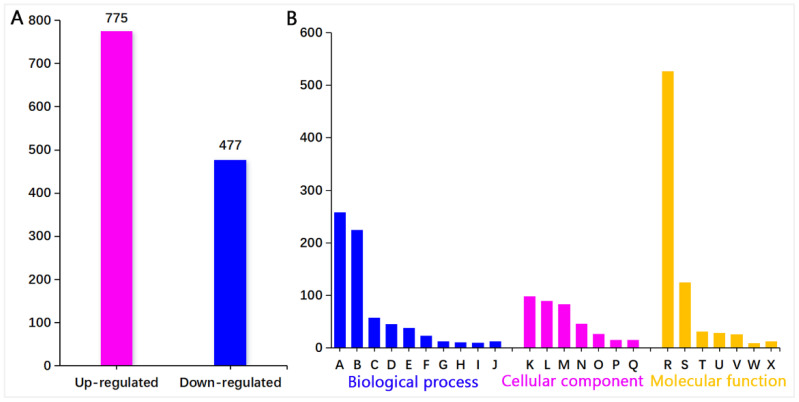
Protein identification and GO enrichment analysis of DEPs. (A) Up- and downregulated protein in cotton plants after mirid bug feeding. (B) GO annotation and functional classification of differentially expressed proteins in cotton plants, categorized as follows: biological process (A: metabolic process, B: single-organism process, C: cellular process metabolic process, D: response to stimulus, E: localization, F: reproductive process, G: signaling, H: cellular process, I: cellular component organization or biogenesis, J: others); cellular component (K: organelle part, L: organelle, M: cell part, N: membrane part, O: macromolecular complex, P: extracellular region, Q: membrane); and molecular function (R: catalytic activity, S: binding, T: transporter activity, U: structural molecule activity, V: antioxidant activity, W: enzyme regulator activity, X: others).
Figure 4
Figure 4
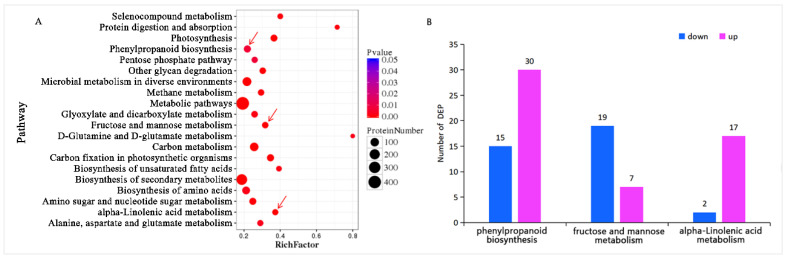
KEGG pathway enrichment. (A) Top 20 enriched pathways. Arrows represent metabolic pathways of interest. (B) Different metabolite changes of the defense-related metabolic pathways.
Figure 5
Figure 5
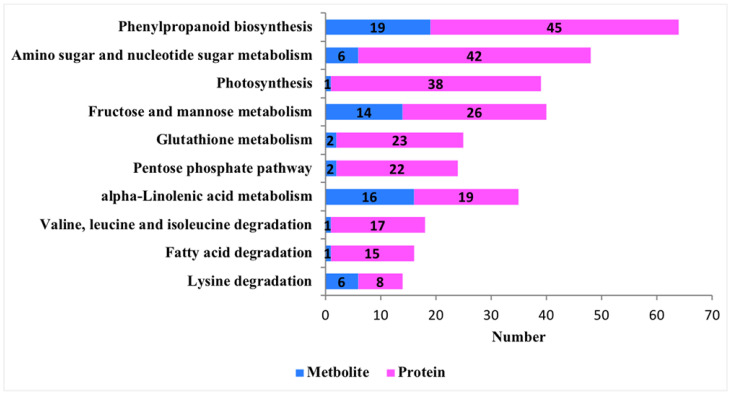
Common metabolic pathways of differential proteins and differential metabolites. Pink represents the number of differentially expressed metabolites (DEMs); blue represents the number of differentially expressed proteins (DEPs).
Figure 6
Figure 6
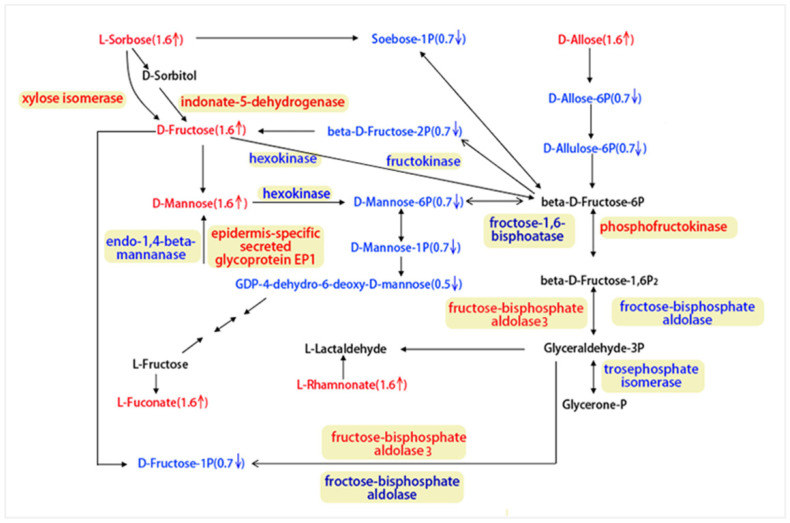
Integrated metabolomic and proteomic analysis of the fructose and mannose metabolism pathway. Red represents upregulated protease or metabolites, blue represents downregulated protease or metabolites, and black represents no change happening. The upregulated proteases were xylose isomerase (CotAD_24396, CotAD_63919, CotAD_02520), idonate-5-dehydrogenase (Cotton_D_gene_10030706), epidermis-specific secreted glycoprotein EP1 (CotAD_00556), phosphofructokinase (Cotton_D_gene_10039158), and fructose-bisphosphate aldolase3 (CotAD_58316). The downregulated proteases comprised hexokinase (CotAD_39434), fructokinase (CotAD_45862, CotAD_26511, CotAD_36008, CotAD_69191, Cotton_D_gene_10035332), endo-1,4-beta-mannanase (CotAD_57668), fructokinase-1-6-bisphosphatase(CotAD_39653), fructose-bisphosphate aldolase (CotAD_24238, CotAD_30698, CotAD_30700, CotAD_58944, CotAD_27060, CotAD_24236, CotAD_58035, CotAD_52093) and triosephosphate isomerase (CotAD_15944, CotAD_23341). The numbers in brackets represent FCs.
Figure 7
Figure 7
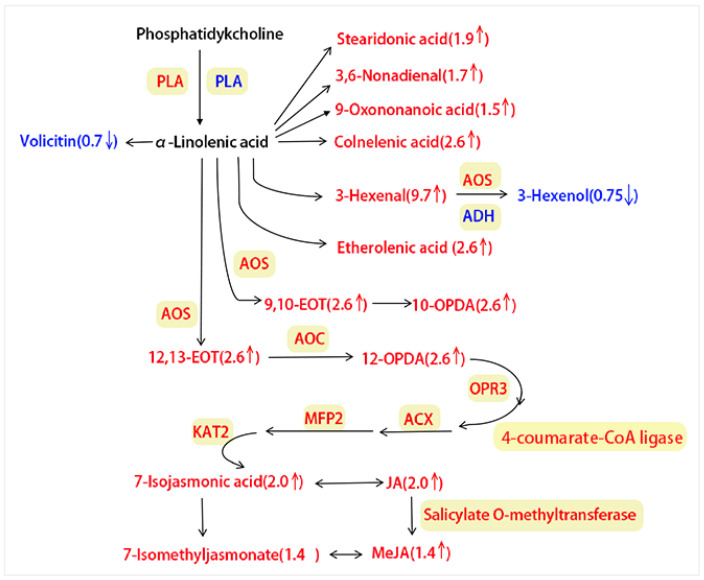
Integrated metabolomic and proteomic analysis of the ALA metabolism pathway. Red represents upregulated protease or metabolites, blue represents downregulated proteases or metabolites, and black represents no change happening. The upregulated proteases were: PLA (CotAD_52791), AOS (CotAD_35840, Cotton_D_gene_10023640, CotAD_58616), AOC (Cotton_D_gene_10007846, Cotton_D_gene_10007844), OPR3 (CotAD_59461, Cotton_D_gene_10037325), 4-coumarate-CoAligase (CotAD_59374), ACX (CotAD_52391, CotAD_12782, Cotton_D_gene_10040584), MFP2 (CotAD_18083), KAT2 (CotAD_51900, CotAD_10744, CotAD_66777), salicylate O-methyltransferase (CotAD_27039). The downregulated proteases comprised PLA (CotAD_64088) and ADH (CotAD_64304). The numbers in brackets represent FCs.
Figure 8
Figure 8
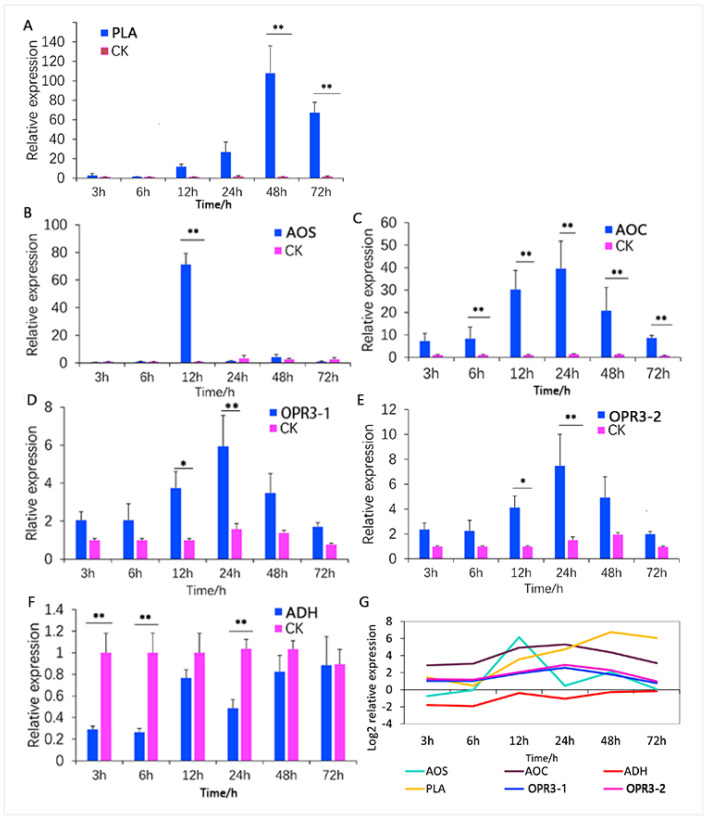
qRT-PCR analysis of the key genes in ALA metabolism pathway in cotton leaves. (A) Key regulator gene PLA, (B) key regulator gene AOS, (C) key regulator gene AOC, (D) key regulator gene OPR3-1, (E) key regulator gene OPR3-2, (F) downregulated gene ADH, (G) dynamic variation in the six ALA metabolism pathway-related genes in cotton plant. “*” represents p < 0.05 and “**” represents p < 0.01.
Figure 9
Figure 9
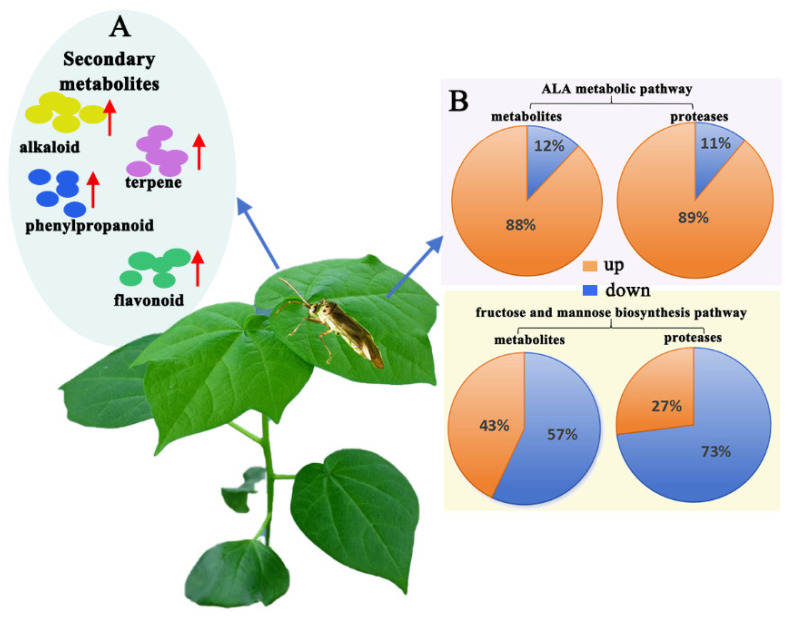
Hypothetic model of A. suturalis-induced cotton plant resistance. (A) Changes in secondary metabolites; (B) two key metabolic pathways.

References

    1. Kessler A., Baldwin I.T. Plant responses to insect herbivory: The emerging molecular analysis. Annu. Rev. Plant Biol. 2002;53:299–328. doi: 10.1146/annurev.arplant.53.100301.135207. - DOI - PubMed
    1. Wu J., Baldwin I.T. New insights into plant responses to the attack from insect herbivores. Annu. Rev. Genet. 2010;44:1–24. doi: 10.1146/annurev-genet-102209-163500. - DOI - PubMed
    1. Howe G.A., Jander G. Plant immunity to insect herbivores. Annu. Rev. Plant Biol. 2008;59:41–66. doi: 10.1146/annurev.arplant.59.032607.092825. - DOI - PubMed
    1. Xu T., Zhou Q., Chen W., Zhang G., He G.F., Gu D.X., Zhang W.Q. Involvement of Jasmonate-signaling pathway in the herbivore-induced rice plant defense. Chin. Sci. Bull. 2003;48:1982–1987. doi: 10.1007/BF03183991. - DOI
    1. Cao J.J., Li M.Y., Chen J., Liu P., Li Z. Effects of MeJA on Arabidopsis metabolome under endogenous JA deficiency. Sci. Rep. 2016;6:37674. doi: 10.1038/srep37674. - DOI - PMC - PubMed

LinkOut - more resources