Review
. 2024 Apr 26;10(1):49.
doi: 10.1038/s41526-024-00392-6.

NASA GeneLab derived microarray studies of Mus musculus and Homo sapiens organisms in altered gravitational conditions

Affiliations
Review

NASA GeneLab derived microarray studies of Mus musculus and Homo sapiens organisms in altered gravitational conditions

Konstantinos I Adamopoulos et al. NPJ Microgravity. .

Abstract

One of the greatest challenges of humanity for deep space exploration is to fully understand how altered gravitational conditions affect human physiology. It is evident that the spaceflight environment causes multiple alterations to musculoskeletal, cardiovascular, immune and central nervous systems, to name a few known effects. To better characterize these biological effects, we compare gene expression datasets from microarray studies found in NASA GeneLab, part of the NASA Open Science Data Repository. In this review, we summarize these archived results for various tissues, emphasizing key genes which are highly reproducible in different mice or human experiments. Such exhaustive mining shows the potential of NASA Open Science data to identify and validate mechanisms taking place when mammalian organisms are exposed to microgravity or other spaceflight conditions. Our comparative meta-analysis findings highlight certain degrees of overlap and reproducibility in genes identified as differentially expressed within musculoskeletal tissues in each species across a variety of altered gravity conditions. However, the level of overlap between species was found to be significantly limited, partly attributed to the limited availability of human samples.


Conflict of interest statement

The authors declare no competing interests.

Figures
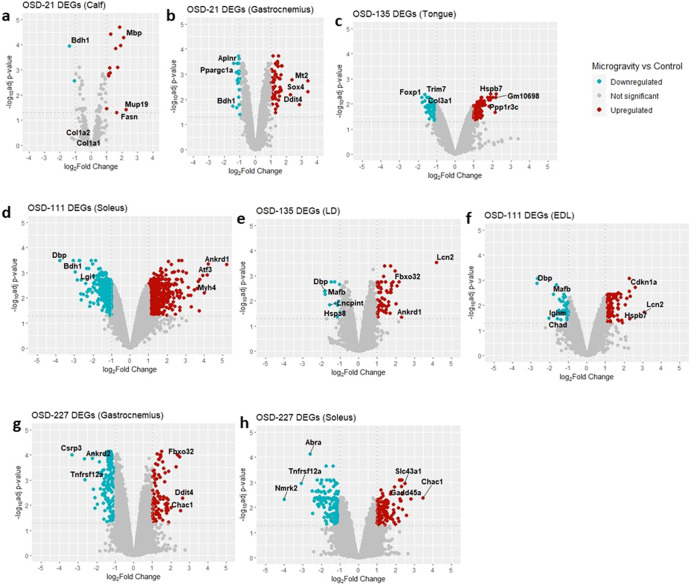
Fig. 1
Fig. 1. Volcano plots showing gene expression between microgravity and control conditions in mouse muscle datasets.
a OSD-21 calf; b OSD-21 gastrocnemius; c OSD-125 tongue; d OSD-111 soleus; e OSD-135 longissimus dorsi; f OSD-111 extensor digitorum longus; g OSD-227 gastrocnemius; h OSD-227 soleus. Genes with a log2-fold change above 1 are represented in red, signifying upregulated expression, while genes with a log2-fold change below −1 are depicted in blue, indicating downregulated expression. The horizontal dashed line corresponds to the adjusted P value threshold of less than 0.05, highlighting genes with statistically significant expression changes.
Fig. 2
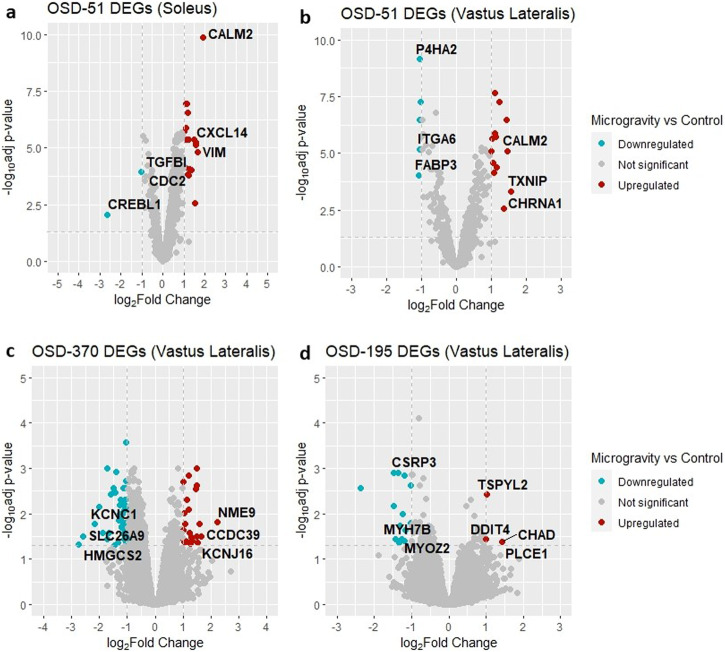
Fig. 2. Volcano plots showing gene expression between microgravity and control conditions in human muscle datasets.
a OSD-51 soleus; b OSD-51 vastus lateralis; c OSD-370 vastus lateralis; d OSD-195 vastus lateralis. Genes with a log2-fold change above 1 are represented in red, signifying upregulated expression, while genes with a log2-fold change below −1 are depicted in blue, indicating downregulated expression. The horizontal dashed line corresponds to the adjusted P value threshold of less than 0.05, highlighting genes with statistically significant expression changes.
Fig. 3
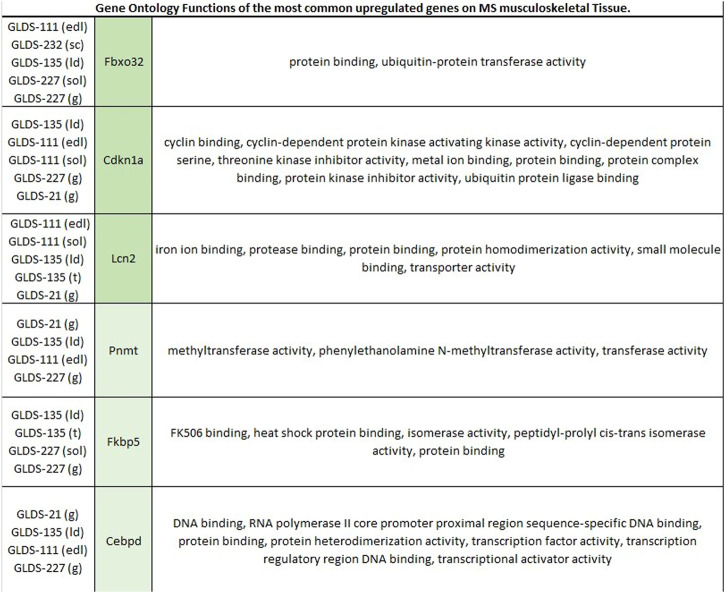
Fig. 3. Gene Ontology functions of all differentially expressed genes upregulated in four or more tissue types in mouse musculoskeletal datasets.
Dark green shadowed genes are differentially expressed in five tissue types; light green shadowed genes are differentially expressed in four tissue types. sc sternal cartilage, ld longissimus dorsi, sol soleus, edl extensor digitorum longus, g gastrocnemius.
Fig. 4
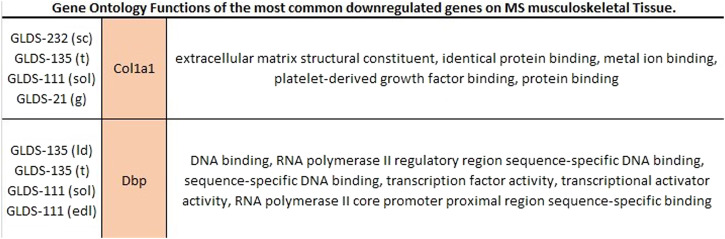
Fig. 4. Gene Ontology functions of all differentially expressed genes downregulated in four tissue types in mouse musculoskeletal datasets.
sc sternal cartilage, ld longissimus dorsi, sol soleus, edl extensor digitorum longus, g gastrocnemiussc sternal cartilage, t tongue, ld longissimus dorsi, sol soleus, sol soleus, g gastrocnemius, edl extensor digitorum longus.
Fig. 5
Fig. 5. Gene Ontology functions of differentially expressed genes upregulated in two human musculoskeletal datasets.
CHRND, CHAD, and RRAD upregulated genes in Homo sapiens’ vastus lateralis tissues appear to be involved in multiple enriched GO terms.
Fig. 6
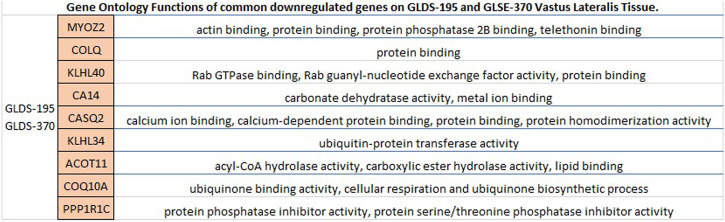
Fig. 6. Gene Ontology functions of all differentially expressed genes downregulated in two human musculoskeletal datasets.
MYOZ2, COLQ, KLHL40, CA14, CASQ2, KLHL34, ACOT11, COQ10A, and PPP1R1C downregulated genes in Homo sapiens' vastus lateralis tissues appear to be involved in multiple enriched GO terms.
Fig. 7
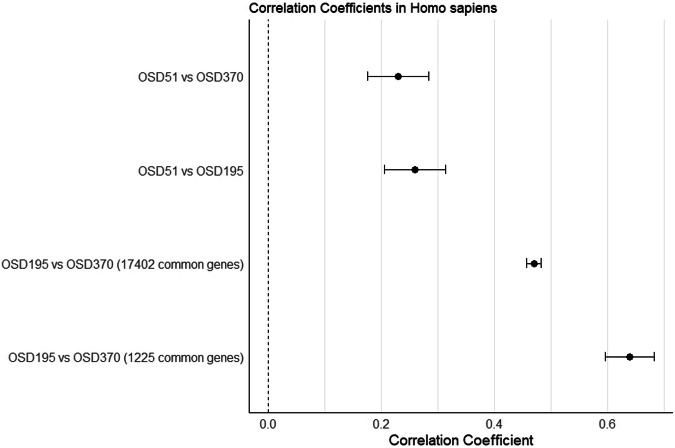
Fig. 7. Forest plot depicting the correlation coefficients for four comparisons including OSD-195 vs OSD-370, OSD-51 vs OSD-195, OSD-51 vs OSD-370, and OSD-195 vs OSD-370 from a larger merged dataset (17402 genes) in Homo sapiens.
The correlation coefficient for each comparison is represented by a black point on the line. The dashed vertical line at the center denotes the point of no correlation (correlation coefficient = 0). The confidence level employed for computing the confidence intervals (CIs) is configured to be 95%, equivalent to an alpha level of 0.05.
Fig. 8
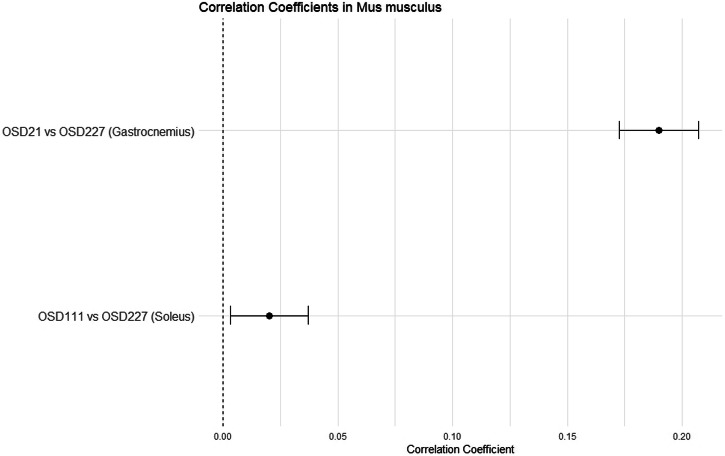
Fig. 8. The figure displays the correlation coefficients for two comparisons including OSD-21 vs OSD-227 (Gastrocnemius), OSD-111 vs OSD-227 (Soleus) in Mus musculus.
The correlation coefficient for each comparison is represented by a black point on the line. The dashed vertical line at the center denotes the point of no correlation (correlation coefficient = 0). The confidence level employed for computing the confidence intervals (CIs) is configured to be 95%, equivalent to an alpha level of 0.05.
Fig. 9
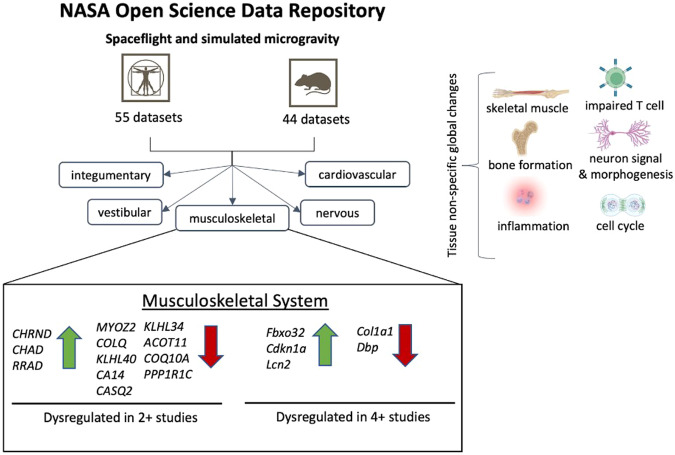
Fig. 9. An overview of the effects of altered gravity environment on various physiological aspects in both mouse and human systems incudes musculoskeletal, immune, cardiovascular, vestibular, integumentary, and nervous system alterations.
Comparative meta-analysis findings highlight certain degrees of overlap and reproducibility in genes identified as differentially expressed within musculoskeletal tissues in each species.

References

    1. Ray S, et al. GeneLab: Omics database for spaceflight experiments. Bioinformatics. 2019;35:1753–1759. doi: 10.1093/bioinformatics/bty884. - DOI - PubMed
    1. Berrios DC, Galazka J, Grigorev K, Gebre S, Costes SV. NASA GeneLab: interfaces for the exploration of space omics data. Nucleic Acids Res. 2021;49:D1515–D1522. doi: 10.1093/nar/gkaa887. - DOI - PMC - PubMed
    1. Adamopoulos, K., Koutsouris, D., Zaravinos, A. & Lambrou, G. I. Gravitational influence on human living systems and the evolution of species on Earth. Molecules26, 2784 (2021). - PMC - PubMed
    1. Morey-Holton, E. R. 9—The impact of gravity on life. In Evolution on Planet Earth (eds. Rothschild, L. J. & Lister, A. M.) 143–159 (Academic Press, 2003).
    1. Beheshti A, Cekanaviciute E, Smith DJ, Costes SV. Global transcriptomic analysis suggests carbon dioxide as an environmental stressor in spaceflight: a systems biology GeneLab case study. Sci. Rep. 2018;8:4191. doi: 10.1038/s41598-018-22613-1. - DOI - PMC - PubMed