Review
. 2024 Mar 27;14(4):404.
doi: 10.3390/biom14040404.

Alcohol-Associated Liver Disease Outcomes: Critical Mechanisms of Liver Injury Progression

Affiliations
Review

Alcohol-Associated Liver Disease Outcomes: Critical Mechanisms of Liver Injury Progression

Natalia A Osna et al. Biomolecules. .

Abstract

Alcohol-associated liver disease (ALD) is a substantial cause of morbidity and mortality worldwide and represents a spectrum of liver injury beginning with hepatic steatosis (fatty liver) progressing to inflammation and culminating in cirrhosis. Multiple factors contribute to ALD progression and disease severity. Here, we overview several crucial mechanisms related to ALD end-stage outcome development, such as epigenetic changes, cell death, hemolysis, hepatic stellate cells activation, and hepatic fatty acid binding protein 4. Additionally, in this review, we also present two clinically relevant models using human precision-cut liver slices and hepatic organoids to examine ALD pathogenesis and progression.

Keywords: MetAld; alcohol-associated liver disease; cell death; epigenetics; fatty acid binding protein 4; fibrosis; hemolysis; hepatic stellate cells; hepatocellular carcinoma; models.


Conflict of interest statement

The authors declare no conflicts of interest. The funders had no role in the design of the study; in the collection, analyses, or interpretation of data; in the writing of the manuscript; or in the decision to publish the results.

Figures
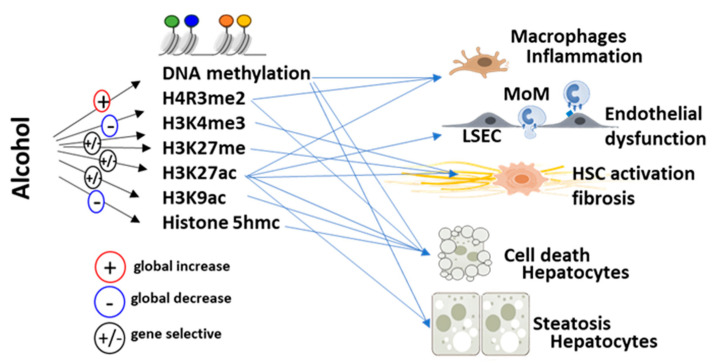
Figure 1
Figure 1
Schematic of major alcohol-induced histone modifications. Major modifications that are affected by alcohol are histone acetylation and DNA and histone methylation. Alcohol promotes a global increase or decrease in several modifications while affecting others in a gene-specific manner (left). These modifications were reported to contribute to alcohol-induced liver inflammation, endothelial dysfunction, hepatic stellate cell activation, liver injury, and hepatocyte steatosis (right).
Figure 2
Figure 2
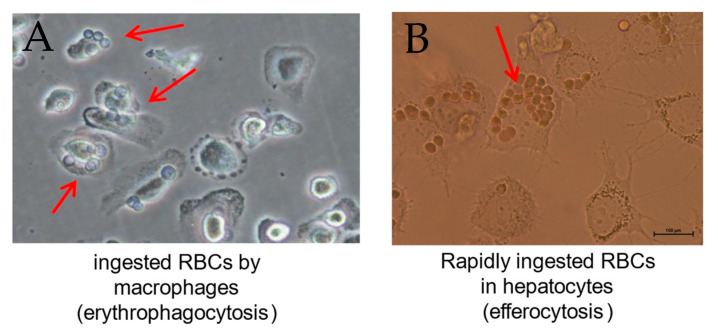
Erythrophagocytosis and hepatocyte-mediated efferocytosis of red blood cells pretreated with ethanol. Human RBCs were pretreated for 24 h with 800 mM ethanol and then cocultured with (A) human THP-1 macrophages or (B) Huh7 hepatoma cells for a further 24 h. As demonstrated in both figures, multiple RBCs can be ingested (arrows). They surround the nucleus, confirming complete internalization B, red arrow). Pictures are directly taken from cell culture dishes using inverted live microscopy.
Figure 3
Figure 3
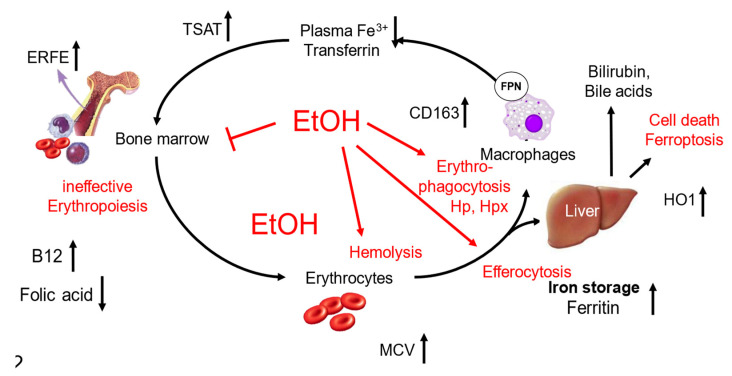
Alcohol and its effects on the red blood cell turnover and laboratory parameters. Hemolytic anemia is one of the major factors associated with long-term mortality in heavy drinkers. Generally, RBC turnover is enhanced. Ethanol interferes with RBC turnover at three major sides. First, it can block hematopoiesis, second, it increases RBC fragility, and third, it primes RBCs for both erythrophagocytosis and efferocytosis. Major consequences are elevated ferritin and MCV, suppressed transferrin, and low RBC count. Of note, B12 is typically elevated in ALD patients, and only folic acid levels are decreased or in the lower normal range. There are first indications that the ingestion of RBCs causes subsequent cell death, most likely due to the release of toxic iron and other compounds. The detailed role of RBC efferocytosis by hepatocytes and their interaction with endothelial cells needs to be addressed in future studies. Abbreviations: ERFE; erythroferrone, EtOH, ethanol; HO1, hemoxygenase-1; MCV, mean corpuscular volume; TSAT, transferrin saturation.
Figure 4
Figure 4
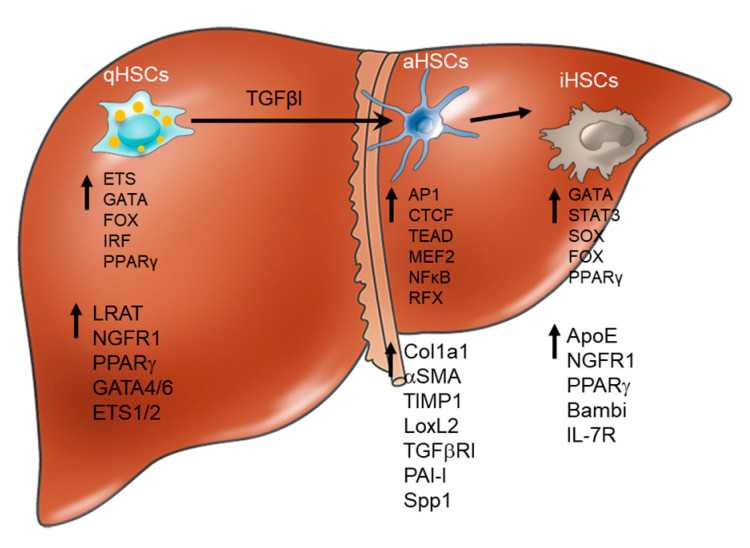
Phenotypic changes in mouse HSCs. Upon development and regression of liver fibrosis. Quiescent HSCs (qHSCs) undergo activation into hepatic myofibroblasts (aHSCs) in response to chronic liver injury. Upon cessation of etiological injury, aHSCs can apoptose or inactivate (iHSCs) in to quiescent-like HSCs. Characteristic genes and regulatory TFs specific for each HSC phenotype. HSC phenotypes are associated with upregulation or downregulation of specific genes: qHSCs express lipogenic and neural markers, but in response to chronic liver injury downregulate these genes and upregulate markers of fibrogenic myofibroblasts. Regulation of HSCs is mediated by a set of specific transcription factors that are lineage-specific and activation-specific. The key transcription factors critical for each phenotype are listed. formula image denotes up-regulation.

References

    1. Amonker S., Houshmand A., Hinkson A., Rowe I., Parker R. Prevalence of alcohol-associated liver disease: A systematic review and meta-analysis. Hepatol. Commun. 2023;7:e0133. doi: 10.1097/HC9.0000000000000133. - DOI - PMC - PubMed
    1. Dang K., Hirode G., Singal A.K., Sundaram V., Wong R.J. Alcoholic liver disease epidemiology in the united states: A retrospective analysis of 3 us databases. Am. J. Gastroenterol. 2020;115:96–104. doi: 10.14309/ajg.0000000000000380. - DOI - PubMed
    1. Lackner C., Tiniakos D. Fibrosis and alcohol-related liver disease. J. Hepatol. 2019;70:294–304. doi: 10.1016/j.jhep.2018.12.003. - DOI - PubMed
    1. Chen M., Zhong W., Xu W. Alcohol and the mechanisms of liver disease. J. Gastroenterol. Hepatol. 2023;38:1233–1240. doi: 10.1111/jgh.16282. - DOI - PubMed
    1. Shukla S.D., Zakhari S. Epigenetics—New frontier for alcohol research. Alcohol Res. 2013;35:1–2. - PMC - PubMed

Publication types