


Relationship between Psychosocial Factors and Physical Activity among Undergraduate Students from a South African University
- PMID: 38673352
- PMCID: PMC11050680
- DOI: 10.3390/ijerph21040441
Relationship between Psychosocial Factors and Physical Activity among Undergraduate Students from a South African University
Abstract
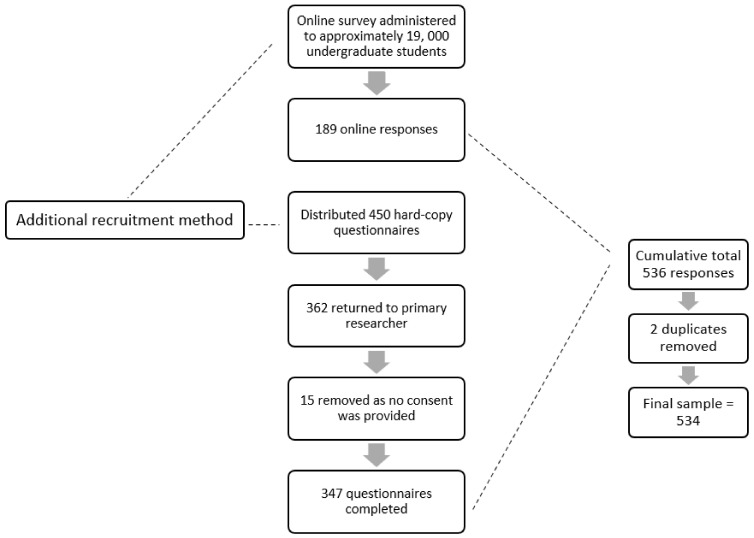
Psychosocial factors such as mental health, motivation, and social support are key determinants of behavior that play a significant role in physical activity participation. Limited studies have investigated the relationship between psychosocial factors and physical activity among university students in Africa. The aim of this study was to determine the relationship between psychosocial factors and physical activity participation among undergraduate university students at a historically disadvantaged university (HDU) in South Africa. This was a cross-sectional study that used convenience sampling (n = 534, majority female, 53.6% with a mean age of 20.69). The study was conducted through an online, self-administered, and hard-copy, valid questionnaire in September 2022. Data on sociodemographic information were collected. Psychosocial factors were assessed using the Depression, Anxiety, and Stress-21 Scale for mental health, the Physical Activity and Leisure Motivation Scale for motivation, and the Perceived Social Support Scale for social support. Physical activity (calculated as MET-min/week) was assessed using the international physical activity questionnaire in short form. Results revealed that almost a third (29%) of undergraduate students were physically inactive, 31.1% were minimally active, and 39.9% were in the health-enhancing category. Physical activity was positively related to stress (r = 0.11, p < 0.05) and anxiety (r = 0.10, p < 0.05). Motivational factors were positively related to psychological condition and others' expectations (r = 0.10, p < 0.05), and depression and others' expectations (r = 0.11, p < 0.05). Results from this study highlighted that psychosocial factors were related to physical activity participation among undergraduate university students. Psychosocial factors should be considered a coping mechanism when implementing health-promoting strategies.
Keywords: South Africa; cross-sectional; mental health; motivation; physical activity; psychosocial factors; social support; students; undergraduate; university.
Conflict of interest statement
The authors declare no conflicts of interest.
References
-
- WHO 2020 WHO Guidelines on Physical Activity and Sedentary Behavior. Sports Medicine and Health Science. 2020. [(accessed on 9 December 2023)]. Available online: https://www.who.int/publications/i/item/9789240015128. - PMC - PubMed
-
- Kljajević V., Stanković M., Ðorđević D., Trkulja-Petković D., Jovanović R., Plazibat K., Oršolić M., Čurić M., Sporiš G. Physical activity and physical fitness among university students—A systematic review. Int. J. Environ. Res. Public Health. 2022;19:158. doi: 10.3390/ijerph19010158. - DOI - PMC - PubMed
-
- Krumrei-Mancuso E.J., Newton F.B., Kim E., Wilcox D. Psychosocial factors predicting first-year college student success. J. Coll. Stud. Dev. 2013;54:247–266. doi: 10.1353/csd.2013.0034. - DOI
-
- Onagbiye S.O., Tsolekile L.P., Puoane T. Knowledge of Non-communicable Disease Risk Factors among Community Health Workers in South Africa. Open Public Health J. 2020;13:430–437. doi: 10.2174/1874944502013010430. - DOI
MeSH terms
Grants and funding
LinkOut - more resources
Full Text Sources
Medical
Miscellaneous
