


Sexual Dysfunction in Postural Orthostatic Tachycardia Syndrome (POTS): A Cross-Sectional, Case-Control Study
- PMID: 38673548
- PMCID: PMC11050785
- DOI: 10.3390/jcm13082274
Sexual Dysfunction in Postural Orthostatic Tachycardia Syndrome (POTS): A Cross-Sectional, Case-Control Study
Abstract
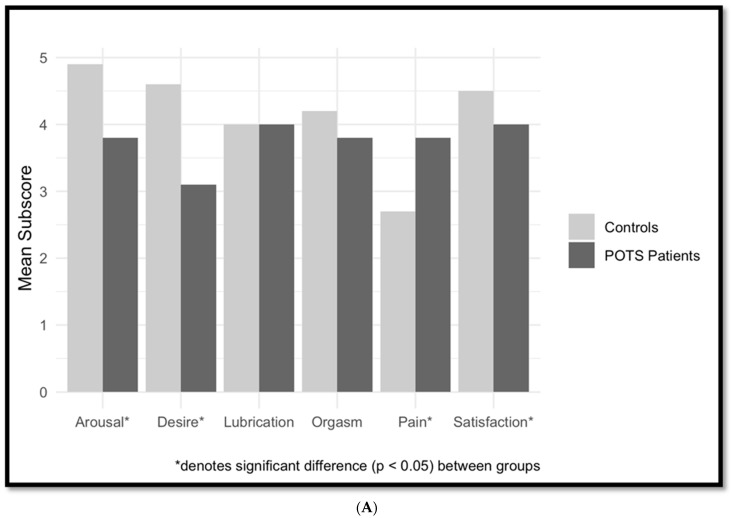
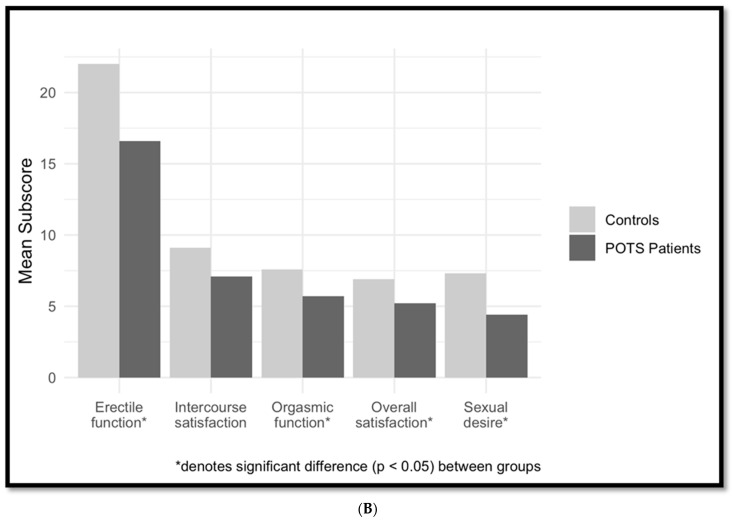
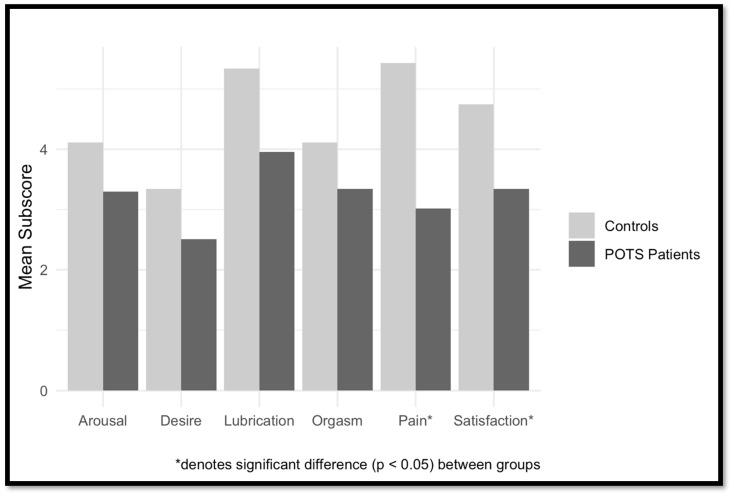
Background: We aimed to determine whether patients with postural orthostatic tachycardia syndrome (POTS) have sexual dysfunction compared to age-matched healthy controls. Methods: Utilizing online COMPASS-31 to evaluate dysautonomia symptom severity, Beck's Depression Inventory Second Edition (BDII), Female Sexual Function (FSF), and International Index of Erection Function (IIEF) questionnaires, we compared sexual function scores in patients with POTS to scores obtained from sex- and age-matched healthy controls via a cross-sectional case-control study. Results: A total of 160 women with POTS, mean age 30.2 ± 7.9 (range 21-50 years), had lower FSF scores than 62 healthy age-matched female controls. IIEF scores in 29 male patients with POTS with a mean age of 30.1 ± 6.0 (range 21-47) were significantly lower than in 27 healthy age-matched male controls. Female POTS patients had significantly lower scores in the sub-domains of desire, arousal, and satisfaction, while male POTS patients had significantly lower scores in erectile and orgasmic function, desire, and satisfaction than healthy controls. Predictive factors of sexual dysfunction were depression in women and age in men. The severity of autonomic symptoms correlated with sexual dysfunction in women, but this effect disappeared after controlling for depression. Conclusions: Compared to healthy controls, women and men with POTS have significant sexual dysfunction, which needs to be considered in the diagnostic and therapeutic approaches as part of comprehensive patient care.
Keywords: case–control study; postural orthostatic tachycardia syndrome (POTS); sexual dysfunction.
Conflict of interest statement
The authors declare no conflicts of interest. A.L., J.B., C.C. and P.G. have no financial interests that are directly or indirectly related to the work submitted for publication. S.B. is a consultant for C.S.L. Behring and has received speaker honoraria from the CDC ECHO program. Non-financial interests: A.L., J.B., C.C. and P.G. have no non-financial interests. J.B. serves on the board of directors for Standing Up to POTS. S.B. serves on the medical advisory board for Dysautonomia International, Dysautonomia Information Network, and Standing Up to POTS. S.B. is an unpaid member of the Member Engagement Committee of the American Academy of Neurology and PASC/Long COVID Collaborative of the American Academy of Physical Medicine and Rehabilitation.
Figures
References
-
- Bourne K.M., Nerenberg K.A., Stiles L.E., Shibao C.A., Okamoto L.E., Garland E.M., Gamboa A., Peltier A., Diedrich A., Biaggioni I., et al. Symptoms of postural orthostatic tachycardia syndrome in pregnancy: A cross-sectional, community-based survey. BJOG. 2023;130:1120–1127. doi: 10.1111/1471-0528.17437. - DOI - PMC - PubMed
-
- Beck A.T., Steer R.A., Brown G. Beck Depression Inventory—II. Psychological Assessment. APA; New York, NY, USA: 1996.
Grants and funding
LinkOut - more resources
Full Text Sources
