


Effects of Different Types of Intermittent Fasting Interventions on Metabolic Health in Healthy Individuals (EDIF): A Randomised Trial with a Controlled-Run in Phase
- PMID: 38674802
- PMCID: PMC11054438
- DOI: 10.3390/nu16081114
Effects of Different Types of Intermittent Fasting Interventions on Metabolic Health in Healthy Individuals (EDIF): A Randomised Trial with a Controlled-Run in Phase
Abstract
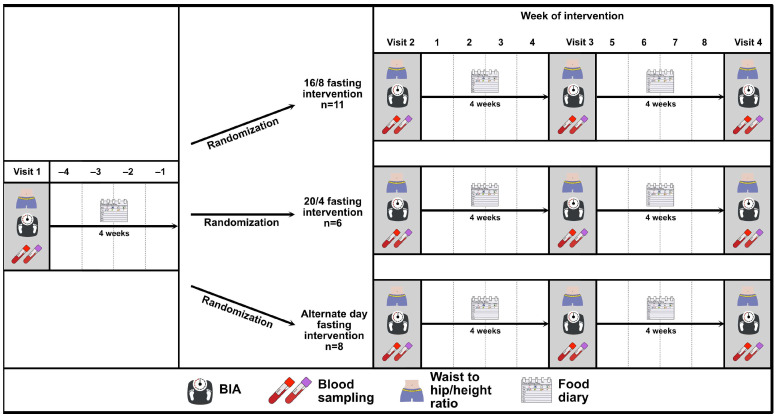
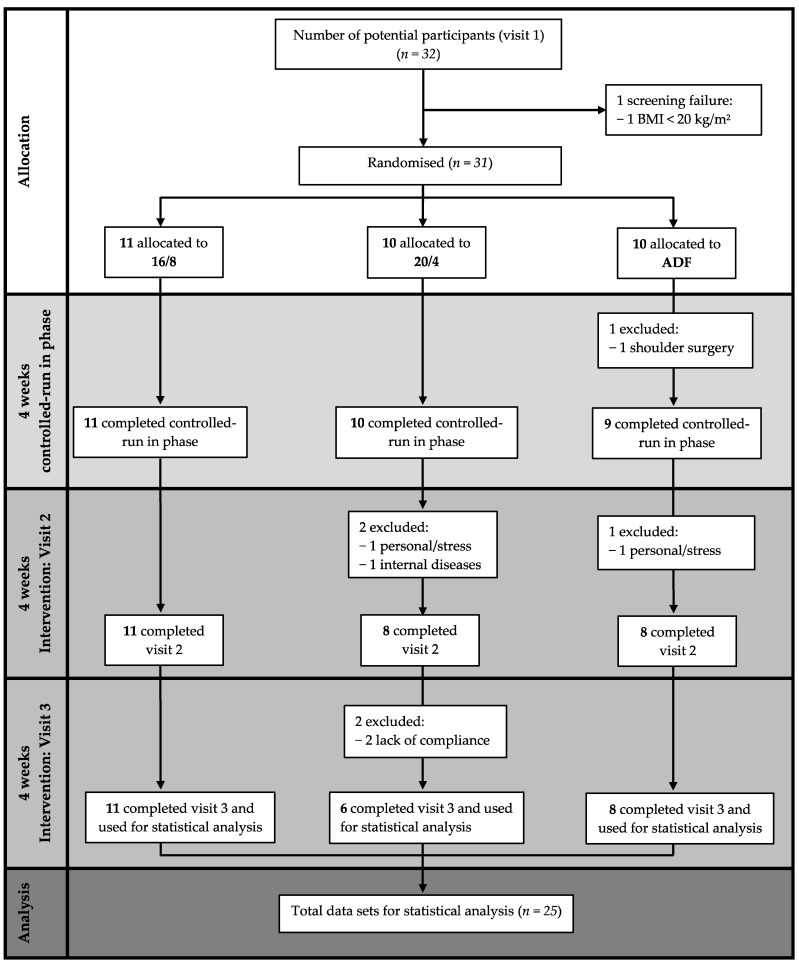
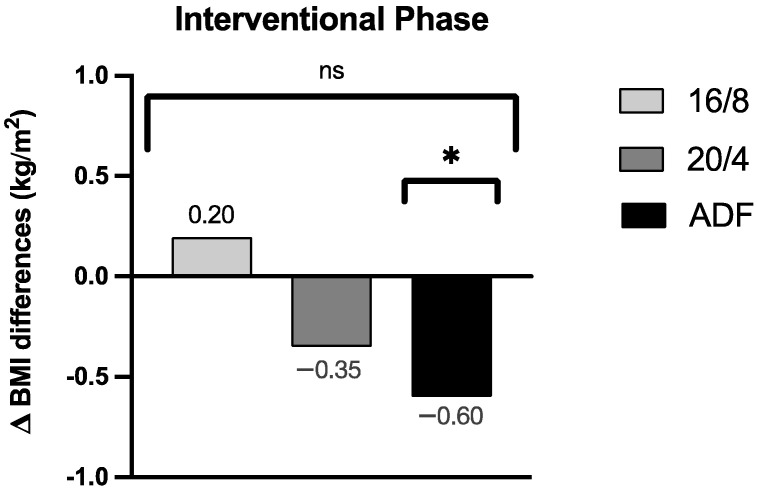
The effects of intermittent fasting (IF) on health promotion in the healthy population remain controversial. Therefore, our study aimed to analyse the efficacy and feasibility of different IF protocols and evaluated the effects within a cohort with a controlled-run in phase on the body mass index (BMI) as the primary outcome, the body composition, and metabolic and haematological markers in healthy participants. A total of 25 individuals were randomised into three fasting groups: 16/8 fasting (n = 11), 20/4 fasting (n = 6), and alternate-day fasting (ADF, n = 8). Assessments were conducted at baseline (visit 1), after a four-week controlled-run in phase (visit 2), and after eight weeks of fasting (visit 3). Both the BMI (p = 0.01) and bodyweight (p = 0.01) were significantly reduced in the ADF group, which was not seen in the 16/8 and 20/4 groups (p > 0.05). Adherence was different but not statistically among the groups (16/8: 84.5 ± 23.0%; 20/4: 92.7 ± 9.5%; and ADF: 78.1 ± 33.5%, p = 0.57). Based on our obtained results, the data suggest that some fasting interventions might be promising for metabolic health. However, adherence to the specific fasting protocols remains challenging even for the healthy population.
Keywords: anthropometry; body mass index; metabolism; time-restricted feeding; weight loss.
Conflict of interest statement
The authors declare no conflicts of interest.
Figures
References
-
- World Obesity Atlas 2023|World Obesity Federation. [(accessed on 18 September 2023)]. Available online: https://www.worldobesity.org/resources/resource-library/world-obesity-at....
-
- World Health Organization Obesity and Overweight. [(accessed on 24 March 2023)]. Available online: https://www.who.int/news-room/fact-sheets/detail/obesity-and-overweight.
-
- St-Onge M.P., Ard J., Baskin M.L., Chiuve S.E., Johnson H.M., Kris-Etherton P., Varady K. Meal Timing and Frequency: Implications for Cardiovascular Disease Prevention: A Scientific Statement from the American Heart Association. Circulation. 2017;135:e96–e121. doi: 10.1161/CIR.0000000000000476. - DOI - PMC - PubMed
Publication types
MeSH terms
Substances
Grants and funding
LinkOut - more resources
Full Text Sources
Research Materials
Miscellaneous
