


Advances in the Production of Sustainable Bacterial Nanocellulose from Banana Leaves
- PMID: 38675076
- PMCID: PMC11054657
- DOI: 10.3390/polym16081157
Advances in the Production of Sustainable Bacterial Nanocellulose from Banana Leaves
Abstract
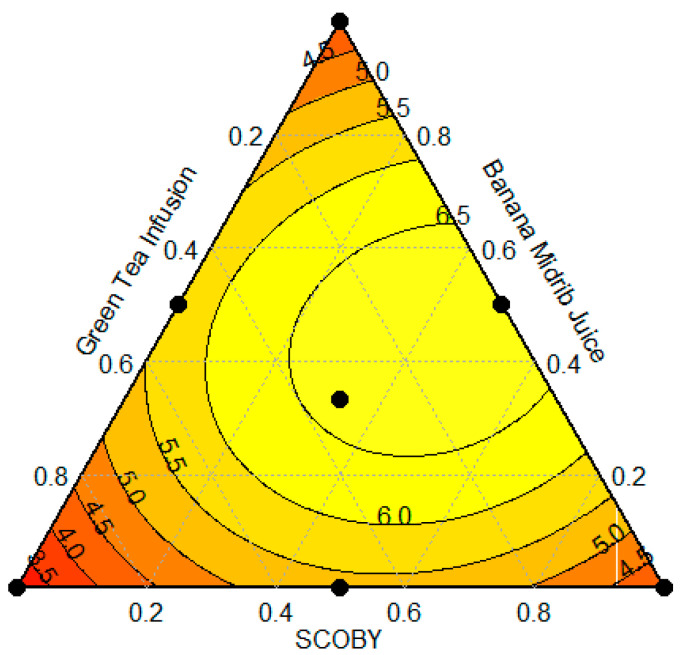
Interest in bacterial nanocellulose (BNC) has grown due to its purity, mechanical properties, and biological compatibility. To address the need for alternative carbon sources in the industrial production of BNC, this study focuses on banana leaves, discarded during harvesting, as a valuable source. Banana midrib juice, rich in nutrients and reducing sugars, is identified as a potential carbon source. An optimal culture medium was designed using a simplex-centroid mixing design and evaluated in a 10 L bioreactor. Techniques such as Fourier transform infrared spectroscopy (FTIR), scanning electron microscopy (SEM), X-ray diffraction (XRD), and thermogravimetric analysis (TGA) were used to characterize the structural, thermal, and morphological properties of BNC. Banana midrib juice exhibited specific properties, such as pH (5.64), reducing sugars (15.97 g/L), Trolox (45.07 µM), °Brix (4.00), and antioxidant activity (71% DPPH). The model achieved a 99.97% R-adjusted yield of 6.82 g BNC/L. Physicochemical analyses revealed distinctive attributes associated with BNC. This approach optimizes BNC production and emphasizes the banana midrib as a circular solution for BNC production, promoting sustainability in banana farming and contributing to the sustainable development goals.
Keywords: bacterial nanocellulose; banana leaves; biomass; biopolymer; circular bioeconomy; fermentation; optimization; simplex-centroid design; sustainability; yield.
Conflict of interest statement
The authors declare no conflicts of interest.
Figures



References
-
- Jonas R., Farah L.F. Production and application of microbial cellulose. Polym. Degrad. Stab. 1998;59:101–106. doi: 10.1016/S0141-3910(97)00197-3. - DOI
-
- Li W., Zhang S., Zhang T., Shen Y., Han L., Peng Z., Xie Z., Zhong C., Jia S. Industrial Crops and Products. Volume 164. Elsevier B.V.; Amsterdam, The Netherlands: 2021. Bacterial cellulose production from ethylenediamine pretreated Caragana korshinskii Kom. - DOI
-
- El-Gendi H., Salama A., El-Fakharany E.M., Saleh A.K. Optimization of bacterial cellulose production from prickly pear peels and its ex situ impregnation with fruit byproducts for antimicrobial and strawberry packaging applications. Carbohydr. Polym. 2023;302:120383. doi: 10.1016/j.carbpol.2022.120383. - DOI - PubMed
-
- Gromovykh T.I., Sadykova V.S., Lutcenko S.V., Dmitrenok A.S., Feldman N.B., Danilchuk T.N., Kashirin V.V. Bacterial cellulose synthesized by Gluconacetobacter hansenii for medical applications. Appl. Biochem. Microbiol. 2017;53:60–67. doi: 10.1134/S0003683817010094. - DOI
-
- Saleh A.K., El-Gendi H., El-Fakharany E.M., Owda M.E., Awad M.A., Kamoun E.A. Exploitation of cantaloupe peels for bacterial cellulose production and functionalization with green synthesized Copper oxide nanoparticles for diverse biological applications. Sci. Rep. 2022;12:19241. doi: 10.1038/s41598-022-23952-w. - DOI - PMC - PubMed
LinkOut - more resources
Full Text Sources
Molecular Biology Databases
