


Cost-Effectiveness Analysis of Fluocinolone Acetonide Intravitreal (FAI) Implant for Chronic Noninfectious Uveitis Affecting the Posterior Segment of the Eye (NIU-PS) in China
- PMID: 38676875
- PMCID: PMC11109073
- DOI: 10.1007/s40123-024-00939-6
Cost-Effectiveness Analysis of Fluocinolone Acetonide Intravitreal (FAI) Implant for Chronic Noninfectious Uveitis Affecting the Posterior Segment of the Eye (NIU-PS) in China
Abstract
Introduction: Chronic non-infectious uveitis affecting the posterior segment (NIU-PS), which can be recurrent and persistent for numerous years, mainly affects people of working age and significantly increases the risk of visual impairment. This study aimed to investigate the cost-effectiveness of fluocinolone acetonide intravitreal (FAI) implant in the treatment of patients with chronic NIU-PS from the Chinese healthcare perspective.
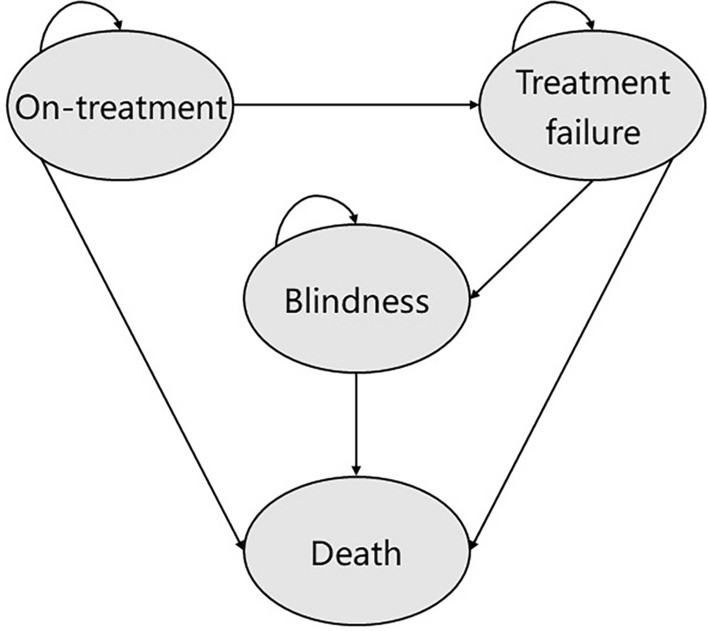
Methods: A Markov model with a 2-week cycle was constructed from the perspective of the Chinese healthcare system over a lifetime time horizon. The model consists of four health states: on-treatment, treatment failure, blindness, and death. The outcomes for effectiveness were based on the Chinese real-world study (RWS). Utilities and mortality rates were derived from published literature and standard sources. Costs were determined from the MENET website, prices of medical service items at local providers, published literature, and expert surveys. Outcomes were measured in quality-adjusted life years (QALYs). Sensitivity analyses were performed to account for the impact of uncertainty.
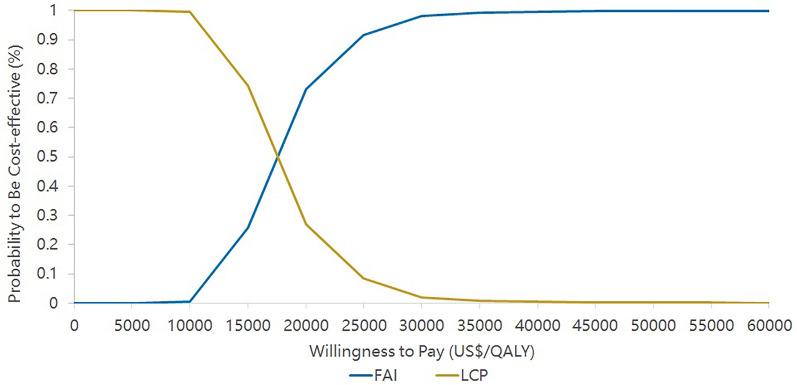
Results: It was estimated that in the base case, the FAI implant provided 0.43 incremental QALYs compared with the limited current practice (LCP) at an additional cost of $7503.72 (¥50,575.05), resulting in an incremental cost-effectiveness ratio (ICER) of $17,373.49 (¥117,097.33) per QALY gained. Parameters related to utility emerged as the primary influencers on the outcomes. In probabilistic sensitivity analysis (PSA), considering the willingness-to-pay (WTP) threshold of $19,072 (¥128,547) and $38,145 (¥257,094), the FAI implant had 67.70% and 99.50% probability of being cost-effective, respectively. As demonstrated in the scenario analysis, if the FAI implant aligns its price reduction with the average rate from the 2023 negotiation of the National Reimbursement Drug List (NRDL), it would result in lower costs and represent an absolute advantage.
Conclusions: The FAI implant, which can effectively reduce the recurrence rate and maintain the incremental costs within the WTP limit, is likely to be cost-effective in treating chronic NIU-PS in China.
Keywords: Cost-effectiveness analysis; Fluocinolone acetonide intravitreal implant; Incremental cost-effectiveness ratios; Non-infectious uveitis; Real-world study.
© 2024. The Author(s).
Conflict of interest statement
Xin Mao, Zhanjing Dai, Jing Yang, Yuhang Wu, Fan Xie, Yun Lu, Jie Yu, Feng Chang, Yuqiong Lu declare that the research was conducted in the absence of any commercial or financial relationships that could be construed as a potential conflict of interest.
Figures


References
-
- Zhang Y, Shao Y, Zhou Q. Progress in systemic treatments of non-infectious uveitis. Int Eye Sci. 2019;19(12):2045–2047.
-
- Hu S, Xie C, Yang P, Huang X. An epidemiological survey of uveitis in southern China. Int Eye Sci. 2002;01:1–3.
-
- European Medicines Agency. EU/3/10/763—orphan designation for treatment of non-infectious uveitis affecting the posterior segment of the eye. 2010. https://www.ema.europa.eu/en/medicines/human/orphan-designations/eu-3-10.... Accessed 22 Oct 2023.
-
- Chen Z. What's new about new drugs and devices. Hainan Dly. B06 (2022-07-28) (in Chinese).
Grants and funding
LinkOut - more resources
Full Text Sources
Research Materials
Miscellaneous
