. 2024 Apr 15;15(4):724-734.
doi: 10.4239/wjd.v15.i4.724.

Teneligliptin mitigates diabetic cardiomyopathy by inhibiting activation of the NLRP3 inflammasome

Affiliations

Teneligliptin mitigates diabetic cardiomyopathy by inhibiting activation of the NLRP3 inflammasome

Gu-Lao Zhang et al. World J Diabetes. .

Abstract

Background: Diabetic cardiomyopathy (DCM), which is a complication of diabetes, poses a great threat to public health. Recent studies have confirmed the role of NLRP3 (NOD-like receptor protein 3) activation in DCM development through the inflammatory response. Teneligliptin is an oral hypoglycemic dipeptidyl peptidase-IV inhibitor used to treat diabetes. Teneligliptin has recently been reported to have anti-inflammatory and protective effects on myocardial cells.

Aim: To examine the therapeutic effects of teneligliptin on DCM in diabetic mice.

Methods: Streptozotocin was administered to induce diabetes in mice, followed by treatment with 30 mg/kg teneligliptin.

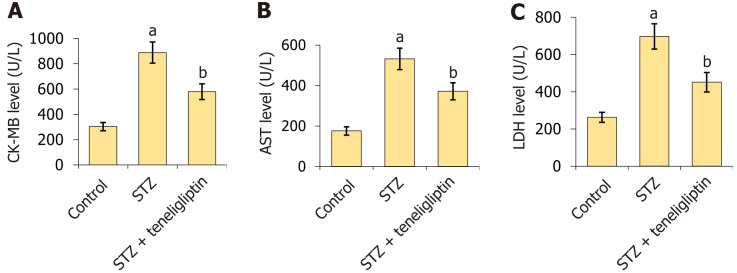
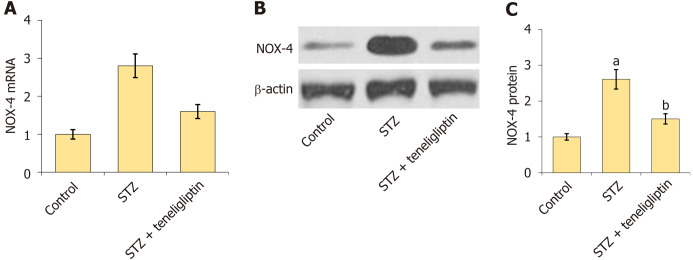
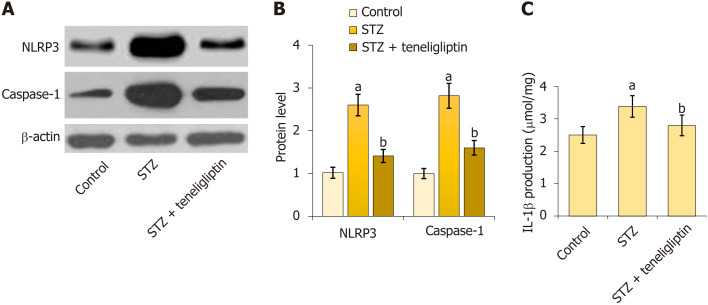
Results: Marked increases in cardiomyocyte area and cardiac hypertrophy indicator heart weight/tibia length reductions in fractional shortening, ejection fraction, and heart rate; increases in creatine kinase-MB (CK-MB), aspartate transaminase (AST), and lactate dehydrogenase (LDH) levels; and upregulated NADPH oxidase 4 were observed in diabetic mice, all of which were significantly reversed by teneligliptin. Moreover, NLRP3 inflammasome activation and increased release of interleukin-1β in diabetic mice were inhibited by teneligliptin. Primary mouse cardiomyocytes were treated with high glucose (30 mmol/L) with or without teneligliptin (2.5 or 5 µM) for 24 h. NLRP3 inflammasome activation. Increases in CK-MB, AST, and LDH levels in glucose-stimulated cardiomyocytes were markedly inhibited by teneligliptin, and AMP (p-adenosine 5'-monophosphate)-p-AMPK (activated protein kinase) levels were increased. Furthermore, the beneficial effects of teneligliptin on hyperglycaemia-induced cardiomyocytes were abolished by the AMPK signaling inhibitor compound C.

Conclusion: Overall, teneligliptin mitigated DCM by mitigating activation of the NLRP3 inflammasome.

Keywords: AMPK; Diabetic cardiomyopathy; Interleukin-1β; NLRP3; Teneligliptin.


Conflict of interest statement

Conflict-of-interest statement: All the Authors declare that they have no conflicts of interest related to this manuscript.

Figures
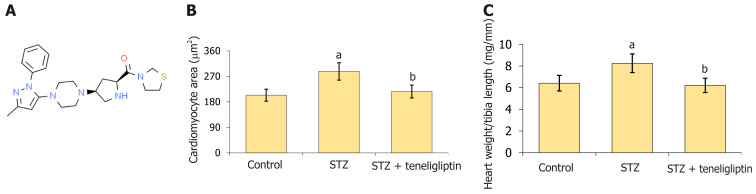
Figure 1
Figure 1
Teneligliptin ameliorated myocardial hypertrophy in streptozotocin-induced diabetic mice. A: Molecular structure of teneligliptin; B: Quantitative analysis of cardiomyocyte area; C: Heart weight/tibia length. aP < 0.05 vs control group; bP < 0.05 vs streptozotocin group, n = 8. STZ: Streptozotocin.
Figure 2
Figure 2
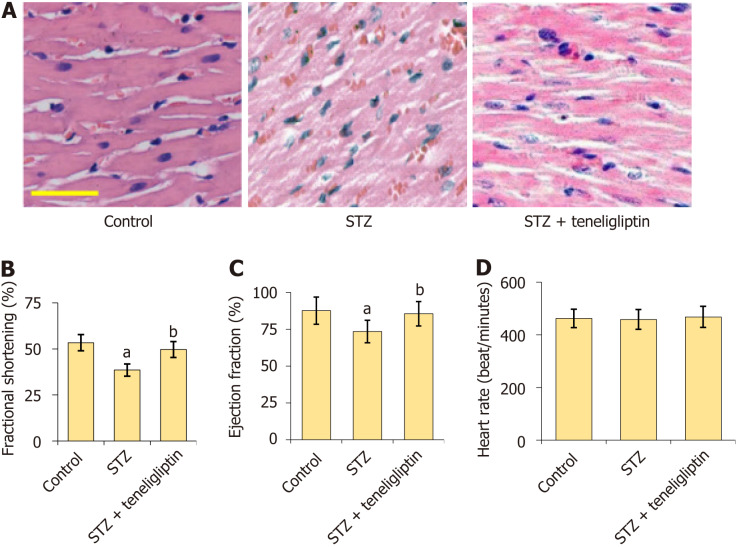
Teneligliptin improved heart function in streptozotocin-induced diabetic mice. A: The results of HE staining, Scale bar = 50 µm; B-D: Mice heart fractional shortening, ejection fraction, and heart rate was measured by echo. aP < 0.05 vs control group; bP < 0.05 vs streptozotocin group, n = 8. STZ: Streptozotocin.
Figure 3
Figure 3
Teneligliptin reduced the expression of the myocardial injury indicators in streptozotocin-induced diabetic mice. A: Creatine kinase-MB level; B: The aspartate transaminase level; C: The lactate dehydrogenase level. aP < 0.05 vs control group; bP < 0.05 vs streptozotocin group, n = 8. STZ: Streptozotocin; CK-MB: Creatine kinase-MB; AST: Aspartate transaminase; LDH: Lactate dehydrogenase.
Figure 4
Figure 4
Teneligliptin reduced the expression of NOX4 in diabetic mice. A: mRNA of NOX-4; B: Protein of NOX-4; C: Quantitative analysis of protein expression levels for panel B. aP < 0.05 vs control group; bP < 0.05 vs streptozotocin group, n = 8. STZ: Streptozotocin.
Figure 5
Figure 5
Teneligliptin reduced activation of the cardiac NLRP3 inflammasome in the control and diabetic mice. A: NLRP3 and caspase-1 measured by Western blot assays; B: Quantitative analysis of protein expression levels for panel A; C: Production of interleukin-1β as measured by ELISA. aP < 0.05 vs control group; bP < 0.05 vs streptozotocin group, n = 8. STZ: Streptozotocin.
Figure 6
Figure 6
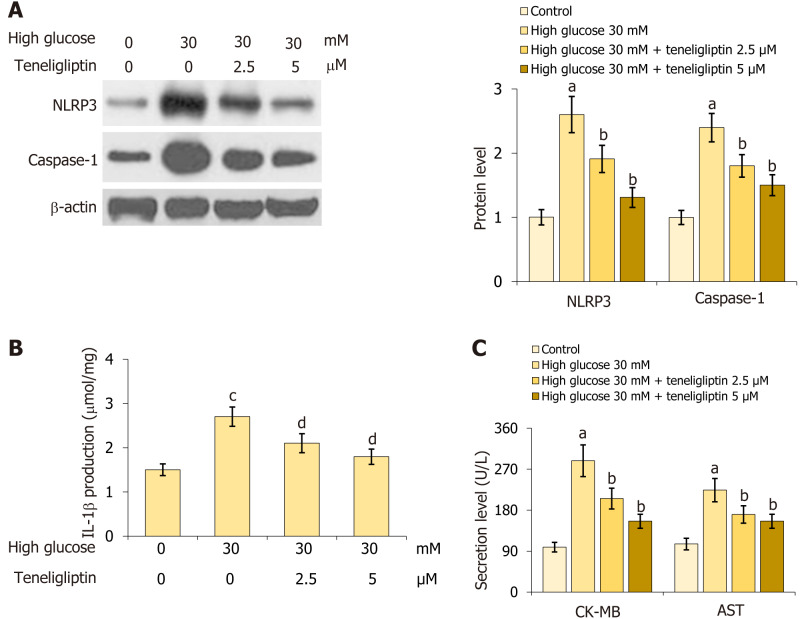
Teneligliptin prevented activation of the cardiac NLRP3 inflammasome and injury in cardiomyocytes. Primary cardiomyocytes were treated with high glucose (30 mmol/L) with or without teneligliptin (2.5 or 5 µM) for 24 h. A: Expression of NLRP3 and caspase-1 were measured by western blot assays; B: Levels of IL-1β as measured by ELISA; C: Levels of creatine kinase-MB and aspartate transaminase level. aP < 0.05 vs control group; bP < 0.05 vs high glucose 30 mmol/L group; cP < 0.05 vs high glucose 0 mmol/L + teneligliptin 0 µM group; dP < 0.05 vs high glucose 30 mmol/L + teneligliptin 0 µM group, n = 5. CK-MB: Creatine kinase-MB; AST: Aspartate transaminase; IL: Interleukin.
Figure 7
Figure 7
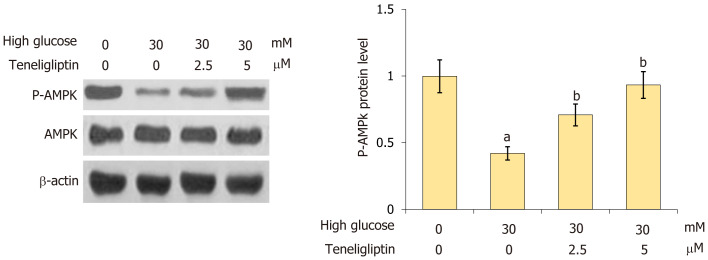
Teneligliptin increased the phosphorylation of AMPK against high glucose in cardiomyocytes. Primary cardiomyocytes were treated with high glucose (30 mmol/L) with or without teneligliptin (2.5 or 5 µM) for 24 h. Levels of p-AMPK were measured by western blot assays. aP < 0.05 vs control group; bP < 0.05 vs high glucose 30 mmol/L + teneligliptin 0 µM group, n = 5.
Figure 8
Figure 8
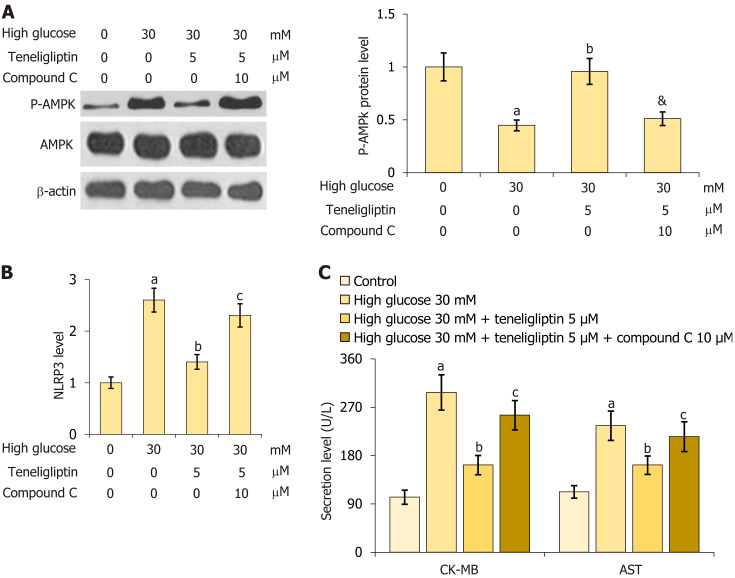
Inhibition of AMPK abolished the beneficial effects of teneligliptin against high glucose in cardiomyocytes. Primary cardiomyocytes were treated with high glucose (30 mmol/L) with or without teneligliptin (5 µM) and compound C (10 μM). A: Levels of p-AMPK; B: The levels of NLRP3; C: Levels of creatine kinase-MB and aspartate transaminase level. aP < 0.05 vs control group; bP < 0.05 vs high glucose 30 mmol/L group; cP < 0.05 vs high glucose 30 mmol/L + teneligliptin 5 µM group, n = 5.

References

    1. Sun H, Saeedi P, Karuranga S, Pinkepank M, Ogurtsova K, Duncan BB, Stein C, Basit A, Chan JCN, Claude Mbanya J, Pavkov ME, Ramachandaran A, Wild SH, James S, Herman WH, Zhang P, Bommer C, Kuo S, Boyko EJ, Magliano DJ. Erratum to "IDF Diabetes Atlas: Global, regional and country-level diabetes prevalence estimates for 2021 and projections for 2045" [Diabetes Res. Clin. Pract. 183 (2022) 109119] Diabetes Res Clin Pract. 2023;204:110945. - PubMed
    1. Japp AG, Gulati A, Cook SA, Cowie MR, Prasad SK. The Diagnosis and Evaluation of Dilated Cardiomyopathy. J Am Coll Cardiol. 2016;67:2996–3010. - PubMed
    1. Tan Y, Zhang Z, Zheng C, Wintergerst KA, Keller BB, Cai L. Mechanisms of diabetic cardiomyopathy and potential therapeutic strategies: preclinical and clinical evidence. Nat Rev Cardiol. 2020;17:585–607. - PMC - PubMed
    1. Zeng C, Duan F, Hu J, Luo B, Huang B, Lou X, Sun X, Li H, Zhang X, Yin S, Tan H. NLRP3 inflammasome-mediated pyroptosis contributes to the pathogenesis of non-ischemic dilated cardiomyopathy. Redox Biol. 2020;34:101523. - PMC - PubMed
    1. Zheng Y, Xu L, Dong N, Li F. NLRP3 inflammasome: The rising star in cardiovascular diseases. Front Cardiovasc Med. 2022;9:927061. - PMC - PubMed