


Food insecurity and academic performance in Spanish adolescents: Results from the EHDLA study
- PMID: 38681539
- PMCID: PMC11053195
- DOI: 10.1016/j.heliyon.2024.e29489
Food insecurity and academic performance in Spanish adolescents: Results from the EHDLA study
Abstract
Introduction: Food insecurity is a growing global issue that affects both developed and developing nations, and mounting evidence suggests that decreased consumption of healthy foods has been linked to lower academic performance in adolescents. The present study aimed to examine the relationship between food insecurity and academic performance in a sample of Spanish adolescents aged 12-17 years from the Valle de Ricote (Region of Murcia, Spain).
Methods: The present study analyzed data from the Eating Healthy and Daily Life Activities study, which included a sample of 777 adolescents (55.3 % girls). The Spanish Child Food Security Survey Module was used to assess food insecurity, and academic performance was evaluated using school records provided by the schools. Linear regression models (fitted by robust methods) were used to compare the relationships between food insecurity status and academic performance-related indicators.
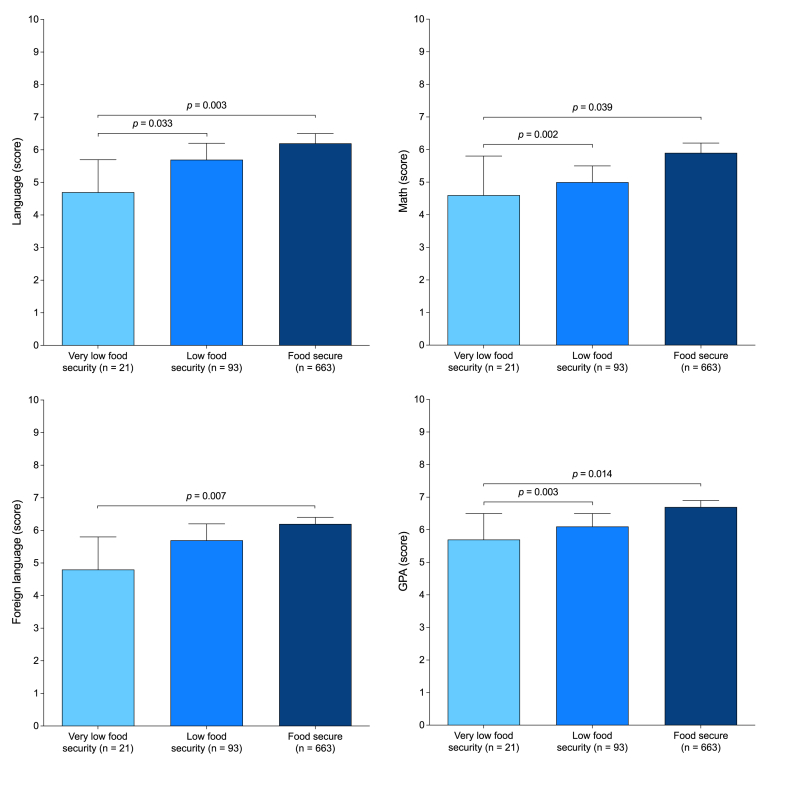
Results: Adolescents with the highest levels of food insecurity reported the lowest academic performance in language (mean [M] = 4.7; 95 % confidence interval [CI] 3.6 to 5.7), math (M = 4.6; 95 % CI 3.5 to 5.8), foreign language (M = 4.8; 95 % CI 3.8 to 5.8), and grade point average (M = 5.7; 95 % CI 4.9 to 6.5). Conversely, adolescents with the lowest levels of food insecurity reported the highest academic performance in language (M = 6.2; 95 % CI 6.0 to 6.5), math (M = 5.9; 95 % CI 5.5 to 6.2), foreign language (M = 6.2; 95 % CI 5.9 to 6.4), and grade point average (M = 6.7; 95 % CI 6.5 to 6.9) compared to those with higher food security.
Conclusions: Living in a more food-insecure household could explain the lower academic performance of adolescents. Food insecurity should always be on the agenda of public policies. The availability of quality basic food essentials must be ensured in permanently satisfactory quantities without compromising access to other fundamental needs.
Keywords: Adolescence; academic achievement; hunger; socioeconomic status; undernourishment.
© 2024 The Author(s).
Conflict of interest statement
The authors declare that they have no known competing financial interests or personal relationships that could have appeared to influence the work reported in this paper.
Figures
References
-
- FAO. Hunger and food insecurity [Internet]. Food and Agriculture Organization of the United Nations. [cited 2023 March 4]. Available from: http://www.fao.org/hunger/en/.
-
- Food Security Information Network (FSIN) Global Report on Food Crises 2022 Mid-year Update – World. 2022. https://reliefweb.int/report/world/global-report-food-crises-2022-mid-ye... [Internet] [cited 2023 April 15]. Available from:
-
- Vilar-Compte M., Burrola-Méndez S., Lozano-Marrufo A., Ferré-Eguiluz I., Flores D., Gaitán-Rossi P., Teruel G., Pérez-Escamilla R. Urban poverty and nutrition challenges associated with accessibility to a healthy diet: a global systematic literature review. Int. J. Equity Health. 2021;20(1):40. doi: 10.1186/s12939-020-01330-0. - DOI - PMC - PubMed
LinkOut - more resources
Full Text Sources
