Review
. 2024 Apr 15;10(8):e29686.
doi: 10.1016/j.heliyon.2024.e29686. eCollection 2024 Apr 30.

Monocytes and macrophages: Origin, homing, differentiation, and functionality during inflammation

Affiliations
Review

Monocytes and macrophages: Origin, homing, differentiation, and functionality during inflammation

Shiba Prasad Dash et al. Heliyon. .

Abstract

Monocytes and macrophages are essential components of innate immune system and have versatile roles in homeostasis and immunity. These phenotypically distinguishable mononuclear phagocytes play distinct roles in different stages, contributing to the pathophysiology in various forms making them a potentially attractive therapeutic target in inflammatory conditions. Several pieces of evidence have supported the role of different cell surface receptors expressed on these cells and their downstream signaling molecules in initiating and perpetuating the inflammatory response. In this review, we discuss the current understanding of the monocyte and macrophage biology in inflammation, highlighting the role of chemoattractants, inflammasomes, and integrins in the function of monocytes and macrophages during events of inflammation. This review also covers the recent therapeutic interventions targeting these mononuclear phagocytes at the cellular and molecular levels.

Keywords: Inflammasomes; Inflammation; Integrins; Macrophages; Metabolic reprogramming; Monocytes.


Conflict of interest statement

The authors declare the following financial interests/personal relationships which may be considered as potential competing interests: The corresponding author Dr. Pranita P Sarangi is an Associate Editor of this journal.r.

Figures
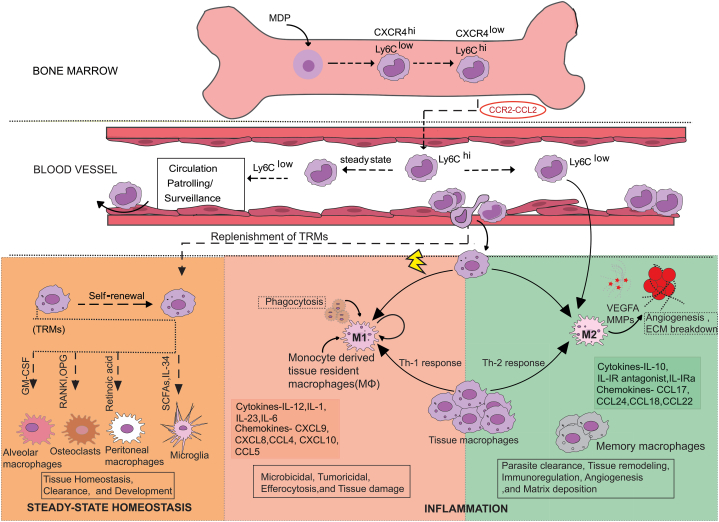
Fig. 1
Fig. 1
The mononuclear phagocyte system-trafficking, recruitment, and differentiation. CXCR4hi/Ly6Clo (precursor of CXCR4lo/Ly6Chi monocytes) is derived from Monocyte-Macrophage and Dendritic cell common precursor (MDPs) in the bone marrow. CCR2-CCL2 dependent extravasation of Ly6Chi, CX3CR1-CX3CL1 dependent extravasation of Ly6Clo; monocytes into blood perform different functions to maintain homeostasis in steady-state conditions. Ly6Clo 'patrol' the endothelial cell supported vessel and can differentiate into pro-resolving/alternatively activated M2 macrophages. In response to injury, inflammation, or neoplasia and infection, inflammatory monocytes (Ly6Chi) mature into inflammatory macrophages, which participate in an inflammatory response by secreting chemokines and TNF-α. In such inflammatory niches, monocyte-derived macrophages undergo maturation towards the resolution phase or M2 subset until the tissue returns to normal or homeostasis. The development of TRMs in response to niche signals gives them unique functional and morphological identities. They can also differentiate into M1 and M2 subtypes depending on Th1/Th2 cell-mediated inflammation, respectively. Monocyte-dendritic cell progenitors (MDPs), Tissue-resident macrophages (TRMs), Ly6C (lymphocyte antigen six complexes, locus C1), C-X-C motif chemokine receptor 4 (CXCR4), Interleukin (IL) Chemokine (C-X-C) motif ligand (CXCL), Chemokine (C-C) motif ligand (CCL), Vascular endothelial growth factor A (VEGFA), Matrix metalloproteinase (MMP).
Fig. 2
Fig. 2
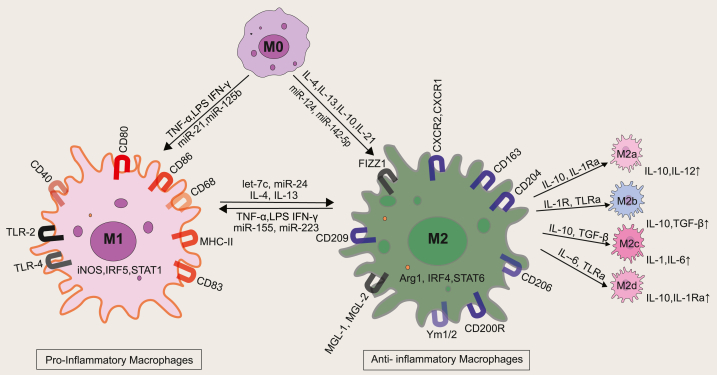
The two extremes of macrophage phenotype. M0 macrophages are non-activated macrophages with the potential to polarize into pro-inflammatory M1 macrophages (upon stimulation with TNF-α, LPS, and IFN-γ, which have a role in the production of pro-inflammatory cytokines). M0 on stimulation with IL-4, IL-13, IL-10, IL-21 matures into M2 macrophages. M2 macrophages can further differentiate into M2a (upon stimulation with IL-10, IL-1RA, which upregulates expression of IL-10 and TGF-β, responsible for tissue regeneration), M2b (upon stimulation with IL-1R, TLRa, which produces IL-10, TNF-α which leads to an anti-inflammatory activity), M2c (upon stimulation with IL-10, TGF-β, glucocorticoids, responsible for the suppression of immune response) and M2d (upon stimulation with IL-6, TLRa, these macrophages are also referred to as TAM or Tumor-associated macrophages. Different regulatory molecules like non-coding micro-RNAs also regulate the inflammatory/non-inflammatory signaling post-transcriptionally, with more details in the main text. MicroRNA (miRNA), Toll-like receptors (TLRs), Arginase 1 (Arg1), Interleukin-1 receptor antagonist (IL-1RA) Interferon regulatory factor (IRF), Signal transducer and activator of transcription (STAT).
Fig. 3
Fig. 3
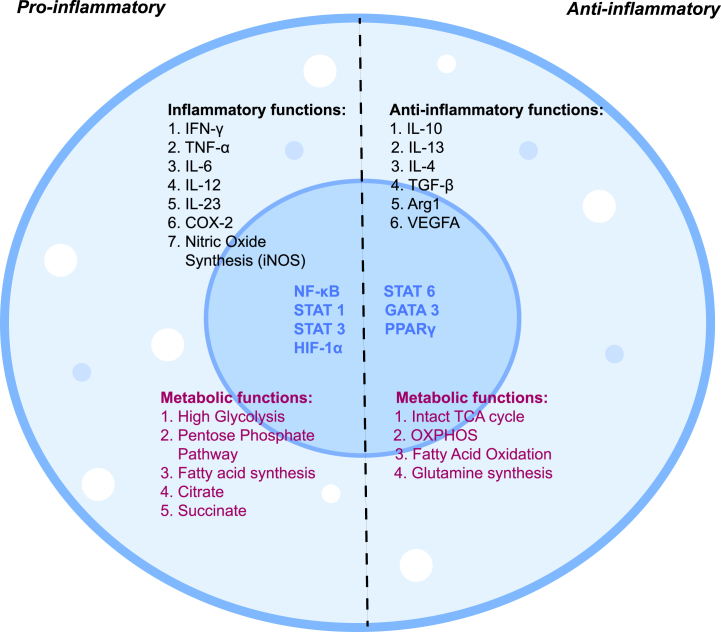
Metabolic signatures of macrophage activation.

References

    1. Guilliams M., et al. Dendritic cells, monocytes and macrophages: a unified nomenclature based on ontogeny. Nat. Rev. Immunol. 2014;14:571–578. - PMC - PubMed
    1. Cooper M.D., Alder M.N. The evolution of adaptive immune systems. Cell. 2006;124:815–822. - PubMed
    1. Tauber A.I. Metchnikoff and the phagocytosis theory. Nat. Rev. Mol. Cell Biol. 2003;4:897–901. - PubMed
    1. Artyomov M.N., et al. Integrating immunometabolism and macrophage diversity. Semin. Immunol. 2016;28:417–424. - PMC - PubMed
    1. Mantovani A., et al. Macrophage plasticity and polarization in tissue repair and remodelling. J. Pathol. 2013;229:176–185. - PubMed

LinkOut - more resources