


Changes in periodontal parameters of splinted versus non-splinted posterior teeth during ten years of supportive periodontal therapy - A retrospective evaluation
- PMID: 38683397
- PMCID: PMC11058677
- DOI: 10.1007/s00784-024-05679-2
Changes in periodontal parameters of splinted versus non-splinted posterior teeth during ten years of supportive periodontal therapy - A retrospective evaluation
Abstract
Objectives: To compare periodontal parameters of splinted posterior teeth versus control teeth over ten years of supportive periodontal therapy (SPT) and to assess the survival rate of splints.
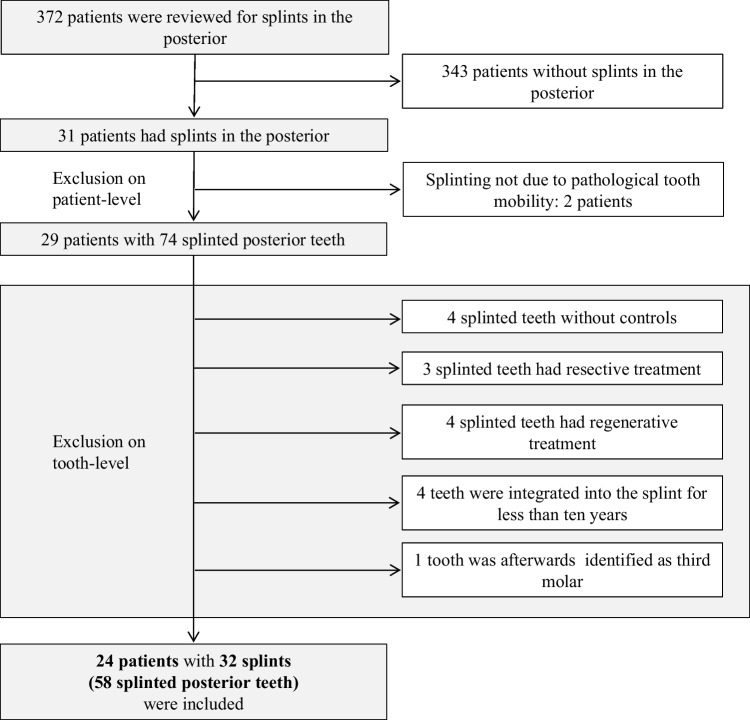
Material and methods: Retrospective data of 372 SPT-patients was screened for splints (composite/fiberglass-reinforced composite) in the posterior (molars/premolars) which were inserted at least ten years before due to increased tooth mobility. For each splinted tooth (test), a corresponding control tooth had to be present at the first SPT-session after splint insertion (T1). Data was assessed at T1 and ten years later (T2). Possible influencing covariates for splint survival (mobility degree/Eichner class) were tested by Cox regression. The change in clinical attachment level (ΔCAL), probing pocket depth (ΔPPD) and the testing of possible influencing covariates was analyzed by using mixed linear regression.
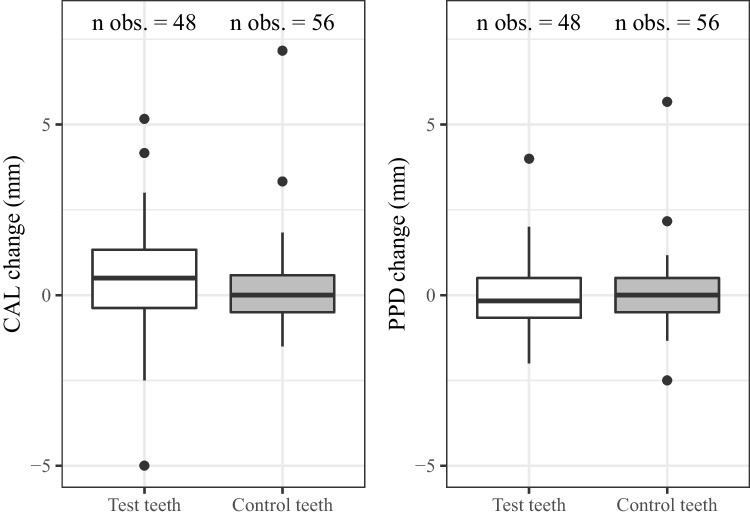
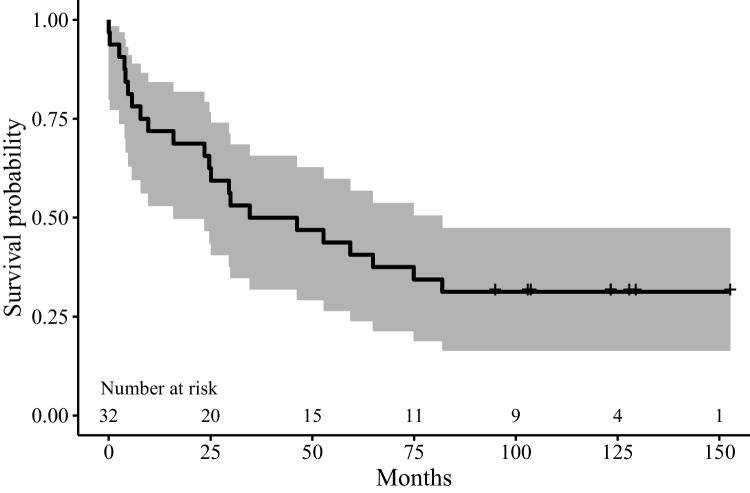
Results: Twenty-four patients (32 splints, 58 splinted teeth) were included. Ten test and two control teeth were lost. No differences were observed between ΔCAL and ΔPPD of test teeth compared to control teeth (ΔCAL -0.38 ± 1.90 vs. 0.20 ± 1.27 mm; ΔPPD -0.17 ± 1.18 vs. 0.10 ± 1.05 mm). Twenty-two splints fractured during the observation period (survival-rate: 31%). Mobility degree and Eichner class did not influence time until fracture.
Conclusions: Splinting of periodontally compromised and mobile posterior teeth does not have any disadvantage regarding the clinical periodontal situation when regular SPT is applied. However, splint fractures occur very often.
Clinical relevance: Splinting of posterior teeth is a treatment option in addition to active periodontal therapy when patients are disturbed by tooth mobility but splints have a high susceptibility to fracture.
Keywords: Fibre-reinforced-composite splint; Periodontal therapy; Splinting therapy; Supportive periodontal therapy; Tooth mobility.
© 2024. The Author(s).
Conflict of interest statement
The authors declare that there are no conflicts of interest regarding this study.
Figures
References
-
- Papapanou PN, Sanz M, Buduneli N, Dietrich T, Feres M, Fine DH, Flemmig TF, Garcia R, Giannobile WV, Graziani F, et al. Periodontitis: Consensus report of workgroup 2 of the 2017 World Workshop on the Classification of Periodontal and Peri-Implant Diseases and Conditions. J Periodontol. 2018;89(Suppl 1):S173–S182. doi: 10.1002/JPER.17-0721. - DOI - PubMed
-
- Kathariya R, Devanoorkar A, Golani R, Shetty N, Vallakatla V, Bhat MY. To Splint or Not to Splint: The Current Status of Periodontal Splinting. J Int Acad Periodontol. 2016;18:45–56. - PubMed
-
- Sekhar LC, Koganti VP, Shankar BR, Gopinath A. A comparative study of temporary splints: bonded polyethylene fiber reinforcement ribbon and stainless steel wire + composite resin splint in the treatment of chronic periodontitis. J Contemp Dent Pract. 2011;12:343–349. doi: 10.5005/jp-journals-10024-1057. - DOI - PubMed
-
- Sonnenschein SK, Ziegler P, Ciardo A, Ruetters M, Krisam J and Kim TS (2021) The impact of splinting mobile mandibular incisors on oral health‐related quality of life—Preliminary observations from a randomized clinical trial. J Clin Periodontol:. 10.1111/jcpe.13454 - PubMed
Publication types
MeSH terms
LinkOut - more resources
Full Text Sources
