


The effect of chronotropic incompetence on physiologic responses during progressive exercise in people with Parkinson's disease
- PMID: 38683403
- PMCID: PMC11365824
- DOI: 10.1007/s00421-024-05492-5
The effect of chronotropic incompetence on physiologic responses during progressive exercise in people with Parkinson's disease
Abstract
Purpose: Heart rate (HR) response is likely to vary in people with Parkinson's disease (PD), particularly for those with chronotropic incompetence (CI). This study explores the impact of CI on HR and metabolic responses during cardiopulmonary exercise test (CPET) in people with PD, and its implications for exercise intensity prescription.
Methods: Twenty-eight participants with mild PD and seventeen healthy controls underwent CPET to identify the presence or absence of CI. HR and metabolic responses were measured at submaximal (first (VT1) and second (VT2) ventilatory thresholds), and at peak exercise. Main outcome measures were HR, oxygen consumption (VO2), and changes in HR responses (HR/WR slope) to an increase in exercise demand.
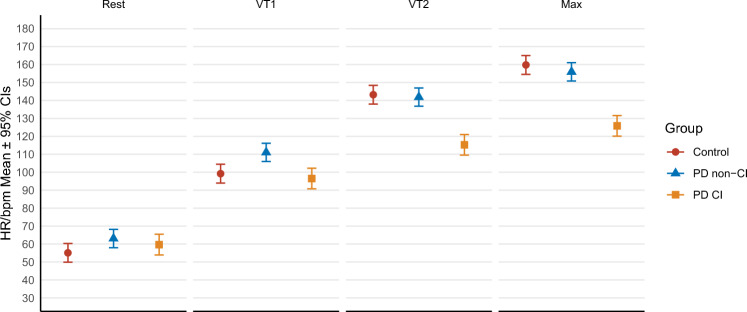
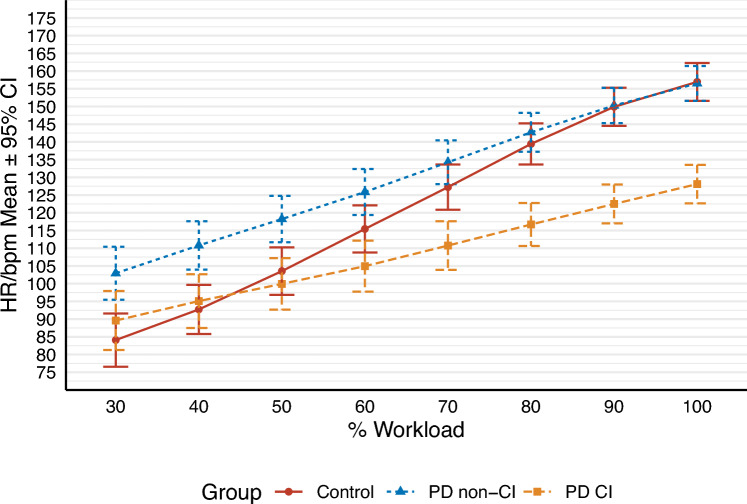
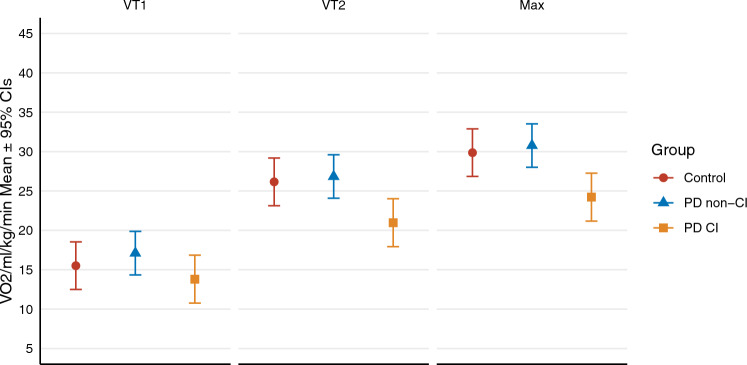
Results: CI was present in 13 (46%) PD participants (PDCI), who during CPET, exhibited blunted HR responses compared to controls and PD non-CI beyond 60% of maximal workload (p ≤ 0.05). PDCI presented a significantly lower HR at VT2, and peak exercise compared to PD non-CI and controls (p ≤ 0.001). VO2 was significantly lower in PDCI than PD non-CI and controls at VT2 (p = 0.003 and p = 0.036, respectively) and at peak exercise (p = 0.001 and p = 0.023, respectively).
Conclusion: Although poorly understood, the presence of CI in PD and its effect on HR and metabolic responses during incremental exercise is significant and important to consider when programming aerobic exercises.
Keywords: Cardiopulmonary exercise test; Exercise prescription; Heart rate; Oxygen consumption.
© 2024. The Author(s).
Conflict of interest statement
The authors declare that there are no conflicts of interest.
Figures
References
-
- American College of Sports Medicine, Liguori G, Feito Y, Fountaine C, Roy B (2022) ACSM's Guidelines for exercise testing and prescription. Liguori G, Feito Y, Fountaine C, Roy BA (Eds.) Eleventh edition. Philadelphia: Wolters Kluwer.
-
- Anselmi F, Cavigli L, Pagliaro A, Valente S, Valentini F, Cameli M, Focardi M, Mochi N, Dendale P, Hansen D, Bonifazi M, Halle M, D’Ascenzi F (2021) The importance of ventilatory thresholds to define aerobic exercise intensity in cardiac patients and healthy subjects. Scand J Med Sci Sports 31(9):1796–1808. 10.1111/sms.14007 10.1111/sms.14007 - DOI - PMC - PubMed
-
- Bates D, Mächler M, Bolker B, Walker S (2015) Fitting linear mixed-effects models using lme4. J Stat Soft. 10.18637/jss.v067.i0110.18637/jss.v067.i01 - DOI
-
- Borg GA (1982, 1982) Psychophysical bases of perceived exertion. Medicine and science in sports and exercise 14(5):377–381. http://europepmc.org/abstract/MED/7154893 - PubMed
MeSH terms
LinkOut - more resources
Full Text Sources
Medical
