


Safranal exerts a neuroprotective effect on Parkinson's disease with suppression of NLRP3 inflammation activation
- PMID: 38683404
- PMCID: PMC11059006
- DOI: 10.1007/s11033-024-09537-y
Safranal exerts a neuroprotective effect on Parkinson's disease with suppression of NLRP3 inflammation activation
Abstract
Background: Parkinson's disease (PD) is a common central nervous system neurodegenerative disease. Neuroinflammation is one of the significant neuropathological hallmarks. As a traditional Chinese medicine, Safranal exerts anti-inflammatory effects in various diseases, however, whether it plays a similar effect on PD is still unclear. The study was to investigate the effects and mechanism of Safranal on PD.
Methods: The PD mouse model was established by 1-Methyl-4-phenyl-1,2,3,6-tetrahydropyridine MPTP firstly. Next, the degree of muscle stiffness, neuromuscular function, motor retardation and motor coordination ability were examined by observing and testing mouse movement behavior. Immunofluorescence staining was used to observe the expression of tyrosine hydroxylase (TH). The dopamine (DA) content of the striatum was detected by High-performance liquid chromatography (HPLC). The expression of TH and NLRP3 inflammasome-related markers NLRP3, IL-1β, and Capase-1 were detected by Real-time Polymerase Chain Reaction (qRT-PCR) and western blotting (WB) respectively.
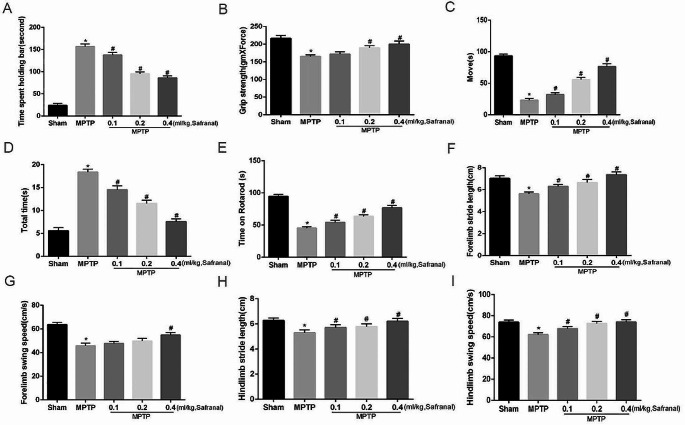
Results: Through behavioral testing, Parkinson's mouse showed a higher muscle stiffness and neuromuscular tension, a more motor retardation and activity disorders, together with a worse motor coordination compared with sham group. Simultaneously, DA content and TH expression in the striatum were decreased. However, after using Safranal treatment, the above pathological symptoms of Parkinson's mouse all improved compared with Safranal untreated group, the DA content and TH expression were also increased to varying degrees. Surprisingly, it observed a suppression of NLRP3 inflammation in the striatum of Parkinson's mouse.
Conclusions: Safranal played a neuroprotective effect on the Parkinson's disease and its mechanism was related to the inhibition of NLRP3 inflammasome activation.
Keywords: NLRP3; Neuroprotective; Parkinson’s disease; Safranal.
© 2024. The Author(s).
Conflict of interest statement
The authors declare no competing interests.
Figures




References
-
- Lappin JM, Darke S (2021) Methamphetamine and heightened risk for early-onset stroke and Parkinson’s disease: a review. Exp Neurol 343:113793 - PubMed
-
- Dong MX, Wei YD, Hu L (2021) The disturbance of lipid metabolism is correlated with neuropsychiatric symptoms in patients with Parkinson’s disease. Chem Phys Lipids 239:105112 - PubMed
-
- Troshev D, Berezhnoy D, Kulikova O, Abaimov D, Muzychuk O, Nalobin D et al (2021) The dynamics of nigrostriatal system damage and neurobehavioral changes in the rotenone rat model of Parkinson’s disease. Brain Res Bull 173:1–13 - PubMed
MeSH terms
Substances
Grants and funding
LinkOut - more resources
Full Text Sources
Medical
Research Materials
