. 2024 Apr 29;15(1):3607.
doi: 10.1038/s41467-024-47646-1.

Sulfur oxidation and reduction are coupled to nitrogen fixation in the roots of the salt marsh foundation plant Spartina alterniflora

Affiliations

Sulfur oxidation and reduction are coupled to nitrogen fixation in the roots of the salt marsh foundation plant Spartina alterniflora

J L Rolando et al. Nat Commun. .

Abstract

Heterotrophic activity, primarily driven by sulfate-reducing prokaryotes, has traditionally been linked to nitrogen fixation in the root zone of coastal marine plants, leaving the role of chemolithoautotrophy in this process unexplored. Here, we show that sulfur oxidation coupled to nitrogen fixation is a previously overlooked process providing nitrogen to coastal marine macrophytes. In this study, we recovered 239 metagenome-assembled genomes from a salt marsh dominated by the foundation plant Spartina alterniflora, including diazotrophic sulfate-reducing and sulfur-oxidizing bacteria. Abundant sulfur-oxidizing bacteria encode and highly express genes for carbon fixation (RuBisCO), nitrogen fixation (nifHDK) and sulfur oxidation (oxidative-dsrAB), especially in roots stressed by sulfidic and reduced sediment conditions. Stressed roots exhibited the highest rates of nitrogen fixation and expression level of sulfur oxidation and sulfate reduction genes. Close relatives of marine symbionts from the Candidatus Thiodiazotropha genus contributed ~30% and ~20% of all sulfur-oxidizing dsrA and nitrogen-fixing nifK transcripts in stressed roots, respectively. Based on these findings, we propose that the symbiosis between S. alterniflora and sulfur-oxidizing bacteria is key to ecosystem functioning of coastal salt marshes.


Conflict of interest statement

The authors declare no competing interests.

Figures
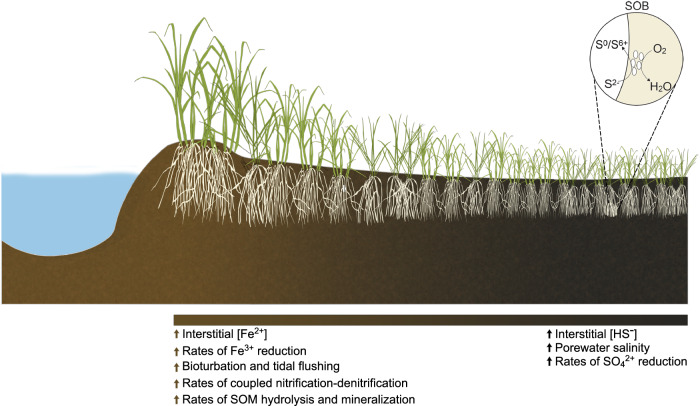
Fig. 1
Fig. 1. Spartina alterniflora biomass gradient as a natural laboratory.
A gradient in S. alterniflora aboveground biomass is commonly observed with tall plants growing at the levees next to large tidal creeks and a short phenotype of S. alterniflora dominating the interior of the marsh. Sediments from the tall S. alterniflora zone are characterized as a more oxidized environment with higher levels of iron reduction and coupled nitrification-denitrification as well as higher rates of organic matter hydrolysis and mineralization. Conversely, sediments from the short phenotype tend to be more chemically reduced, with higher rates of sulfate reduction, elevated porewater salinity, and less bioturbation and tidal flushing. Roots from the short S. alterniflora phenotype have been proposed to harbor sulfur-oxidizing bacteria (SOB) that benefit the plant by detoxifying the root environment.
Fig. 2
Fig. 2. Prokaryotic abundance, functional diversity, and activity are determined by Spartina alterniflora phenotype and microbiome compartment.
Metagenomic nonpareil diversity, 16S rRNA gene, and transcript abundance as quantified by qPCR and RT-qPCR, respectively (n = 4 per compartment and S. alterniflora phenotype) (A). Principal coordinate analysis (PCoA) ordination plot based on the Bray-Curtis dissimilatory index of functional profiles from KEGG orthology annotations (KO level) of metagenome and metatranscriptome libraries (B). In boxplots, boxes are defined by the upper and lower interquartile; the median is represented as a horizontal line within the boxes; whiskers extend to the most extreme data point which is no more than 1.5 times the interquartile range. Different letter indicates statistical difference based on pairwise Mann–Whitney tests (two-sided, p-value < 0.05).
Fig. 3
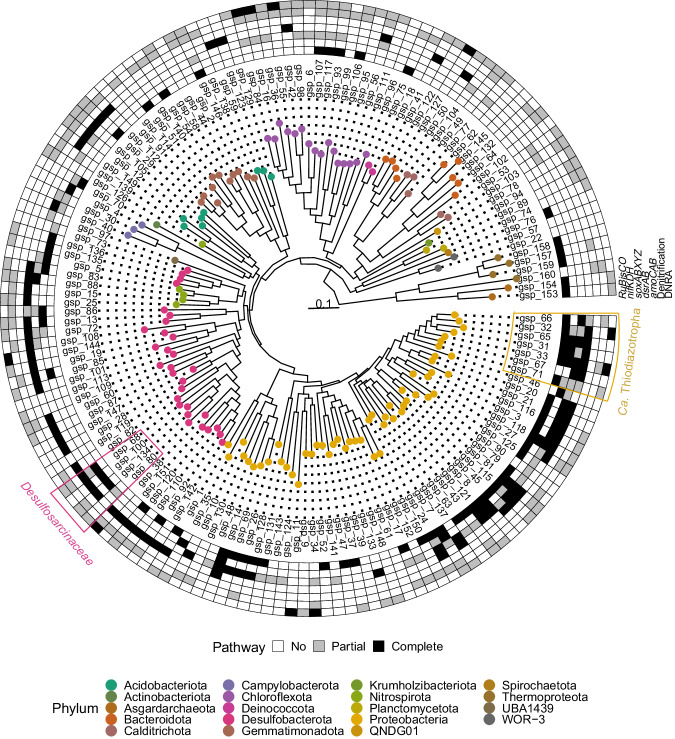
Fig. 3. Phylogenetic reconstruction of 160 dereplicated metagenome-assembled genomes (MAGs, >50 quality score) binned from Spartina alterniflora sediment, rhizosphere, and root samples.
Outer rim shows the presence/absence of genes for carbon fixation (RuBisCO), nitrogen fixation (nifHDK), thiosulfate oxidation (soxABXYZ), dissimilatory sulfite reduction/oxidation (dsrAB), nitrification (amoCAB), denitrification, and dissimilatory nitrate reduction to ammonium (DNRA). Desulfosarcinaceae and Candidatus Thiodiazotropha genomospecies are highlighted within pink and orange polygons, respectively.
Fig. 4
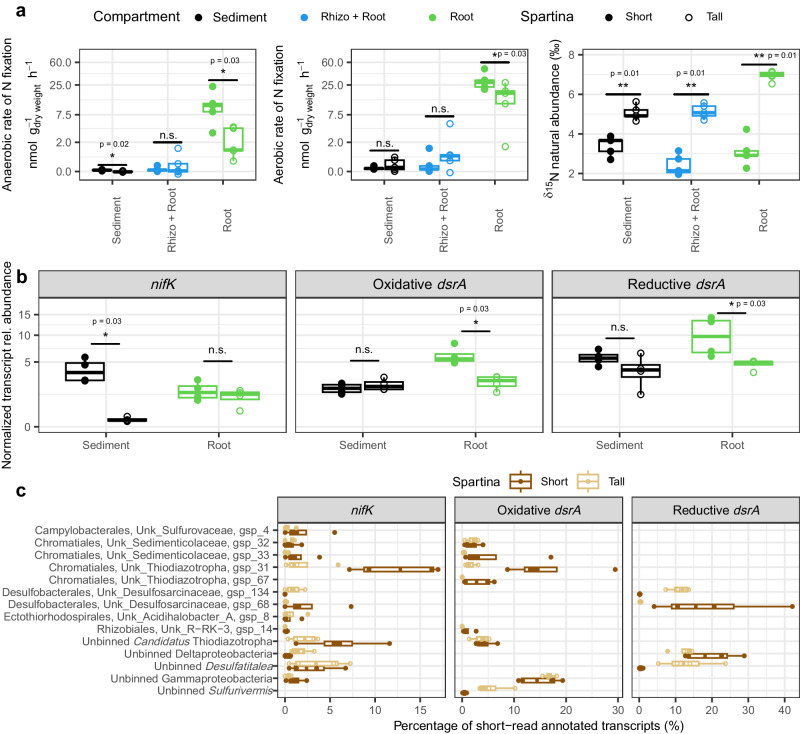
Fig. 4. Drivers and metagenome-assembled genomes (MAGs) associated with rates of N fixation in the salt marsh environment.
Rates of N fixation (under anoxic and oxic conditions) and 15N isotopic natural abundance per microbiome compartment and Spartina alterniflora phenotype (n = 4 per compartment and S. alterniflora phenotype) (a). 15N natural abundance is expressed as the per mille (‰) deviation from air 15N:14N ratio (δ15N). Normalized transcript relative abundance of the nitrogenase gene (nifK), and the reductive and oxidative dsrA types per microbiome compartment and S. alterniflora phenotype (b). Percentage contribution of nifK reductive and oxidative types of dsrA short read transcripts mapping to the most active MAGs and unbinned scaffolds (c). In boxplots, boxes are defined by the upper and lower interquartile; the median is represented as a horizontal line within the boxes; whiskers extend to the most extreme data point which is no more than 1.5 times the interquartile range. Statistical significance based on non-parametric pairwise Mann–Whitney tests (two-sided). n.s. = p-value > 0.05, *p-value < 0.05, **p-value < 0.01.
Fig. 5
Fig. 5. Phylogenetic tree of the Sedimenticolaceae family.
Taxonomic annotation of the Candidatus Thiodiazotropha genus was based on Osvatic et al.. The diagram next to the species name recognizes genomes recovered as symbionts of eukaryotic organisms. The average relative abundance of the metagenome-assembled genomes (MAGs) from the present study is shown in the adjacent panels per microbiome compartment and Spartina alterniflora phenotype. Relative abundance was calculated at the DNA level based on average coverage per position in metagenomic libraries. Purple sulfur bacteria Allochromatium vinosum was used as an outgroup for the phylogenetic tree.
Fig. 6
Fig. 6. Roots from marine-influenced ecosystems assemble a distinct microbial community enriched by bacteria known to conserve energy from sulfur metabolism.
Non-metric multidimensional scaling (NMDS) ordination plot based on the Bray-Curtis dissimilatory index of root-associated prokaryotic communities at the genus level, colored by ecosystem type (a). Relative abundance of putative sulfur-oxidizing (b) and sulfate-reducing root bacteria (c) by ecosystem type. Prokaryotic communities were characterized by analyzing an SSU rRNA gene amplicon dataset of 1182 samples assessing roots from 56 plant species. In boxplots, boxes are defined by the upper and lower interquartile; the median is represented as a horizontal line within the boxes; whiskers extend to the most extreme data point which is no more than 1.5 times the interquartile range. Different letter indicates statistical differences based on pairwise Mann–Whitney tests (two-sided, p-value < 0.05). NMDS stress: 0.10.

References

    1. Bulgarelli D, Schlaeppi K, Spaepen S, Van Themaat EVL, Schulze-Lefert P. Structure and functions of the bacterial microbiota of plants. Annu. Rev. Plant Biol. 2013;64:807–838. doi: 10.1146/annurev-arplant-050312-120106. - DOI - PubMed
    1. Trivedi P, Leach JE, Tringe SG, Sa T, Singh BK. Plant–microbiome interactions: from community assembly to plant health. Nat. Rev. Microbiol. 2020;18:607–621. doi: 10.1038/s41579-020-0412-1. - DOI - PubMed
    1. Barbier EB, et al. The value of estuarine and coastal ecosystem services. Ecol. Monogr. 2011;81:169–193. doi: 10.1890/10-1510.1. - DOI
    1. Duarte CM, Losada IJ, Hendriks IE, Mazarrasa I, Marbà N. The role of coastal plant communities for climate change mitigation and adaptation. Nat. Clim. change. 2013;3:961–968. doi: 10.1038/nclimate1970. - DOI
    1. Gandy EL, Yoch DC. Relationship between nitrogen-fixing sulfate reducers and fermenters in salt marsh sediments and roots of Spartina alterniflora. Appl. Environ. Microbiol. 1988;54:2031–2036. doi: 10.1128/aem.54.8.2031-2036.1988. - DOI - PMC - PubMed

Publication types