


Assessment of Ventilation Using Adult and Pediatric Manual Resuscitators in a Simulated Adult Patient
- PMID: 38688544
- PMCID: PMC11298233
- DOI: 10.4187/respcare.11588
Assessment of Ventilation Using Adult and Pediatric Manual Resuscitators in a Simulated Adult Patient
Abstract
Background: The bag-valve-mask (BVM) or manual resuscitator bag is used as a first-line technique to ventilate patients with respiratory failure. Volume-restricted manual resuscitator bags (eg, pediatric bags) have been suggested to minimize overventilation and associated complications. There are studies that both support and caution against the use of a pediatric resuscitator bag to ventilate an adult patient. In this study, we evaluated the ability of pre-hospital clinicians to adequately ventilate an adult manikin with both an adult- and pediatric-size manual resuscitator bag without the assistance of an advanced airway or airway adjunct device.
Methods: This study was conducted at an international conference in 2022. Conference attendees with pre-hospital health care experience were recruited to ventilate an adult manikin using a BVM for 1 min with both an adult and pediatric resuscitator bag, without the use of adjunct airway devices, while 6 ventilatory variables were collected or calculated: tidal volume (VT), breathing frequency, adequate breaths (VT > 150 mL), proportion of adequate breaths, peak inspiratory pressure (PIP), and estimated alveolar ventilation (EAV).
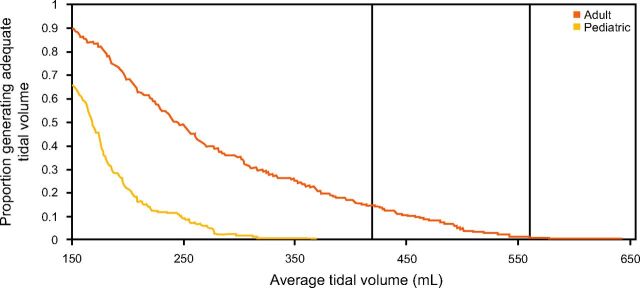
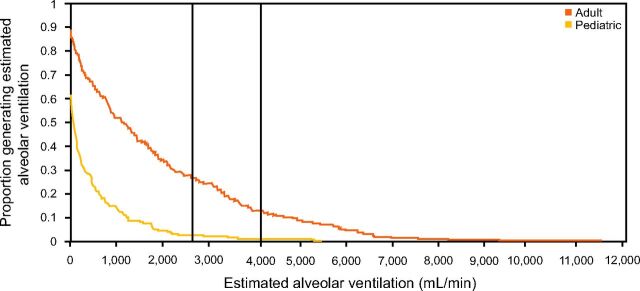
Results: A total of 208 participants completed the study. Ventilation with the adult-sized BVM delivered an average VT of 290.4 mL compared to 197.1 mL (P < .001) when using the pediatric BVM. PIP with the adult BVM was higher than with the pediatric BVM (10.6 cm H2O vs 8.6 cm H2O, P < .001). The median EAV with the adult bag (1,138.1 [interquartile range [IQR] 194.0-2,869.9] mL/min) was markedly greater than with the pediatric BVM (67.7 [IQR 0-467.3] mL/min, P < .001).
Conclusions: Both pediatric- and adult-sized BVM provided lower ventilation volumes than those recommended by professional guidelines for an adult. Ventilation with the pediatric BVM was significantly worse than with the adult bag when ventilating a simulated adult subject.
Keywords: bag-valve-mask; estimated alveolar ventilation; manual ventilation; simulated patient; tidal volume.
Copyright © 2024 by Daedalus Enterprises.
Conflict of interest statement
Dr Slutsky discloses a relationship with SafeBVM Corporation. The remaining authors have disclosed no conflicts of interest.
Figures
References
-
- Perkins GD, Graesner J-T, Semeraro F, Olasveengen T, Soar J, Lott C, et al. ; European Resuscitation Council Guideline Collaborators. European Resuscitation Council guidelines 2021: executive summary. Resuscitation 2021;161:1-60. - PubMed
-
- Lyng JW, Guyette FX, Levy M, Bosson N. Prehospital manual ventilation: an NAEMSP position statement and resource document. Prehosp Emerg Care 2022;26(sup1):23-31. - PubMed
-
- Neth MR, Benoit JL, Stolz U, McMullan J. Ventilation in simulated out-of-hospital cardiac arrest resuscitation rarely meets guidelines. Prehosp Emerg Care 2021;25(5):712-720. - PubMed
-
- Scott JB, Schneider JM, Schneider K, Li J. An evaluation of manual tidal volume and respiratory rate delivery during simulated resuscitation. Am J Emerg Med 2021;45:446-450. - PubMed
MeSH terms
LinkOut - more resources
Full Text Sources
