


Enhancing Nasopharyngeal Carcinoma Survival Prediction: Integrating Pre- and Post-Treatment MRI Radiomics with Clinical Data
- PMID: 38689151
- PMCID: PMC11522233
- DOI: 10.1007/s10278-024-01109-7
Enhancing Nasopharyngeal Carcinoma Survival Prediction: Integrating Pre- and Post-Treatment MRI Radiomics with Clinical Data
Abstract
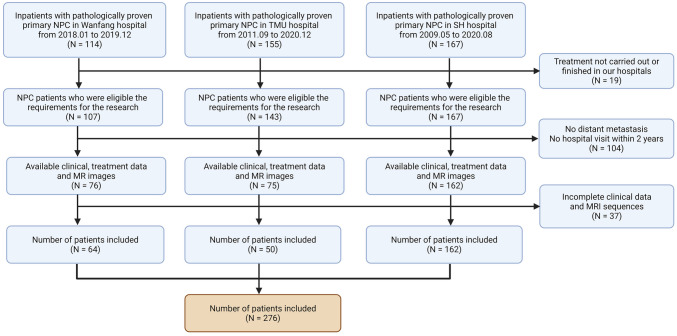
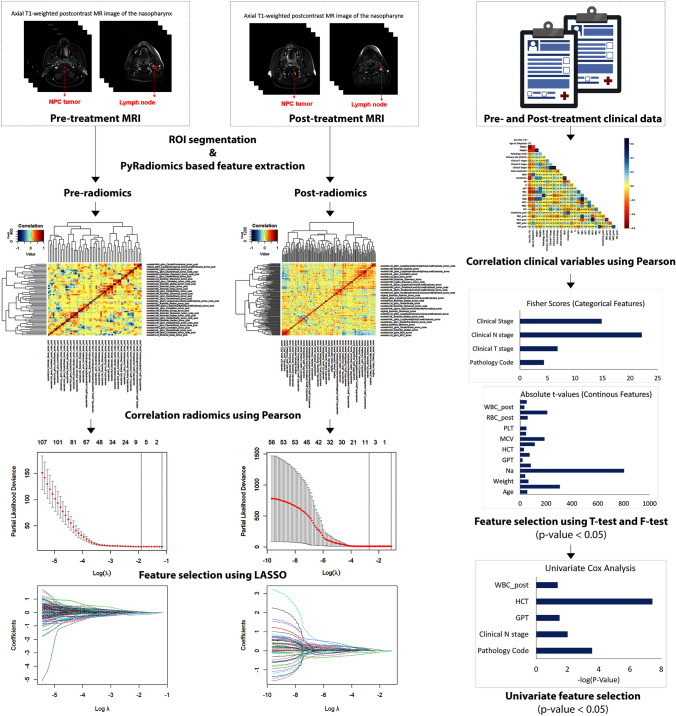
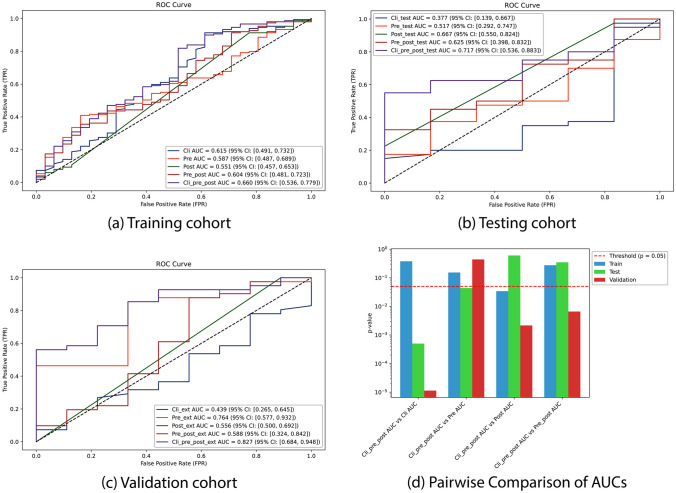
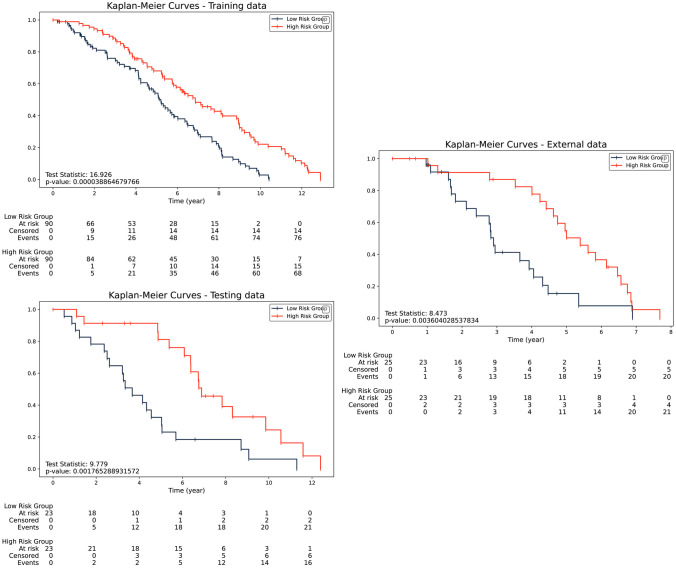
Recurrences are frequent in nasopharyngeal carcinoma (NPC) despite high remission rates with treatment, leading to considerable morbidity. This study aimed to develop a prediction model for NPC survival by harnessing both pre- and post-treatment magnetic resonance imaging (MRI) radiomics in conjunction with clinical data, focusing on 3-year progression-free survival (PFS) as the primary outcome. Our comprehensive approach involved retrospective clinical and MRI data collection of 276 eligible NPC patients from three independent hospitals (180 in the training cohort, 46 in the validation cohort, and 50 in the external cohort) who underwent MRI scans twice, once within 2 months prior to treatment and once within 10 months after treatment. From the contrast-enhanced T1-weighted images before and after treatment, 3404 radiomics features were extracted. These features were not only derived from the primary lesion but also from the adjacent lymph nodes surrounding the tumor. We conducted appropriate feature selection pipelines, followed by Cox proportional hazards models for survival analysis. Model evaluation was performed using receiver operating characteristic (ROC) analysis, the Kaplan-Meier method, and nomogram construction. Our study unveiled several crucial predictors of NPC survival, notably highlighting the synergistic combination of pre- and post-treatment data in both clinical and radiomics assessments. Our prediction model demonstrated robust performance, with an accuracy of AUCs of 0.66 (95% CI: 0.536-0.779) in the training cohort, 0.717 (95% CI: 0.536-0.883) in the testing cohort, and 0.827 (95% CI: 0.684-0.948) in validation cohort in prognosticating patient outcomes. Our study presented a novel and effective prediction model for NPC survival, leveraging both pre- and post-treatment clinical data in conjunction with MRI features. Its constructed nomogram provides potentially significant implications for NPC research, offering clinicians a valuable tool for individualized treatment planning and patient counseling.
Keywords: Artificial intelligence; Magnetic resonance radiomics; Nasopharyngeal carcinoma; Prognosis.
© 2024. The Author(s) under exclusive licence to Society for Imaging Informatics in Medicine.
Conflict of interest statement
The authors declare no competing interests.
Figures

References
-
- X. Zhou, W. Zhao, Y. Chen, and Z. Zhang, “Chapter Six - Patient-derived tumor models for human nasopharyngeal carcinoma,” in Chick Chorioallantoic Membrane Model and Precision Cancer Therapy, vol. 46, F. B. T.-T. E. Tamanoi, Ed., Academic Press, 2019, pp. 81–96. 10.1016/bs.enz.2019.08.007. - PubMed
-
- L.-X. Peng and C.-N. Qian, “Chapter 17 - Nasopharyngeal Cancer,” S. G. B. T.-E. C. T. Gray, Ed., Boston: Academic Press, 2015, pp. 373–389. 10.1016/B978-0-12-800206-3.00017-3.
-
- P. J. Slootweg and A. K. El-Naggar, “World Health Organization 4th edition of head and neck tumor classification: insight into the consequential modifications.” Virchows Archiv: an international journal of pathology, vol. 472, no. 3. Germany, pp. 311–313, Mar. 2018. 10.1007/s00428-018-2320-6. - PubMed
-
- H. Peng et al., “Prognostic value of deep learning PET/CT-based radiomics: Potential role for future individual induction chemotherapy in advanced nasopharyngeal carcinoma,” Clinical Cancer Research, vol. 25, no. 14, pp. 4271–4279, 2019. 10.1158/1078-0432.CCR-18-3065. - PubMed
MeSH terms
Grants and funding
LinkOut - more resources
Full Text Sources
Medical