


Neural representation of phonological wordform in temporal cortex
- PMID: 38689188
- PMCID: PMC11680662
- DOI: 10.3758/s13423-024-02511-6
Neural representation of phonological wordform in temporal cortex
Abstract
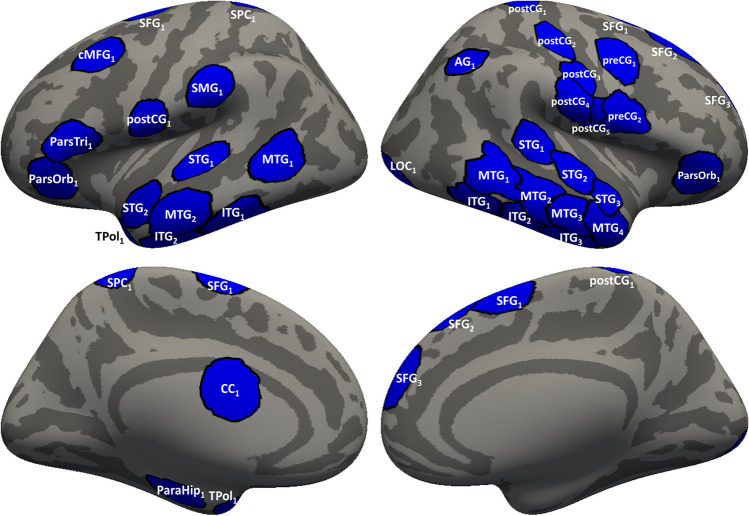
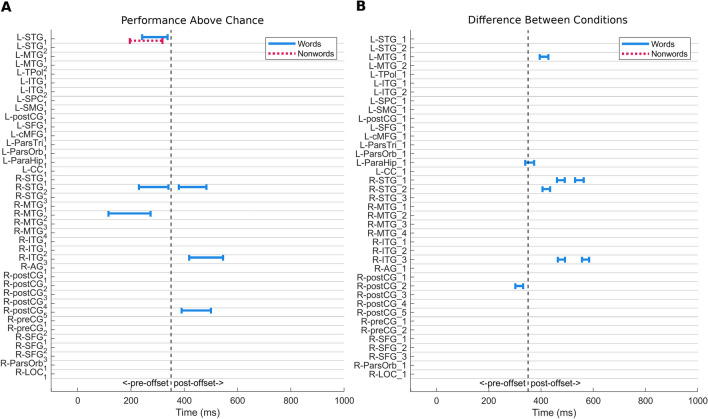
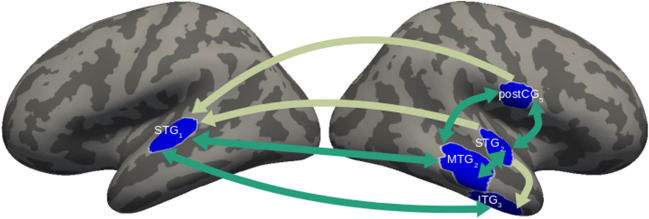
While the neural bases of the earliest stages of speech categorization have been widely explored using neural decoding methods, there is still a lack of consensus on questions as basic as how wordforms are represented and in what way this word-level representation influences downstream processing in the brain. Isolating and localizing the neural representations of wordform is challenging because spoken words activate a variety of representations (e.g., segmental, semantic, articulatory) in addition to form-based representations. We addressed these challenges through a novel integrated neural decoding and effective connectivity design using region of interest (ROI)-based, source-reconstructed magnetoencephalography/electroencephalography (MEG/EEG) data collected during a lexical decision task. To identify wordform representations, we trained classifiers on words and nonwords from different phonological neighborhoods and then tested the classifiers' ability to discriminate between untrained target words that overlapped phonologically with the trained items. Training with word neighbors supported significantly better decoding than training with nonword neighbors in the period immediately following target presentation. Decoding regions included mostly right hemisphere regions in the posterior temporal lobe implicated in phonetic and lexical representation. Additionally, neighbors that aligned with target word beginnings (critical for word recognition) supported decoding, but equivalent phonological overlap with word codas did not, suggesting lexical mediation. Effective connectivity analyses showed a rich pattern of interaction between ROIs that support decoding based on training with lexical neighbors, especially driven by right posterior middle temporal gyrus. Collectively, these results evidence functional representation of wordforms in temporal lobes isolated from phonemic or semantic representations.
Keywords: Neural decoding; Neural representation; Phonology; Recognition; Spoken word.
© 2024. The Author(s).
Figures
Update of
-
Neural representation of phonological wordform in bilateral posterior temporal cortex.bioRxiv [Preprint]. 2023 Jul 21:2023.07.19.549751. doi: 10.1101/2023.07.19.549751. bioRxiv. 2023. Update in: Psychon Bull Rev. 2024 Dec;31(6):2659-2671. doi: 10.3758/s13423-024-02511-6. PMID: 37503242 Free PMC article. Updated. Preprint.
References
-
- Abrahams, S., Goldstein, L. H., Simmons, A., Brammer, M. J., Williams, S. C., Giampietro, V. P., ..., Leigh, P. N. (2003). Functional magnetic resonance imaging of verbal fluency and confrontation naming using compressed image acquisition to permit overt responses. Hum Brain Mapp, 20(1), 29-40. 10.1002/hbm.10126 - PMC - PubMed
-
- Albright, A. (2009). Feature-based generalization as a source of gradient acceptability. Phonology,26(1), 9–41. 10.1017/S0952675709001705
-
- Allopenna, P. D., Magnuson, J. S., & Tanenhaus, M. K. (1998). Tracking the time course of spoken word recognition using eye movements: Evidence for continuous mapping models. Journal of Memory and Language,38(4), 419–439. 10.1006/jmla.1997.2558
MeSH terms
Grants and funding
LinkOut - more resources
Full Text Sources
