


The utility of serum glucose potassium ratio as a predictive factor for haemorrhagic transformation, stroke recurrence, and mortality among ischemic stroke patients
- PMID: 38690210
- PMCID: PMC11059537
- DOI: 10.1016/j.jsps.2024.102082
The utility of serum glucose potassium ratio as a predictive factor for haemorrhagic transformation, stroke recurrence, and mortality among ischemic stroke patients
Abstract
Background and objective: Glucose-Potassium Ratio (GPR) has emerged as a biomarker in several pathophysiological conditions. However, the association between GPR and long-term outcomes in stroke patients has not been investigated. Our study evaluated the applicability of baseline GPR as a predictive prognostic tool for clinical outcomes in ischemic stroke patients.
Methods: The multicenter retrospective cohort study included acute-subacute adult ischemic stroke patients who had their baseline serum GPR levels measured. Eligible patients were categorized into two sub-cohorts based on the baseline GPR levels (<1.67 vs. ≥ 1.67). The primary outcome was the incidence of 30-day hemorrhagic transformation, while stroke recurrence, and all-cause mortality within twelve months, were considered secondary.
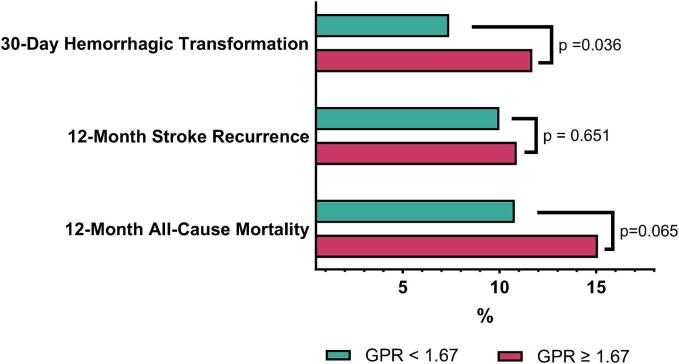
Results: Among 4083 patients screened, 1047 were included in the current study. In comparison with GPR < 1.67 group, patients with ≥ 1.67 GPR had a significantly higher ratio of all-cause mortality within twelve months (aHR 2.07 [95 % CI 1.21-3.75] p = 0.01), and higher ratio of 30-day hemorrhagic transformation but failed to reach the statistical significance (aHR 1.60 [95 % CI 0.95-2.79], p = 0.08).
Conclusion: Overall, baseline GPR serum is an independent predictor of all-cause mortality within twelve months in patients with acute and subacute ischemic stroke. Further clinical studies are necessary to validate these findings.
Keywords: Brain Injury; Brain Ischemia; Glucose; Mortality; Potassium; Stroke.
© 2024 The Author(s).
Figures



References
-
- Adams H.P., Jr, Bendixen B.H., Kappelle L.J., Biller J., Love B.B., Gordon D.L., Marsh E., 3rd Classification of subtype of acute ischemic stroke. Definitions for use in a multicenter clinical trial. TOAST. Trial of Org 10172 in Acute Stroke Treatment. Stroke. 1993;24(1):35–41. - PubMed
-
- Alamri F.F., Al Shoyaib A., Syeara N., Paul A., Jayaraman S., Karamyan S.T., Arumugam T.V., Karamyan V.T. Delayed atomoxetine or fluoxetine treatment coupled with limited voluntary running promotes motor recovery in mice after ischemic stroke. Neural Regen. Res. 2021;16(7):1244–1251. doi: 10.4103/1673-5374.301031. - DOI - PMC - PubMed
-
- Alharbi A.R., Alali A.S., Samman Y., Alghamdi N.A., Albaradie O., Almaghrabi M., Makkawi S., Alghamdi S., Alzahrani M.S., Alsalmi M., Karamyan V.T., Al Sulaiman K., Aljuhani O., Alamri F.F. Vitamin D serum level predicts stroke clinical severity, functional independence, and disability-A retrospective cohort study. Front. Neurosci. 2022;16 doi: 10.3389/fnins.2022.951283. - DOI - PMC - PubMed
LinkOut - more resources
Full Text Sources
