. 2024 May 8;4(5):100544.
doi: 10.1016/j.xgen.2024.100544. Epub 2024 Apr 30.

Blood-based epigenome-wide analyses of chronic low-grade inflammation across diverse population cohorts

Affiliations

Blood-based epigenome-wide analyses of chronic low-grade inflammation across diverse population cohorts

Robert F Hillary et al. Cell Genom. .

Abstract

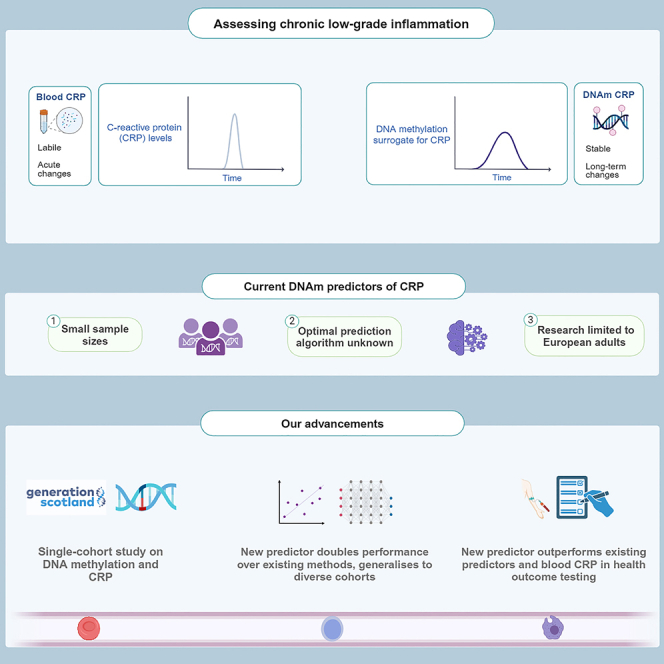
Chronic inflammation is a hallmark of age-related disease states. The effectiveness of inflammatory proteins including C-reactive protein (CRP) in assessing long-term inflammation is hindered by their phasic nature. DNA methylation (DNAm) signatures of CRP may act as more reliable markers of chronic inflammation. We show that inter-individual differences in DNAm capture 50% of the variance in circulating CRP (N = 17,936, Generation Scotland). We develop a series of DNAm predictors of CRP using state-of-the-art algorithms. An elastic-net-regression-based predictor outperformed competing methods and explained 18% of phenotypic variance in the Lothian Birth Cohort of 1936 (LBC1936) cohort, doubling that of existing DNAm predictors. DNAm predictors performed comparably in four additional test cohorts (Avon Longitudinal Study of Parents and Children, Health for Life in Singapore, Southall and Brent Revisited, and LBC1921), including for individuals of diverse genetic ancestry and different age groups. The best-performing predictor surpassed assay-measured CRP and a genetic score in its associations with 26 health outcomes. Our findings forge new avenues for assessing chronic low-grade inflammation in diverse populations.

Keywords: ALSPAC; C-reactive protein; DNA methylation; Generation Scotland; HELIOS; Lothian Birth Cohorts; SABRE; chronic inflammation; feature selection; prediction.


Conflict of interest statement

Declaration of interests R.F.H. and R.E.M. act as scientific consultants for Optima Partners. R.E.M. is an advisor to the Epigenetic Clock Development Foundation. R.F.H. has received consultant fees from Illumina. P.W. reports grant income from Roche Diagnostics in relation to and outside of the submitted work, as well as grant income from AstraZeneca, Boehringer Ingelheim, and Novartis outside the submitted work and speaker fees from Novo Nordisk and Raisio outside the submitted work. N.S. has consulted for Afimmune, Amgen, AstraZeneca, Boehringer Ingelheim, Eli Lilly, Hanmi Pharmaceuticals, Merck Sharp & Dohme, Novartis, Novo Nordisk, Pfizer, and Sanofi and has received grant support paid to his university from AstraZeneca, Boehringer Ingelheim, Novartis, and Roche Diagnostics outside the submitted work.

Figures
None
Graphical abstract
Figure 1
Figure 1
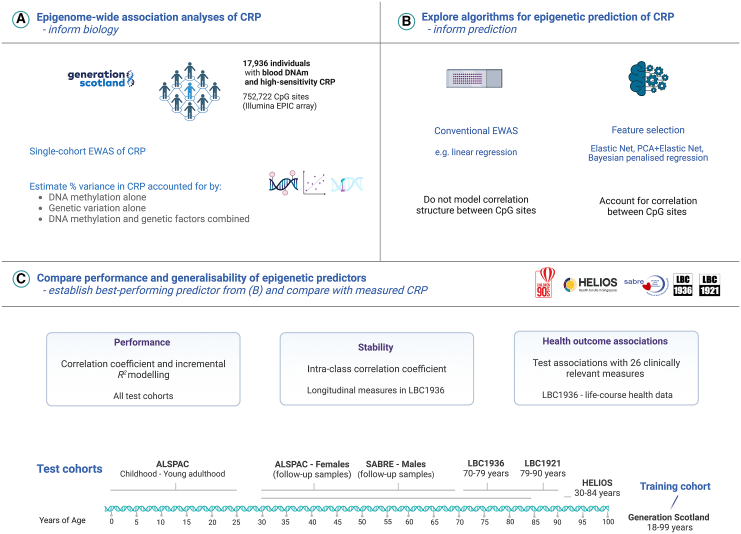
Blood epigenome-wide analyses of CRP levels across a diverse set of population cohorts (A) There were 17,936 individuals in Generation Scotland with complete high-sensitivity CRP measurements and genome-wide DNAm profiling. This allowed for an epigenome-wide scan of associations between differential DNAm and blood CRP levels, alongside a variance component analysis of molecular phenotypes and CRP. (B) A suite of feature selection and transformation methods were implemented to develop new DNAm predictors of CRP. These methods account for the correlation structure between features (CpG sites) and may offer improved predictive performances over existing methods (i.e., methylation risk scores with weights from linear regression models). (C) The predictive performances of CRP predictors derived from feature selection methods in (B) were compared against existing predictors. The five test cohorts harbored cross-sectional samples that encompass the life course (i.e., cord blood samples and childhood through to later life), adult males and females, and individuals from different ethnic backgrounds and countries of residency. Of the test cohorts, the Lothian Birth Cohort 1936 was selected for health outcome testing, given that the study population was at elevated risk for age-related disease states when compared to other cohorts and subgroups. It also constituted a larger analytical sample than the Lothian Birth Cohort 1921. ALSPAC, Avon Longitudinal Study of Parents and Children; CpG, cytosine-phosphate-guanine dinucleotide; CRP, C-reactive protein; DNAm, DNA methylation; EWAS, epigenome-wide association study; GS, Generation Scotland; HELIOS, Health for Life in Singapore; LBC1921, Lothian Birth Cohort 1921; LBC1936, Lothian Birth Cohort 1936; SABRE, Southall And Brent Revisited. Image was created with BioRender.com.
Figure 2
Figure 2
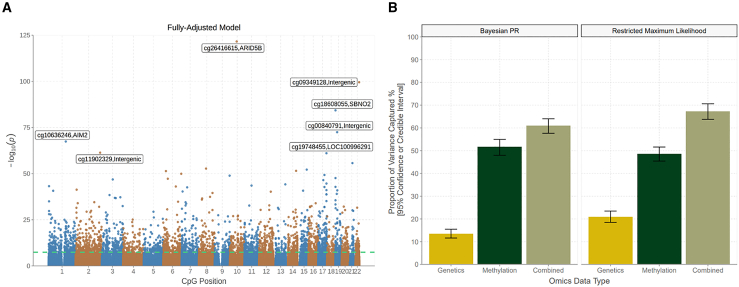
Epigenome-wide association and variance component analyses of blood CRP levels in Generation Scotland (A) A Manhattan plot shows associations between genome-wide CpG probes and log-transformed CRP levels (N = 17,936). Associations from a fully adjusted linear regression model are displayed. The green line denotes the epigenome-wide significance threshold at p < 3.6 × 10−8. The seven strongest associations (smallest p values) are annotated for clarity. (B) The proportion of variance captured by genome-wide genetic and methylation factors, separately, are shown in gold and dark green bars, respectively. The beige bar details the joint variance captured by genetic and methylation variation when conditioned on one another. Vertical bars denote the 95% credible (Bayesian PR) and confidence (restricted maximum likelihood) intervals, respectively. CpG, cytosine-phosphate-guanine dinucleotide; CRP; C-reactive protein; PR, penalized regression.
Figure 3
Figure 3
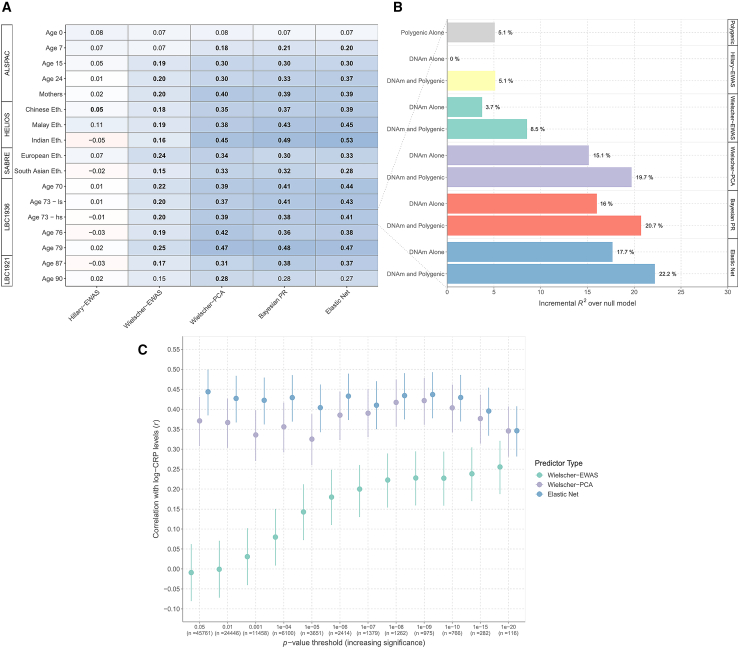
DNAm prediction of blood CRP levels using five separate strategies (A) Pearson’s correlation coefficients between log-transformed CRP levels and five different DNAm predictors of circulating levels. Weighted linear DNAm predictors for CRP levels were derived from (1) elastic net regression (Elastic Net), (2) Bayesian penalized regression (Bayesian PR), (3) PCA combined with elastic net regression (Wielscher-PCA6), (4) an EWAS by Wielscher et al. (Wielscher-EWAS6), and (5) the present EWAS (Hillary-EWAS). Low-sensitivity and high-sensitivity CRP measures were available at age 73 (wave 2) of the LBC1936 and are included in this plot to enable cross-assay comparison. The high-sensitivity measures alone are reported in the main text for this time point. (B) The proportion of variance captured in log-transformed CRP levels by a polygenic score alone and DNAm CRP from (A) are shown for wave 2 of the LBC1936 (N = 756, incremental R2 estimates above null model, see main text). An additive genetic and DNAm model is also shown for each of the five prediction strategies. (C) The PCA and elastic net regression method in the main text relied on pre-filtering sites to those that surpassed genome-wide significance in the Wielscher et al. EWAS (i.e., p < 1.0 × 10−7). The method was then repeated using different p value thresholds to filter probes prior to PCA. The resulting predictors were compared against (1) weighted linear combinations using EWAS weights alone and (2) elastic net regression on the filtered CpGs (i.e., bypassing the PCA step). Pearson’s correlations were computed between log-transformed CRP and DNAm CRP for all three methods and for p value thresholds with increasing stringency. Vertical lines denote the 95% confidence interval. ALSPAC, Avon Longitudinal Study of Parents and Children; CpG, cytosine-phosphate-guanine dinucleotide; CRP; C-reactive protein; DNAm, DNA methylation; Eth., ethnicity; EWAS, epigenome-wide association study; HELIOS, Health for Life in Singapore; LBC1936, Lothian Birth Cohort 1936; PCA, principal-component analysis; PR, penalized regression.
Figure 4
Figure 4
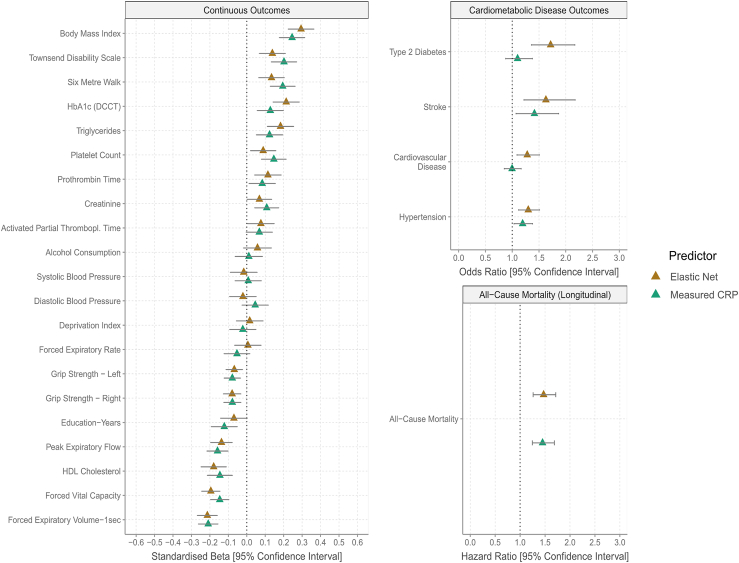
Associations of health outcomes with DNAm CRP from elastic net regression and assay-measured CRP Linear and logistic regression models (two-sided) were used to test for cross-sectional associations of DNAm and assay-measured (i.e., phenotypic) CRP with cardiometabolic, lifestyle, and self-report disease variables at wave 2 of the LBC1936 (N ≤ 756). Cox proportional hazard models tested for associations between CRP (assay measured or DNAm) derived at wave 2 and time to death due to all-cause mortality. Here, only DNAm CRP from elastic net regression was utilized, given that it was deemed the best-performing method in correlation analysis and incremental R2 modeling. Association tests using DNAm CRP from other prediction strategies and a polygenic score for CRP are shown in Figures S3–S8. CRP, C-reactive protein; DCCT, Diabetes Control and Complications Trial; DNAm, DNA methylation; HDL, high-density lipoprotein; Thrombopl., thromboplastin.

References

    1. Alfaddagh A., Martin S.S., Leucker T.M., Michos E.D., Blaha M.J., Lowenstein C.J., Jones S.R., Toth P.P. Inflammation and cardiovascular disease: From mechanisms to therapeutics. Am. J. Prev. Cardiol. 2020;4:100130. - PMC - PubMed
    1. Tsalamandris S., Antonopoulos A.S., Oikonomou E., Papamikroulis G.A., Vogiatzi G., Papaioannou S., Deftereos S., Tousoulis D. The Role of Inflammation in Diabetes: Current Concepts and Future Perspectives. Eur. Cardiol. 2019;14:50–59. doi: 10.15420/ecr.2018.33.1. - DOI - PMC - PubMed
    1. Emerging Risk Factors Collaboration. Kaptoge S., Di Angelantonio E., Lowe G., Pepys M.B., Thompson S.G., Collins R., Danesh J. C-reactive protein concentration and risk of coronary heart disease, stroke, and mortality: an individual participant meta-analysis. Lancet (London, England) 2010;375:132–140. doi: 10.1016/s0140-6736(09)61717-7. - DOI - PMC - PubMed
    1. Bogaty P., Dagenais G.R., Joseph L., Boyer L., Leblanc A., Bélisle P., Brophy J.M. Time variability of C-reactive protein: implications for clinical risk stratification. PLoS One. 2013;8:e60759. doi: 10.1371/journal.pone.0060759. - DOI - PMC - PubMed
    1. Jaenisch R., Bird A. Epigenetic regulation of gene expression: how the genome integrates intrinsic and environmental signals. Nat. Genet. 2003;33:245–254. doi: 10.1038/ng1089. - DOI - PubMed

Publication types

Substances