


Comparison of discovery rates and prognostic utility of [68Ga]Ga-PSMA-11 PET/CT and circulating tumor DNA in prostate cancer-a cross-sectional study
- PMID: 38693454
- PMCID: PMC11224100
- DOI: 10.1007/s00259-024-06698-7
Comparison of discovery rates and prognostic utility of [68Ga]Ga-PSMA-11 PET/CT and circulating tumor DNA in prostate cancer-a cross-sectional study
Abstract
Background: Circulating-tumor DNA (ctDNA) and prostate-specific membrane antigen (PSMA) ligand positron-emission tomography (PET) enable minimal-invasive prostate cancer (PCa) detection and survival prognostication. The present study aims to compare their tumor discovery abilities and prognostic values.
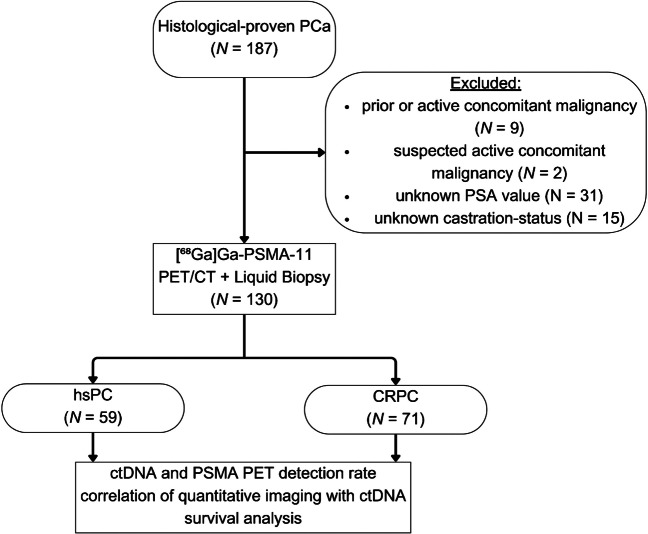
Methods: One hundred thirty men with confirmed PCa (70.5 ± 8.0 years) who underwent [68Ga]Ga-PSMA-11 PET/CT (184.8 ± 19.7 MBq) imaging and plasma sample collection (March 2019-August 2021) were included. Plasma-extracted cell-free DNA was subjected to whole-genome-based ctDNA analysis. PSMA-positive tumor lesions were delineated and their quantitative parameters extracted. ctDNA and PSMA PET/CT discovery rates were compared, and the prognostic value for overall survival (OS) was evaluated.
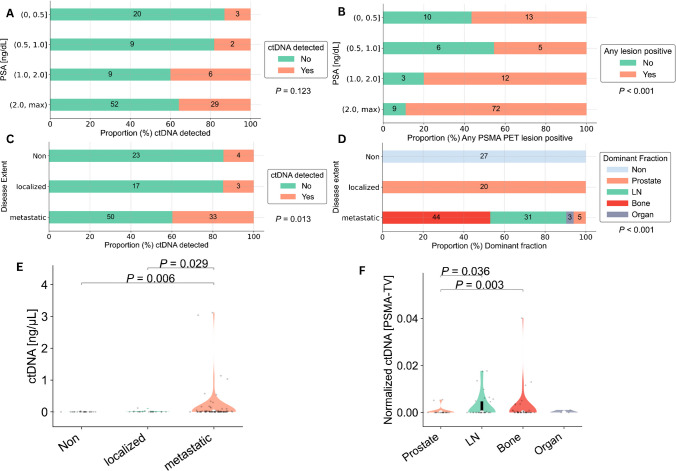
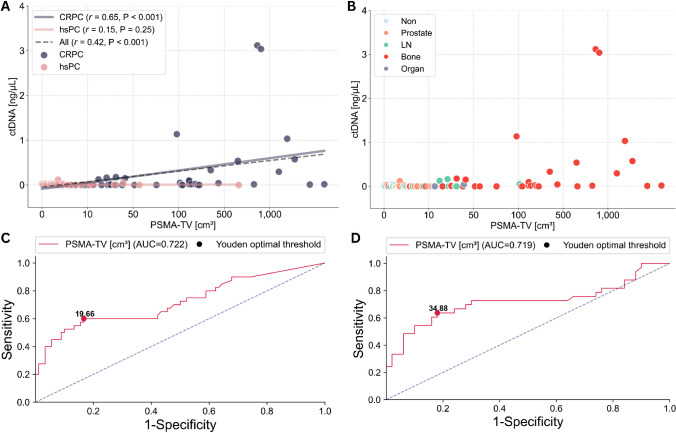
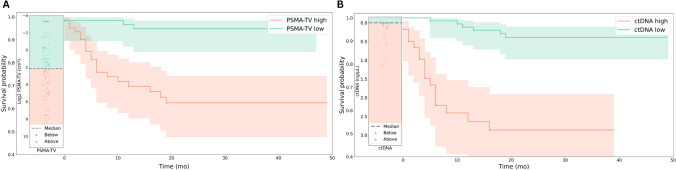
Results: PSMA PET discovery rates according to castration status and PSA ranges did differ significantly (P = 0.013, P < 0.001), while ctDNA discovery rates did not (P = 0.311, P = 0.123). ctDNA discovery rates differed between localized and metastatic disease (P = 0.013). Correlations between ctDNA concentrations and PSMA-positive tumor volume (PSMA-TV) were significant in all (r = 0.42, P < 0.001) and castration-resistant (r = 0.65, P < 0.001), however not in hormone-sensitive patients (r = 0.15, P = 0.249). PSMA-TV and ctDNA levels were associated with survival outcomes in the Logrank (P < 0.0001, P < 0.0001) and multivariate Cox regression analysis (P = 0.0023, P < 0.0001).
Conclusion: These findings suggest that PSMA PET imaging outperforms ctDNA analysis in detecting prostate cancer across the whole spectrum of disease, while both modalities are independently highly prognostic for survival outcomes.
Keywords: Liquid biopsy; PET/CT; PSMA; Prostate cancer; ctDNA.
© 2024. The Author(s).
Conflict of interest statement
The authors declare no competing interests.
Figures
References
-
- Howlader N, Noone AM, Krapcho M, Miller D, Brest A. SEER cancer statistics review (CSR), 1975–2016. National Cancer Institute. Update April.
Publication types
MeSH terms
Substances
Grants and funding
LinkOut - more resources
Full Text Sources
Medical
Research Materials
Miscellaneous
