


Ethnobotany and diversity of Citrus spp. (Rutaceae) as a source of "Kem-kem" traditional medicine used among the Karo sub-ethnic in North Sumatra, Indonesia
- PMID: 38694125
- PMCID: PMC11061673
- DOI: 10.1016/j.heliyon.2024.e29721
Ethnobotany and diversity of Citrus spp. (Rutaceae) as a source of "Kem-kem" traditional medicine used among the Karo sub-ethnic in North Sumatra, Indonesia
Abstract
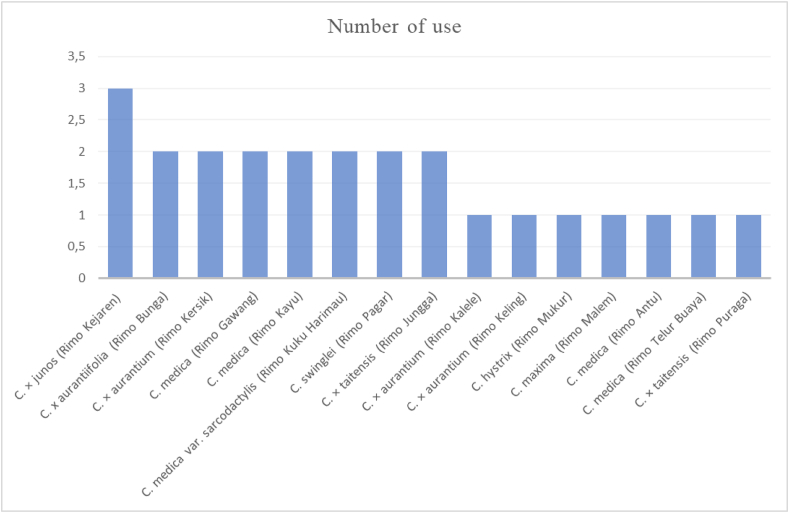
The Karo sub-ethnic is one of five Batak sub-ethnicities in the Karo Regency, North Sumatra Province, Indonesia. They are famous for their local knowledge about the traditional use of medicinal plants to treat various diseases. The "Kem-kem" traditional medicine is one of the traditional healing practices that involve using plants passed down through generations from their ancestors. One of the plant genus group in the Rutaceae family utilized in the traditional "Kem-kem" healing practice is a citrus known as "Rimo". This study aims to document the local knowledge about the diversity of Citrus spp. as Kem-kem's herbal medicinal plant. This study was conducted from April to July 2023 in the Kabanjahe and Berastagi districts, Karo Regency, North Sumatra. Data was collected using interviews with traditional healers, herbal medicine vendors, and direct observations at traditional markets, involving a total of 8 Citrus spp. The Karo uses "Rimo" with different local names as sources of traditional medicinal ingredients in practicing "Kem-kem". There are 15 local names comprising eight species of Citrus. Four are hybrids, i.e., Citrus x aurantiifolia (Christm.) Swingle, Citrus × aurantium L, Citrus × junos Siebold ex Yu.Tanaka, and Citrus × taitensis Risso. Two of the remaining species are recognized in infraspecific rank, one variety (Citrus medica var. sarcodactylis (Hoola van Nooten) Swingle) and one form (Citrus × aurantium f. deliciosa (Ten.) M.Hiroe). They were used as material sources for Kem-kem traditional medicine to treat at least nine health problems. There are two species with six local names included in the Least Concern (LC) category, namely C. medica (Rimo Gawang, Rimo Hantuantu, Rimo Kayu), C. medica var. sarcodactylis (Rimo Kuku Harimau), and C. medica (Rimo Telur Buaya), C. maxima (Burm.) Merr. (Rimo Malem). Nine local names are included in the Not Evaluated (NE) category, namely C. × junos (Rimo Kejaren), C. × taitensis (Rimo Jungga), C. × aurantium f. deliciosa (Rimo Keling), C. × aurantium (Rimo Kersik), Citrus hystrix DC. (Rimo Mukur), C. × taitensis (Rimo Puraga), C. × aurantium (Rimo Kalele), Citrus swinglei Burkill ex Harms (Rimo Pagar), and C. x aurantiifolia (Rimo Bunga). Rimo Kejaren (C. × junos) is a species that has the most benefits.
Keywords: Citrus spp.; Indonesia; Karo sub-ethnic; Local knowledge; Medicinal plants.
© 2024 The Authors.
Conflict of interest statement
The authors declare that they have no known competing financial interests or personal relationships that could have appeared to influence the work reported in this paper.
Figures


References
-
- Elfahmi, Woerdenbag H.J., Kayser O. Jamu: Indonesian traditional herbal medicine towards rational phytopharmacological use. J. Herb. Med. 2014;4(2):51–73. doi: 10.1016/j.hermed.2014.01.002. - DOI
-
- Moteetee A., Moffett R.O., Seleteng-Kose L. A review of the ethnobotany of the basotho of Lesotho and the free state province of South Africa (South Sotho) South Afr. J. Bot. 2019;122:21–56. doi: 10.1016/j.sajb.2017.12.012. - DOI
-
- Cita K.D., Hasibuan R.S., Waluyo P., Susdiyanti T. Medicinal plant use by Sundanese ethnic in nyangkewok hamlet , sukabumi regency. Media Konservasi. 2020;25(3):185–193. doi: 10.29244/medkon.25.3.185-193. - DOI
-
- Affandi O., Batubara R. In: The 8th International Symposium for Sustainable Humanosphere. Publishing I.O.P., editor. IOP Conference Series: Earth and Environmental Science PAPER; 2019. Study of medicinal plant used by the ethnic community of Karo around Lau Debuk-Debuk Tourism Park , Indonesia Study of medicinal plant used by the ethnic community of Karo around Lau Debuk-Debuk Tourism Park , Indonesia; pp. 1–8. - DOI
-
- Singarimbun, & and Masri . University of California Press; 1975. Kinship, Descent and Alliance Among the Karo Batak.
LinkOut - more resources
Full Text Sources
Miscellaneous
