


Astronomy's climate emissions: Global travel to scientific meetings in 2019
- PMID: 38694146
- PMCID: PMC11060108
- DOI: 10.1093/pnasnexus/pgae143
Astronomy's climate emissions: Global travel to scientific meetings in 2019
Abstract
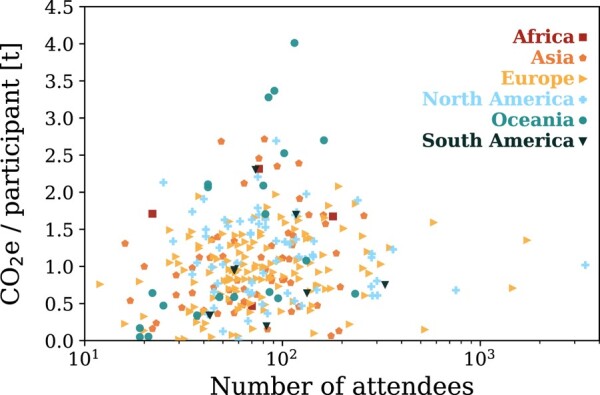
Travel to academic conferences-where international flights are the norm-is responsible for a sizeable fraction of the greenhouse gas (GHG) emissions associated with academic work. In order to provide a benchmark for comparison with other fields, as well as for future reduction strategies and assessments, we estimate the CO2-equivalent emissions for conference travel in the field of astronomy for the prepandemic year 2019. The GHG emission of the international astronomical community's 362 conferences and schools in 2019 amounted to 42,500 tCO2e, assuming a radiative-forcing index factor of 1.95 for air travel. This equates to an average of 1.0 ± 0.6 tCO2e per participant per meeting. The total travel distance adds up to roughly 1.5 Astronomical Units, that is, 1.5 times the distance between the Earth and the Sun. We present scenarios for the reduction of this value, for instance with virtual conferencing or hub models, while still prioritizing the benefits conferences bring to the scientific community.
Keywords: astronomy and astrophysics; climate-change impacts; climate-change mitigation; conferences and meetings.
© The Author(s) 2024. Published by Oxford University Press on behalf of National Academy of Sciences.
Figures




References
-
- Eyring V, et al. 2021. Human influence on the climate system. Vol. 423. Cambridge, UK and New York (NY): Cambridge University Press.
-
- Intergovernmental Panel on Climate Change (IPCC) . 2023. Weather and climate extreme events in a changing climate. Cambridge, UK and New York (NY): Cambridge University Press. p. 1513–1766.
-
- International Air Transport Association (IATA) . 2019. Climate change and carbon offsetting and reduction scheme for international aviation (CORSIA) report.
-
- International Energy Agency (IEA) . 2020. Tracking transport 2020, international energy agency tracking transport report 2020.
-
- Avila D, Sherry L, Thompson T. 2019. Reducing global warming by airline contrail avoidance: a case study of annual benefits for the contiguous United States. TRIP. 2:100033.
LinkOut - more resources
Full Text Sources
