


Effectiveness of a sensorimotor exercise program on proprioception, balance, muscle strength, functional mobility and risk of falls in older people
- PMID: 38694207
- PMCID: PMC11061438
- DOI: 10.3389/fphys.2024.1309161
Effectiveness of a sensorimotor exercise program on proprioception, balance, muscle strength, functional mobility and risk of falls in older people
Abstract
Introduction: Sensory systems provide the necessary information for a motor response to be provided. In this sense, the objective of this study is to evaluate the effectiveness of a sensorimotor exercise program on proprioceptive acuity, balance, muscle strength, functional mobility and risk of falls in institutionalized elderly.
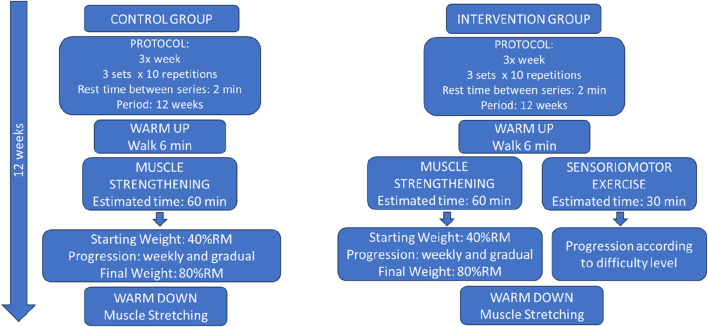
Methodology: 56 participants (84.6 ± 8.4 years) were randomly distributed between the control (CG, n = 28) and intervention groups (IG, n = 28). The CG performed a protocol based on warm-up, muscle strengthening and warm down and the IG performed the same intervention, with the addition of sensorimotor exercises. Joint Position Sensation (JPS) was evaluated in both limbs at angles of 20° and 45°, balance, functional mobility, fear of falling in the elderly and muscle strength of quadriceps, hamstrings, adductors and abductors in both limbs, before and after the 12 weeks of intervention.
Results: Both groups showed gains in muscle strength. When analyzing functionality through Timed Up and Go (TUG), before and after for each group separately, both showed a significant difference (CG p = 0.002; IG p < 0.001). For the Short Physical Performance Battery (SPPB) variable, there were significant differences in IG in balance (p < 0.001), gait speed time (s) (p = 0.004) and sit-to-stand (p = 0.002). In JPS, significant differences were recorded for Absolute Error 45° Non-Dominant (p = 0.045) and Relative Error 45° Non-Dominant (p = 0.045) in the CG and Relative Error 45° Non-Dominant for IG (p = 0.018). In the Falls Efficacy Scale International (FES-I) variable there were significant improvements in the CG (p = 0.006) and in the GI (p = 0.002). However, only IG showed significant improvements (p = 0.013) for Activities-Specific Balance Confident (ABC) in a comparison between before and after the 12-week research period. When comparing the differences verified with the intervention between CG and IG, only balance SPPB (p < 0.001) and sit-to-stand SPPB (p = 0.022) showed significant values.
Conclusion: He effectiveness of sensorimotor exercises provides balance gain in the elderly (p < 0.001) and positively impacts their confidence (p = 0.013) when performing their duties. It is concluded that the protocol presented in its different levels of difficulty is effective and important for the quality of life of the institutionalized sedentary elderly.
Keywords: balance; elderly; quality of life; risk of fall; sensorimotor exercises.
Copyright © 2024 Freire and Seixas.
Conflict of interest statement
The authors declare that the research was conducted in the absence of any commercial or financial relationships that could be construed as a potential conflict of interest.
Figures


References
-
- Ahmad I., Verma S., Noohu M. M., Shareef M. Y., Hussain M. E. (2020). Sensorimotor and gait training improves proprioception, nerve function, and muscular activation in patients with diabetic peripheral neuropathy: a randomized control trial. J. Musculoskelet. Neuronal Interact. 20 (2), 234–248. - PMC - PubMed
-
- Amato A., Baldassano S., Vasto S., Schirò G., Davì C., Drid P., et al. (2022). Effects of a resistance training protocol on physical performance, body composition, bone metabolism, and systemic homeostasis in patients diagnosed with Parkinson's disease: a pilot study. Int. J. Environ. Res. public health 19 (20), 13022. 10.3390/ijerph192013022 - DOI - PMC - PubMed
LinkOut - more resources
Full Text Sources
Miscellaneous
