. 2024 Apr 18:5:100081.
doi: 10.1016/j.cris.2024.100081. eCollection 2024.

Transgenerational plasticity in aphids reared in a poor-resource environment

Affiliations

Transgenerational plasticity in aphids reared in a poor-resource environment

Vincenzo Trotta et al. Curr Res Insect Sci. .

Abstract

The changing environmental conditions can affect insect biology over multiple generations and phenotypic plasticity is important for coping with these changes. Transgenerational plasticity occurs when the environment in which the parents developed influences the plastic response of the offspring phenotype. In the present study, the plastic effects of resource limitation on important life history traits such as body size, fecundity, survival, and resistance to starvation of the pea aphid Acyrthosiphon pisum were investigated over two generations. This study focused on understanding how resource limitation can determine an adaptive expression of maternal effects and transgenerational plasticity in fitness-related traits. Aphids showed phenotypic plasticity for the life history traits investigated, as they performed better when grown in an optimal environment than in a resource-poor one. Also, aphids had a poorer performance if their mothers were raised in a resource-poor environment. The effects of transgenerational plasticity were observed only in response to resistance to starvation, through increased survival in the offspring of the mother reared in a resource-poor environment, suggesting an evolutionary bet-hedging strategy. The results of this study showed that the effects of adaptive transgenerational plasticity may be partially masked in stressful environments, where developmental problems instead predominate. More information on the transgenerational response to resource limitation across generations can contribute to a better understanding of aphid biology.

Keywords: Acyrthosiphon pisum; Body size; Fecundity; Maternal effects; Parental manipulation; Resistance to starvation; Survival.


Conflict of interest statement

The authors declare that they have no known competing financial interests or personal relationships that could have appeared to influence the work reported in this paper.

Figures

Fig 1
Fig. 1
Life history traits of A. pisum in the F0 generation as a function of optimal and food-restricted environments. Data are presented as mean ± SE. (A) Nymph-to-adult survival; (B) survival at day 14; (C) body size measured as tibial length [mm]; (D) fecundity measured as the number of nymphs / individual / days. O, optimal resource environment (plant); P, poor-resource environment (leaves).
Fig 2
Fig. 2
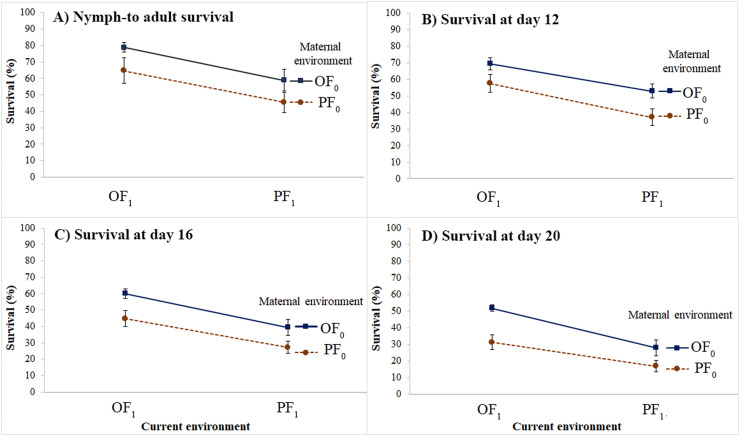
Mean percentage of survival (± standard errors) of Acyrthosiphon pisum in the F1 generation as a function of optimal (O) and poor-resource (P) rearing environments. (A) Nymph-to adult survival; (B) survival at day 12; (C) survival at day 16; (D) survival at day 20. F0 refers to the environment in which the mother developed. F1 refers to the current environment in which the aphids developed.
Fig 3
Fig. 3
Mean fecundity (± standard errors) measured as the total number of nymphs per adult per day of Acyrthosiphon pisum in the F1 generation as a function of optimal (O) and poor-resource (P) rearing environments. (A) fecundity between days 9–12; (B) fecundity between days 13–16; (C) fecundity between days 17–20. F0 refers to the environment in which the mother developed. F1 refers to the current environment in which the aphids developed.
Fig 4
Fig. 4
Mean body size (± standard errors) measured as the length of the hind tibia of adult Acyrthosiphon pisum individuals in the generation F1 as a function of optimal (O) and poor-resource (P) rearing environments. F0 refers to the environment in which the mother developed. F1 refers to the current environment in which the aphids developed.
Fig 5
Fig. 5
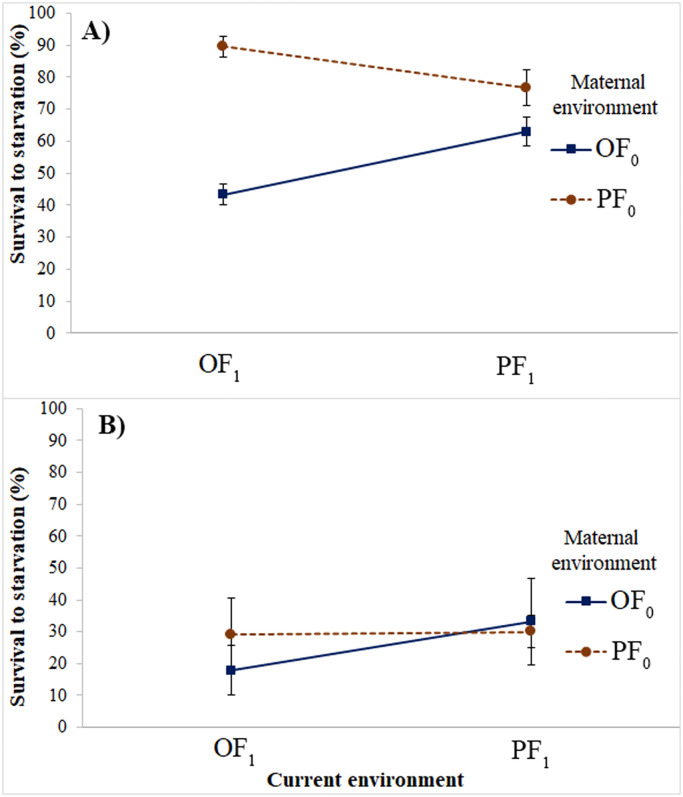
Mean values of starvation tolerance (± standard errors) of Acyrthosiphon pisum in the F1 generation as a function of optimal (O) and poor-resource (P) rearing environments. Starvation tolerance was estimated as the number of aphids alive relative to the initial number of aphids after 24 h of starvation (A) and after 48 h (B). F0 refers to the environment in which the mother developed. F1 refers to the current environment in which the aphids developed.

References

    1. Agrawal A.A., Laforsch C., Tollrian R. Transgenerational induction of defences in animals and plants. Nature. 1999;401:60–63.
    1. Allen R.M., Buckley Y.M., Marshall D.J. Offspring size plasticity in response to intraspecific competition: an adaptive maternal effect across life-history stages. Am. Nat. 2008;171:225–237. doi: 10.1086/524952. - DOI - PubMed
    1. Arnold P.A., Nicotra A.B., Kruuk L.E.B. Sparse evidence for selection on phenotypic plasticity in response to temperature. Philos. Trans. R. Soc. Lond., B, Biol. Sci. 2019;374 doi: 10.1098/rstb.2018.0185. - DOI - PMC - PubMed
    1. Ashra H., Nair S. Review: trait plasticity during plant-insect interactions: from molecular mechanisms to impact on community dynamics. Plant Sci. 2022;317 doi: 10.1016/j.plantsci.2022.111188. - DOI - PubMed
    1. Badyaev A.V., Uller T. Parental effects in ecology and evolution: mechanisms, processes and implications. Philos. Trans. R. Soc. Lond., B, Biol. Sci. 2009;364:1169–1177. doi: 10.1098/rstb.2008.0302. - DOI - PMC - PubMed

LinkOut - more resources