A study of antibiotic resistance pattern of clinical bacterial pathogens isolated from patients in a tertiary care hospital
- PMID: 38694800
- PMCID: PMC11061477
- DOI: 10.3389/fmicb.2024.1383989
A study of antibiotic resistance pattern of clinical bacterial pathogens isolated from patients in a tertiary care hospital
Abstract
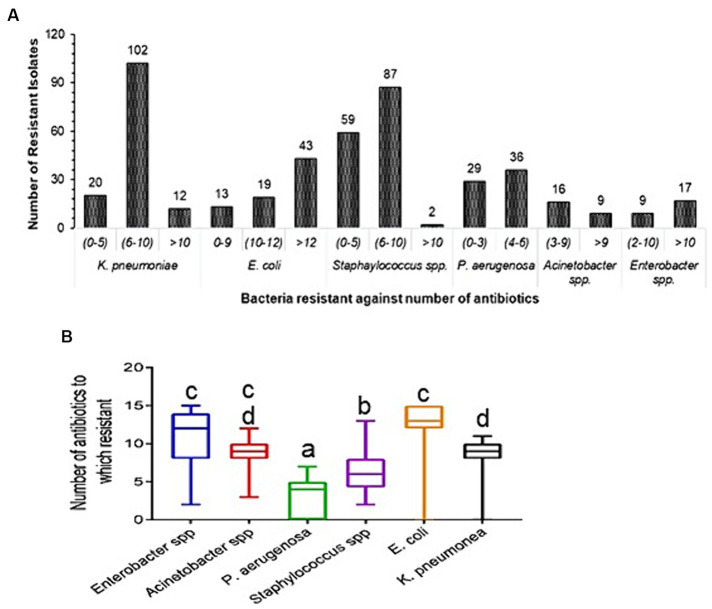
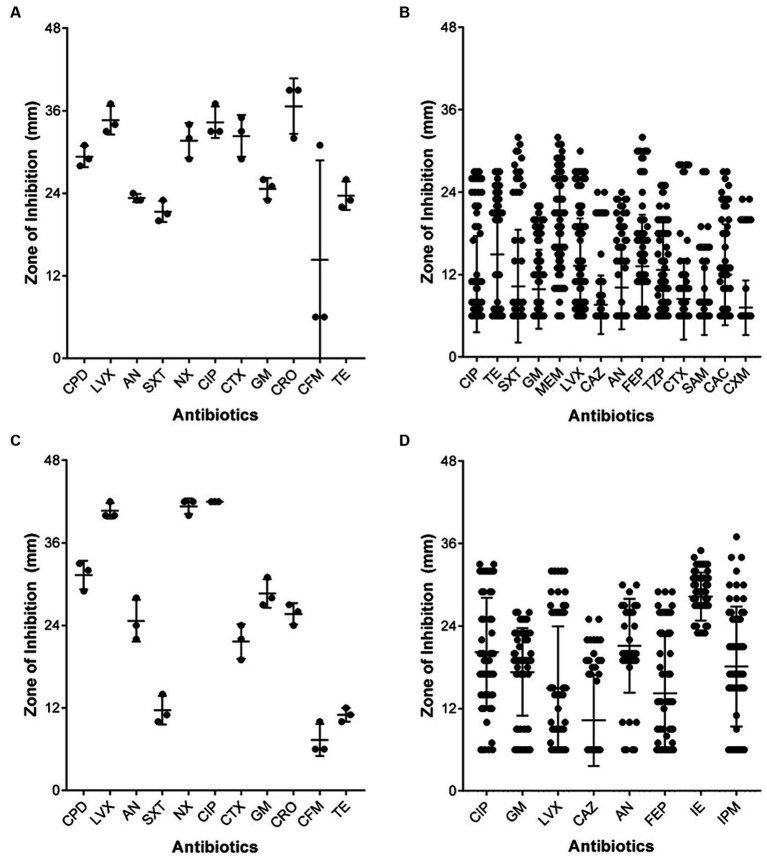
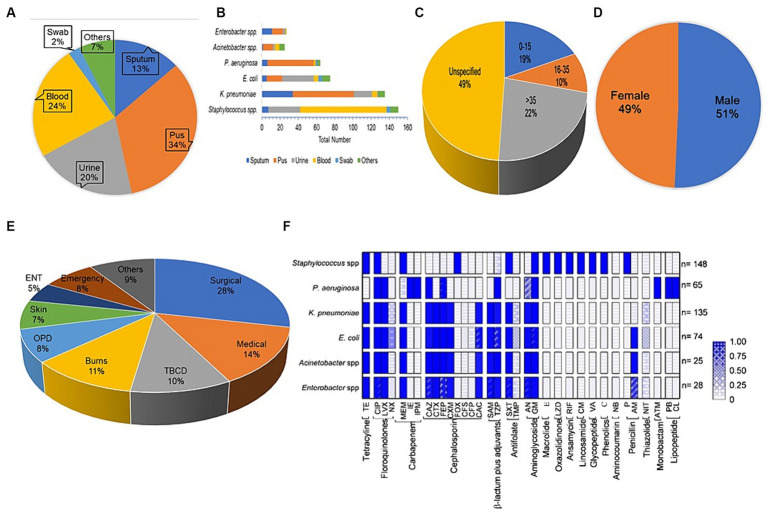
We investigated antibiotic resistance pattern in clinical bacterial pathogens isolated from in-patients and out-patients, and compared it with non-clinical bacterial isolates. 475 bacterial strains isolated from patients were examined for antibiotic resistance. Staphylococcus spp. (148; 31.1%) were found to be the most prevalent, followed by Klebsiella pneumoniae (135; 28.4%), Escherichia coli (74; 15.5%), Pseudomonas aeruginosa (65; 13.6%), Enterobacter spp. (28; 5.8%), and Acinetobacter spp. (25; 5.2%). Drug-resistant bacteria isolated were extended spectrum-β-lactamase K. pneumoniae (8.8%), E. coli (20%), metallo-β-lactamase P. aeruginosa (14; 2.9%), erythromycin-inducing clindamycin resistant (7.4%), and methicillin-resistant Staphylococcus species (21.6%). Pathogens belonging to the Enterobacteriaceae family were observed to undergo directional selection developing resistance against antibiotics ciprofloxacin, piperacillin-tazobactam, cefepime, and cefuroxime. Pathogens in the surgical ward exhibited higher levels of antibiotic resistance, while non-clinical P. aeruginosa and K. pneumoniae strains were more antibiotic-susceptible. Our research assisted in identifying the drugs that can be used to control infections caused by antimicrobial resistant bacteria in the population and in monitoring the prevalence of drug-resistant bacterial pathogens.
Keywords: antimicrobial resistance; erythromycin-induced clindamycin resistance; extended spectrum-β-lactamase; metallo-β-lactamase; methicillin-resistant Staphylococcus aureus.
Copyright © 2024 Handa, Patel, Bhattacharya, Kothari, Kavathia and Vyas.
Conflict of interest statement
The authors declare that the research was conducted in the absence of any commercial or financial relationships that could be construed as a potential conflict of interest.
Figures
Similar articles
-
Antimicrobial-resistant pathogens in intensive care units in Canada: results of the Canadian National Intensive Care Unit (CAN-ICU) study, 2005-2006.Antimicrob Agents Chemother. 2008 Apr;52(4):1430-7. doi: 10.1128/AAC.01538-07. Epub 2008 Feb 19. Antimicrob Agents Chemother. 2008. PMID: 18285482 Free PMC article.
-
Evaluation of the in vitro activity of six broad-spectrum beta-lactam antimicrobial agents tested against over 2,000 clinical isolates from 22 medical centers in Japan. Japan Antimicrobial Resistance Study Group.Diagn Microbiol Infect Dis. 1999 Jun;34(2):123-34. doi: 10.1016/s0732-8893(99)00019-x. Diagn Microbiol Infect Dis. 1999. PMID: 10354863
-
[Analysis of the pathogenic characteristics of 162 severely burned patients with bloodstream infection].Zhonghua Shao Shang Za Zhi. 2016 Sep 20;32(9):529-35. doi: 10.3760/cma.j.issn.1009-2587.2016.09.004. Zhonghua Shao Shang Za Zhi. 2016. PMID: 27647068 Chinese.
-
Literature review on the distribution characteristics and antimicrobial resistance of bacterial pathogens in neonatal sepsis.J Matern Fetal Neonatal Med. 2022 Mar;35(5):861-870. doi: 10.1080/14767058.2020.1732342. Epub 2020 Feb 26. J Matern Fetal Neonatal Med. 2022. PMID: 32102584 Review.
-
Sulopenem: An Intravenous and Oral Penem for the Treatment of Urinary Tract Infections Due to Multidrug-Resistant Bacteria.Drugs. 2022 Apr;82(5):533-557. doi: 10.1007/s40265-022-01688-1. Epub 2022 Mar 16. Drugs. 2022. PMID: 35294769 Review.
Cited by
-
Prevalence and molecular insights into carbapenem resistance: a 2-year retrospective analysis of superbugs in South India.Front Med (Lausanne). 2025 May 30;12:1571231. doi: 10.3389/fmed.2025.1571231. eCollection 2025. Front Med (Lausanne). 2025. PMID: 40520804 Free PMC article.
-
Superbug Surge-A Tale of Seven-Year Battle Against Escalating Antimicrobial Resistance in North India.Curr Microbiol. 2025 Jun 19;82(8):340. doi: 10.1007/s00284-025-04321-y. Curr Microbiol. 2025. PMID: 40536523
-
Intestinal Colonization of Multidrug-Resistant Organisms: Identification and Antibiotic Susceptibility Patterns of Bacteria Isolated From Healthy Human Fecal Specimens.Cureus. 2024 Dec 2;16(12):e75006. doi: 10.7759/cureus.75006. eCollection 2024 Dec. Cureus. 2024. PMID: 39749090 Free PMC article.
-
Antibiogram and Antibiotic Resistance Patterns in Bacterial Isolates from Hayatabad Medical Complex, Peshawar.Cureus. 2024 Oct 20;16(10):e71934. doi: 10.7759/cureus.71934. eCollection 2024 Oct. Cureus. 2024. PMID: 39564021 Free PMC article.
-
Emerging antibiotic resistance in bacterial bloodstream infections: a clinical study at the Holy Family Hospital, Nkawkaw, Ghana.BMC Infect Dis. 2025 May 19;25(1):721. doi: 10.1186/s12879-025-11102-2. BMC Infect Dis. 2025. PMID: 40389858 Free PMC article.
References
-
- Akiba M., Senba H., Otagiri H., Prabhasankar V. P., Taniyasu S., Yamashita N., et al. . (2015). Impact of wastewater from different sources on the prevalence of antimicrobial-resistant Escherichia coli in sewage treatment plants in South India. Ecotoxicol. Environ. Saf. 115, 203–208. doi: 10.1016/j.ecoenv.2015.02.018, PMID: - DOI - PubMed
LinkOut - more resources
Full Text Sources
Miscellaneous