


Regulation of RAF family kinases: new insights from recent structural and biochemical studies
- PMID: 38695730
- PMCID: PMC11346419
- DOI: 10.1042/BST20230552
Regulation of RAF family kinases: new insights from recent structural and biochemical studies
Abstract
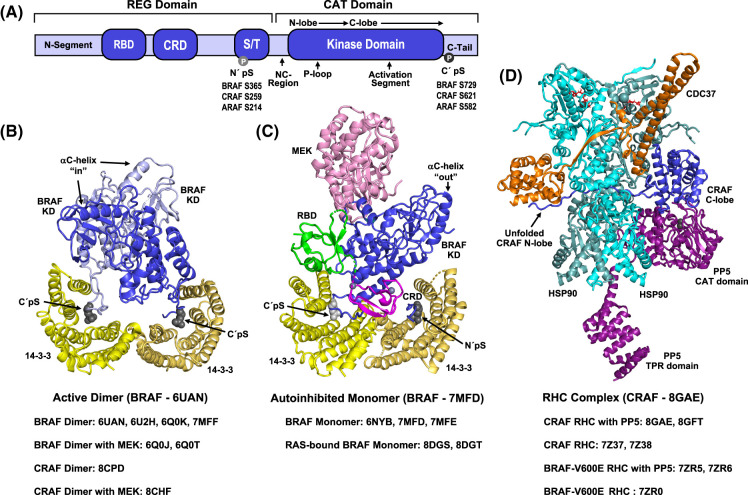
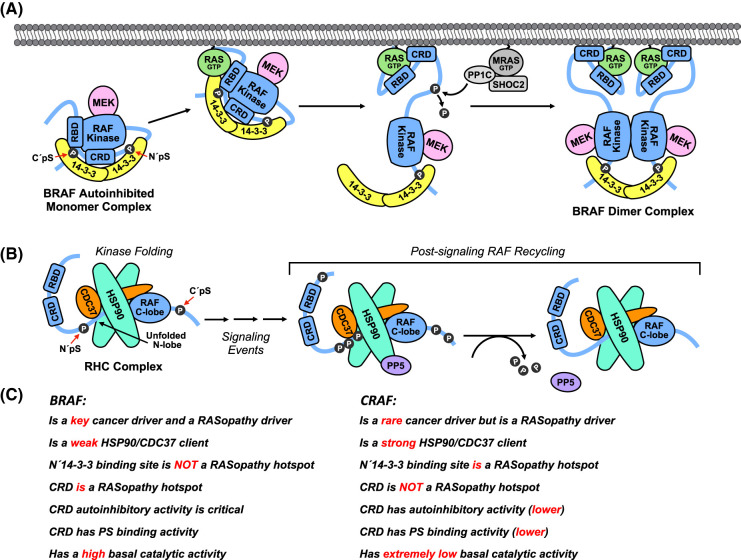
The RAF kinases are required for signal transduction through the RAS-RAF-MEK-ERK pathway, and their activity is frequently up-regulated in human cancer and the RASopathy developmental syndromes. Due to their complex activation process, developing drugs that effectively target RAF function has been a challenging endeavor, highlighting the need for a more detailed understanding of RAF regulation. This review will focus on recent structural and biochemical studies that have provided 'snapshots' into the RAF regulatory cycle, revealing structures of the autoinhibited BRAF monomer, active BRAF and CRAF homodimers, as well as HSP90/CDC37 chaperone complexes containing CRAF or BRAFV600E. In addition, we will describe the insights obtained regarding how BRAF transitions between its regulatory states and examine the roles that various BRAF domains and 14-3-3 dimers play in both maintaining BRAF as an autoinhibited monomer and in facilitating its transition to an active dimer. We will also address the function of the HSP90/CDC37 chaperone complex in stabilizing the protein levels of CRAF and certain oncogenic BRAF mutants, and in serving as a platform for RAF dephosphorylation mediated by the PP5 protein phosphatase. Finally, we will discuss the regulatory differences observed between BRAF and CRAF and how these differences impact the function of BRAF and CRAF as drivers of human disease.
Keywords: HSP90/CDC37 chaperone complexes; RAF kinases; RAS pathway; RASopathies; cancer.
© 2024 The Author(s).
Conflict of interest statement
The authors declare that there are no competing interests associated with the manuscript.
Figures
Similar articles
-
Oncogenic non-V600 mutations evade the regulatory machinery of RAF including the Cdc37/Hsp90 chaperone and the 14-3-3 scaffold.Theranostics. 2025 Jan 6;15(5):2035-2051. doi: 10.7150/thno.103958. eCollection 2025. Theranostics. 2025. PMID: 39897565 Free PMC article.
-
ARAF acts as a scaffold to stabilize BRAF:CRAF heterodimers.Oncogene. 2013 Jun 27;32(26):3207-12. doi: 10.1038/onc.2012.330. Epub 2012 Aug 27. Oncogene. 2013. PMID: 22926515
-
RAF inhibitors transactivate RAF dimers and ERK signalling in cells with wild-type BRAF.Nature. 2010 Mar 18;464(7287):427-30. doi: 10.1038/nature08902. Nature. 2010. PMID: 20179705 Free PMC article.
-
Signaling from RAS to RAF: The Molecules and Their Mechanisms.Annu Rev Biochem. 2024 Aug;93(1):289-316. doi: 10.1146/annurev-biochem-052521-040754. Epub 2024 Jul 2. Annu Rev Biochem. 2024. PMID: 38316136 Review.
-
The RAF cysteine-rich domain: Structure, function, and role in disease.Adv Cancer Res. 2024;164:69-91. doi: 10.1016/bs.acr.2024.04.009. Epub 2024 May 14. Adv Cancer Res. 2024. PMID: 39306370 Review.
Cited by
-
Ensemble-Based Binding Free Energy Profiling and Network Analysis of the KRAS Interactions with DARPin Proteins Targeting Distinct Binding Sites: Revealing Molecular Determinants and Universal Architecture of Regulatory Hotspots and Allosteric Binding.Biomolecules. 2025 Jun 5;15(6):819. doi: 10.3390/biom15060819. Biomolecules. 2025. PMID: 40563459 Free PMC article.
-
Allostery in Disease: Anticancer Drugs, Pockets, and the Tumor Heterogeneity Challenge.J Mol Biol. 2025 Feb 26:169050. doi: 10.1016/j.jmb.2025.169050. Online ahead of print. J Mol Biol. 2025. PMID: 40021049 Review.
-
A diaryl urea derivative, SMCl inhibits cell proliferation through the RAS/RAF/MEK/ERK pathway in hepatocellular carcinoma.Front Pharmacol. 2025 Jul 10;16:1605515. doi: 10.3389/fphar.2025.1605515. eCollection 2025. Front Pharmacol. 2025. PMID: 40709085 Free PMC article.
References
Publication types
MeSH terms
Substances
Grants and funding
LinkOut - more resources
Full Text Sources
Research Materials
Miscellaneous
