


Explaining why increases in generic use outpace decreases in brand name medicine use in multisource markets and the role of regulation
- PMID: 38696520
- PMCID: PMC11065256
- DOI: 10.1371/journal.pone.0301716
Explaining why increases in generic use outpace decreases in brand name medicine use in multisource markets and the role of regulation
Abstract
Background: Healthcare systems worldwide face escalating pharmaceutical expenditures despite interventions targeting pricing and generic substitution. Existing studies often overlook unwarranted volume increases in multisource markets due to differential physician perceptions of brand name and generics.
Objective: This study aims to explain the outpacing of generic medicine use over brand name use in multisource markets and assess the regulatory role, specifically examining the impact of reference pricing on volume and intensity increases.
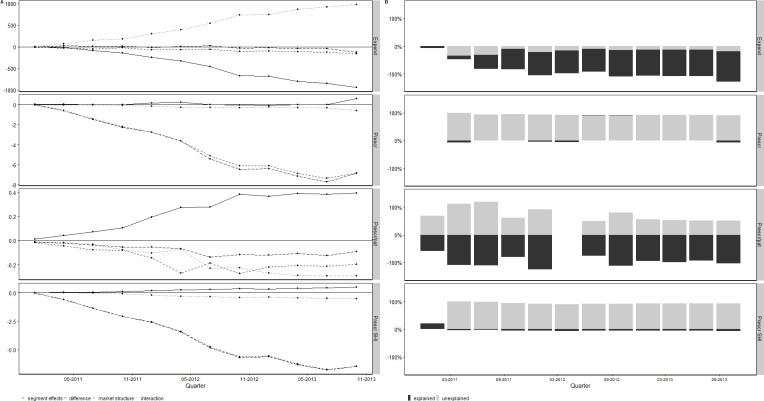
Methods: Analyzing German multisource prescription medicine markets from 2011 to 2014, we evaluate regulatory mechanisms and explore whether brand name and generic medicines constitute separate market segments. Using an Oaxaca-Blinder decomposition approach, we divide the differential in brand name versus generic medicine use rates into market structure and unobserved segment effects.
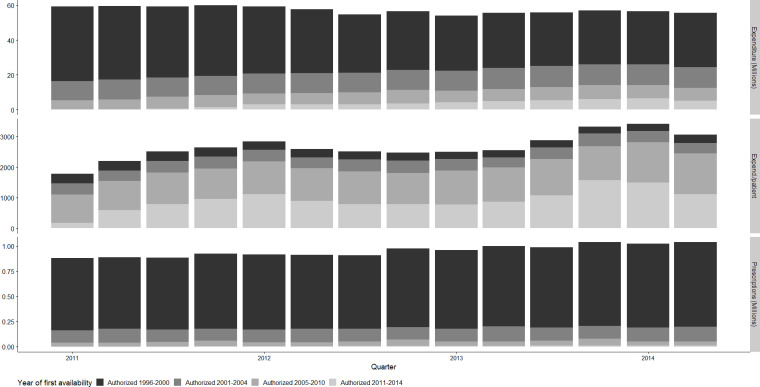
Results: Generic use rates surpass same-market brand name substitution by 3.87 prescriptions per physician and medicine, on average. Reference pricing mitigated volume increase, treatment intensity and expenditure. Disparities in quantity and expenditure dynamics between brand name and generic segments are partially explained by market structure and segment effects.
Conclusion: Generic medicine use effectively reduces expenditures but contributes to increased net prescription rates. Reference pricing may control medicine use, but divergent physician perceptions of brand name and generics, revealed by identified segment effects, call for nuanced policy interventions.
Copyright: © 2024 Blankart, Vandoros. This is an open access article distributed under the terms of the Creative Commons Attribution License, which permits unrestricted use, distribution, and reproduction in any medium, provided the original author and source are credited.
Conflict of interest statement
The authors have declared that no competing interests exist.
Figures
Similar articles
-
Reference pricing with endogenous generic entry.J Health Econ. 2016 Dec;50:312-329. doi: 10.1016/j.jhealeco.2016.04.003. Epub 2016 Jun 8. J Health Econ. 2016. PMID: 27350294
-
Pricing dynamics of anti-seizure medications in the U.S.Seizure. 2024 Nov;122:26-33. doi: 10.1016/j.seizure.2024.09.010. Epub 2024 Sep 18. Seizure. 2024. PMID: 39306895
-
Choice of generic versus brand-name antidepressants in a regulated prescription drug market: evidence from Taiwan.J Ment Health Policy Econ. 2014 Dec;17(4):163-72. J Ment Health Policy Econ. 2014. PMID: 25599280
-
Impact of European pharmaceutical price regulation on generic price competition: a review.Pharmacoeconomics. 2010;28(8):649-63. doi: 10.2165/11535360-000000000-00000. Pharmacoeconomics. 2010. PMID: 20515079 Review.
-
Generics versus brand-named drugs for glaucoma: the debate continues.Rom J Ophthalmol. 2020 Jul-Sep;64(3):239-244. Rom J Ophthalmol. 2020. PMID: 33367157 Free PMC article. Review.
Cited by
-
The 10 top prescribed medicines in Germany from 1985 to 2022: pharmacological analysis.Naunyn Schmiedebergs Arch Pharmacol. 2025 May;398(5):5509-5529. doi: 10.1007/s00210-024-03615-5. Epub 2024 Nov 21. Naunyn Schmiedebergs Arch Pharmacol. 2025. PMID: 39570381 Free PMC article.
References
-
- Schwabe U, Paffrath D. Arzneiverordnungen 2015 im Überblick. In: Schwabe U, Paffrath D, editors. Arzneiverordnungs-Report 2016. Berlin, Heidelberg: Springer Berlin Heidelberg; 2016. pp. 3–27. doi: 10.1007/978-3-662-50351-5_1 - DOI
-
- Godman B, Shrank W, Andersen M, Berg C, Bishop I, Burkhardt T, et al.. Comparing policies to enhance prescribing efficiency in Europe through increasing generic utilization: changes seen and global implications. Expert Review of Pharmacoeconomics & Outcomes Research. 2010;10: 707–722. doi: 10.1586/erp.10.72 - DOI - PubMed
Publication types
MeSH terms
Substances
LinkOut - more resources
Full Text Sources
Miscellaneous
