Disparities in Access to Deep Brain Stimulation for Parkinson's Disease and Proposed Interventions: A Literature Review
- PMID: 38697047
- PMCID: PMC11152032
- DOI: 10.1159/000538748
Disparities in Access to Deep Brain Stimulation for Parkinson's Disease and Proposed Interventions: A Literature Review
Abstract
Background: Deep brain stimulation (DBS) is an effective therapy for Parkinson's disease (PD), but disparities exist in access to DBS along gender, racial, and socioeconomic lines.
Summary: Women are underrepresented in clinical trials and less likely to undergo DBS compared to their male counterparts. Racial and ethnic minorities are also less likely to undergo DBS procedures, even when controlling for disease severity and other demographic factors. These disparities can have significant impacts on patients' access to care, quality of life, and ability to manage their debilitating movement disorders.
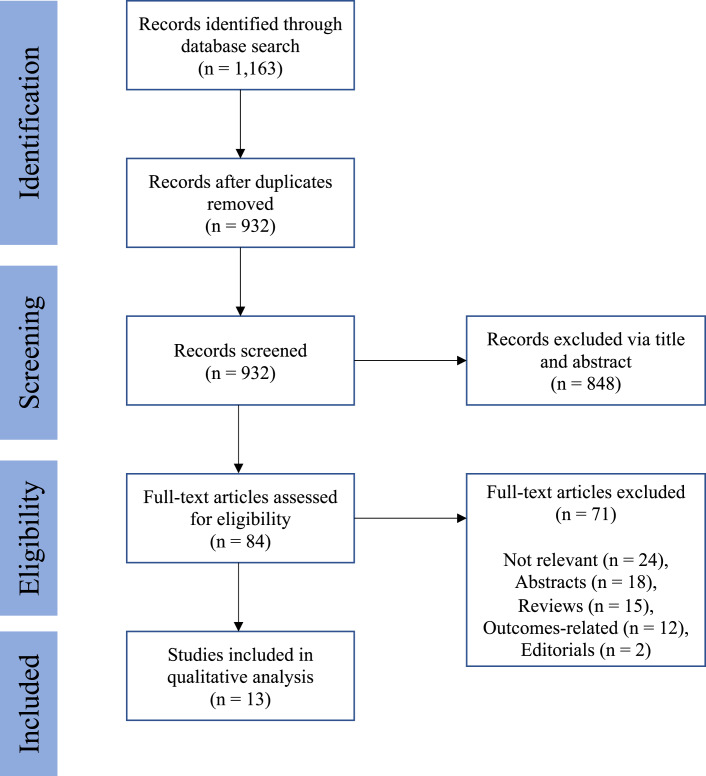
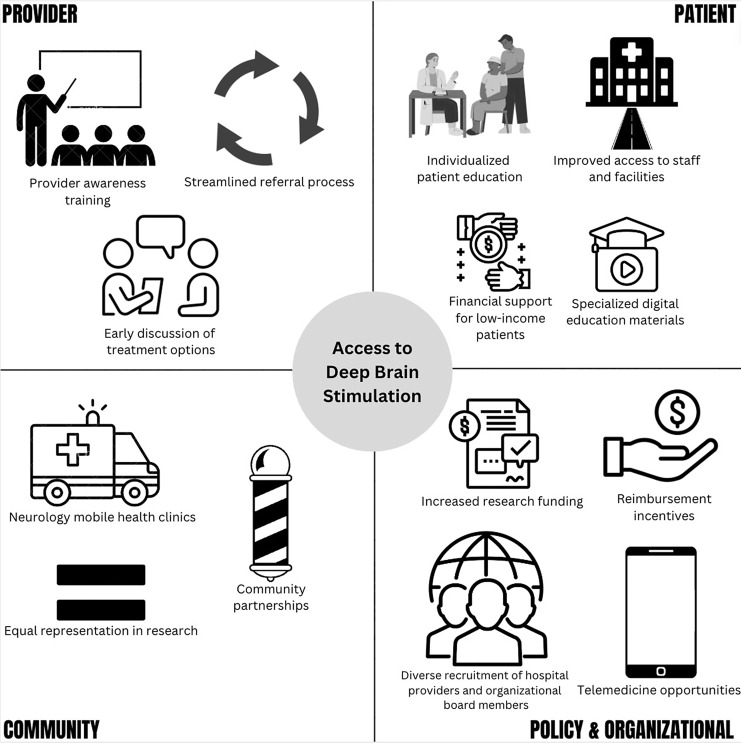
Key messages: Addressing these disparities requires increasing patient awareness and education, minimizing barriers to equitable access, and implementing diversity and inclusion initiatives within the healthcare system. In this systematic review, we first review literature discussing gender, racial, and socioeconomic disparities in DBS access and then propose several patient, provider, community, and national-level interventions to improve DBS access for all populations.
Keywords: Deep brain stimulation; Disparities; Ethnicity; Gender; Minorities; Socioeconomic status.
© 2024 The Author(s). Published by S. Karger AG, Basel.
Conflict of interest statement
The authors have no conflicts of interest to declare.
Figures
Similar articles
-
Deep brain stimulation access in 2025: geographic, gender, racial, and socioeconomic disparities re-examined.Curr Opin Neurol. 2025 Aug 1;38(4):330-336. doi: 10.1097/WCO.0000000000001377. Epub 2025 May 16. Curr Opin Neurol. 2025. PMID: 40377666 Review.
-
Healthcare disparities in deep brain stimulation access and utilization: a systematic review.J Neurosurg. 2023 Oct 6;140(4):1137-1147. doi: 10.3171/2023.7.JNS23277. Print 2024 Apr 1. J Neurosurg. 2023. PMID: 38240596
-
Motor outcomes in unilateral, bilateral rapid, and bilateral delayed staging deep brain stimulation for Parkinson's disease.J Parkinsons Dis. 2024 Nov;14(8):1614-1622. doi: 10.1177/1877718X241296014. Epub 2024 Dec 8. J Parkinsons Dis. 2024. PMID: 39957194
-
How lived experiences of illness trajectories, burdens of treatment, and social inequalities shape service user and caregiver participation in health and social care: a theory-informed qualitative evidence synthesis.Health Soc Care Deliv Res. 2025 Jun;13(24):1-120. doi: 10.3310/HGTQ8159. Health Soc Care Deliv Res. 2025. PMID: 40548558
-
Modulation of Cerebellar Oscillations with Subthalamic Stimulation in Patients with Parkinson's Disease.J Parkinsons Dis. 2024;14(7):1417-1426. doi: 10.3233/JPD-240065. J Parkinsons Dis. 2024. PMID: 39331106 Free PMC article.
Cited by
-
Brittle Response to Levodopa as a Marker of Parkinson's Disease Phenotype Characterized by Heavy Motor and Non Motor Burden.J Mov Disord. 2025 Jan;18(1):31-34. doi: 10.14802/jmd.24182. Epub 2024 Nov 11. J Mov Disord. 2025. PMID: 39522514 Free PMC article. No abstract available.
-
The future of Parkinson's care: a need to expand access.Front Neurol. 2025 Jun 19;16:1622283. doi: 10.3389/fneur.2025.1622283. eCollection 2025. Front Neurol. 2025. PMID: 40612798 Free PMC article.
References
-
- Hitti FL, Ramayya AG, McShane BJ, Yang AI, Vaughan KA, Baltuch GH. Long-term outcomes following deep brain stimulation for Parkinson’s disease. J Neurosurg. 2019:1–6. - PubMed
-
- Defer GL, Widner H, Marié RM, Rémy P, Levivier M. Core assessment program for surgical interventional therapies in Parkinson’s disease (CAPSIT-PD). Mov Disord. 1999;14(4):572–84. - PubMed
Publication types
MeSH terms
LinkOut - more resources
Full Text Sources
Medical