


Association of child marriage and nutritional status of mothers and their under-five children in Bangladesh: a cross-sectional study with a nationally representative sample
- PMID: 38698456
- PMCID: PMC11067235
- DOI: 10.1186/s40795-024-00874-6
Association of child marriage and nutritional status of mothers and their under-five children in Bangladesh: a cross-sectional study with a nationally representative sample
Abstract
Background: Child marriage remains an important problem around the world with young mothers and their under-five children often experiencing under-nutrition. The problem is rarely studied in the Bangladeshi population. This paper was designed to identify the association between child marriage and nutritional status of mothers and their under-five children in Bangladesh.
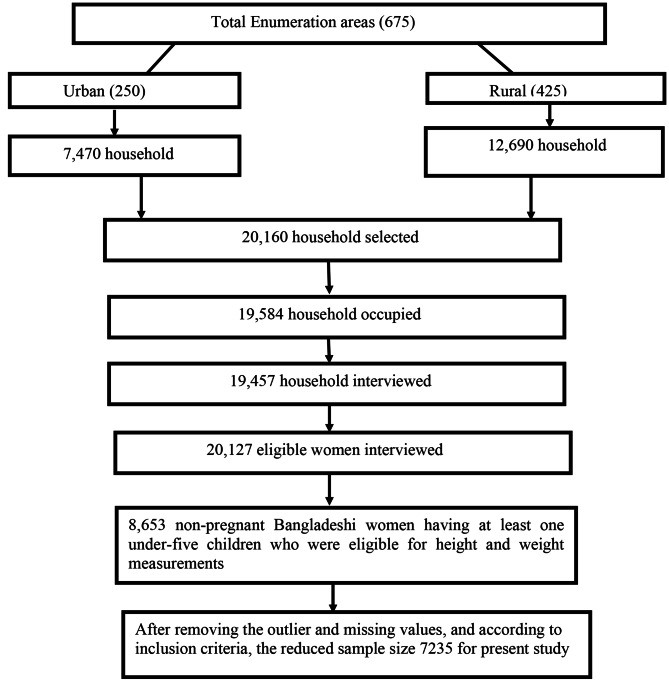
Methods: Nationally representative secondary data was used for this study, data was extracted from the Bangladesh Demographic and Health Survey (BDHS) 2017-18. The sample consisted of 7235 mothers aged 18-49 years and their under-five children. The mothers were classified into two classes according to their age at first marriage: (i) child marriage (marriage at < 18 years) and (ii) not child marriage (marriage at ≥ 18 years). The nutritional status of mothers was measured by body mass index (BMI), and under-five children's nutritional status was measured by (i) height-for-age (z-score) (stunting), (ii) weight-for-age (z-score) (underweight), and (iii) weight-for-height (z-score) (wasting). The chi-square test and two-level logistic regression model were used for data analysis using SPSS software (IBM version 20).
Results: The prevalence of child marriage among Bangladeshi women was 69.0%, with the mean and median of age at the first marriage being 16.57 ± 2.83 years and 16 years, respectively. Of the mothers, 15.2% suffered from chronic energy deficiency (underweight), and 72.8% were married at < 18 years. The prevalence of stunting, underweight, and wasting among under-five children in Bangladesh was 31.0%, 22.0%, and 8.5%, respectively. Compared to women married at the age of ≥ 18 years, there was a significantly higher likelihood of chronic energy deficiency among women who married at < 18 years [Adjusted OR = 1.27, CI: 1.05-1.82; p < 0.05]. Under-five children of mothers married before the age of 18 were more likely to have stunting [Adjusted OR = 1.201, CI: 1.11-1.72; p < 0.05], wasting [Adjusted OR = 1.519, CI: 1.15-2.00; p < 0.01], and underweight [Adjusted OR = 1.150, CI: 1.09-1.82; p < 0.05] compared to children of mothers who married at age ≥ 18.
Conclusion: The rate of child marriage among Bangladeshi women is high, and it is significantly associated with malnutrition among mothers and their under-five children. The Bangladesh government can use the findings of this study to prevent and reduce child marriage and malnutrition among mothers and their under-five children to achieve sustainable development goals by 2030.
Keywords: Mothers’ child marriage; Nutritional status; Two-level logistic regression model; Under-five children.
© 2024. The Author(s).
Conflict of interest statement
The authors declare no competing interests.
Figures
References
-
- UNICEF. 2023. Child Marriage. https://www.unicef.org/rosa/what-we-do/child-protection/child-marriage
-
- UNICEF. 2019. Child marriage. https://www.unicef.org/rosa/what-we-do/child-protection/child-marriage
-
- UNICEF. 2016. Global Program to End Child Marriage. https://www.unicef.org/protection/unfpa-unicef-global-programme-end-chil...
-
- UNICEF. 2022. Child marriage. https://www.unicef.org/protection/child-marriage
LinkOut - more resources
Full Text Sources