


Exploring causal correlations between inflammatory cytokines and knee osteoarthritis: a two-sample Mendelian randomization
- PMID: 38698846
- PMCID: PMC11063282
- DOI: 10.3389/fimmu.2024.1362012
Exploring causal correlations between inflammatory cytokines and knee osteoarthritis: a two-sample Mendelian randomization
Abstract
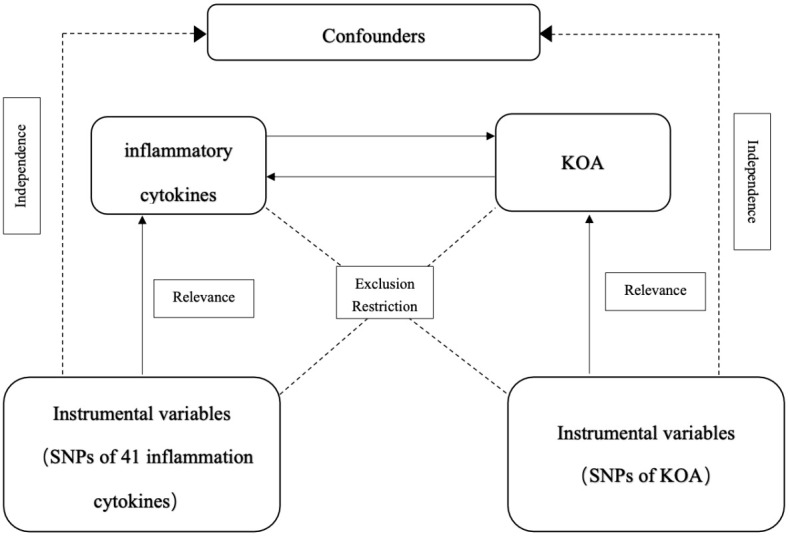
Objectives: Knee osteoarthritis (KOA) and certain inflammatory cytokines (such as interleukin 1 [IL-1] and tumor necrosis factor alpha [TNF-a]) are related; however, the causal relationship remains unclear. Here, we aimed to assess the causal relationship between 41 inflammatory cytokines and KOA using Mendelian randomization (MR).
Methods: Two-sample bidirectional MR was performed using genetic variation data for 41 inflammatory cytokines that were obtained from European Genome-Wide Association Study (GWAS) data (n=8293). KOA-related genetic association data were also obtained from European GWAS data (n=40,3124). Inverse variance weighting (IVW), MR, heterogeneity, sensitivity, and multiple validation analyses were performed.
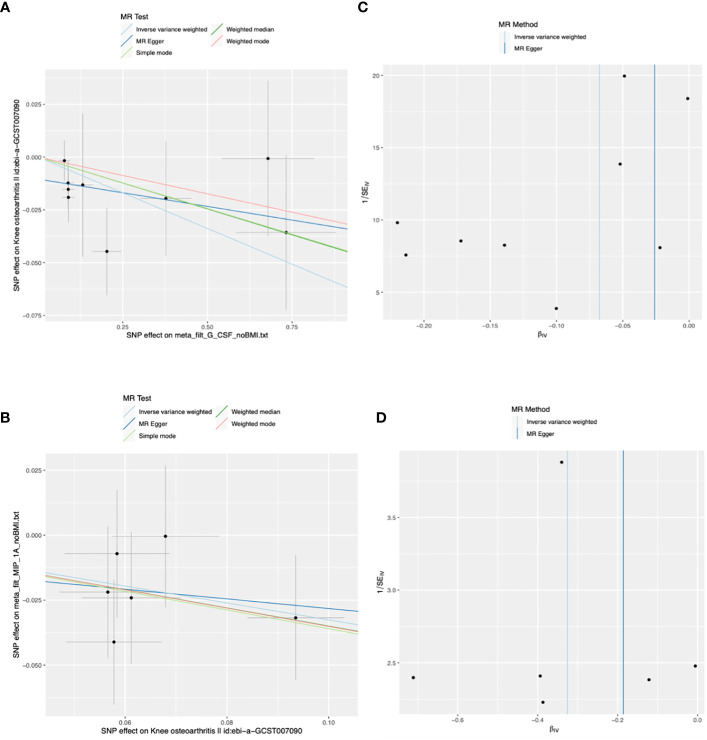
Results: Granulocyte colony-stimulating factor (G-CSF) or colony-stimulating factor 3 (CSF-3) levels were negatively associated with the risk of developing KOA (OR: 0.93, 95%CI:0.89-0.99, P=0.015). Additionally, macrophage inflammatory protein-1 alpha (MIP-1A/CCL3) was a consequence of KOA (OR: 0.72, 95%CI:0.54-0.97, P=0.032). No causal relationship was evident between other inflammatory cytokines and KOA development.
Conclusion: This study suggests that certain inflammatory cytokines may be associated with KOA etiology. G-CSF exerts an upstream influence on KOA development, whereas MIP-1A (CCL-3) acts as a downstream factor.
Keywords: Mendelian randomization; disease etiology; genetic variation; inflammatory cytokines; knee osteoarthritis.
Copyright © 2024 Zhang, Li and Qiu.
Conflict of interest statement
The authors declare that the research was conducted in the absence of any commercial or financial relationships that could be construed as a potential conflict of interest.
Figures
References
-
- The Joint Surgery Branch of the Chinese Orthopaedic Association, The Subspecialty Group of Osteoarthritis, Chinese Association of Orthopaedic Surgeons, The National Clinical Research Center for Geriatric Disorders (Xiangya Hospital), Editorial Office of Chinese Journal of Orthopaedics. Wang K, Lei G, et al. . Chinese guidelines for the diagnosis and treatment of osteoarthritis (2021 edition). Chin J Orthopedics. (2021) 18):1291–314. doi: 10.3760/cma.j.cn121113-20210624-00424 - DOI
Publication types
MeSH terms
Substances
LinkOut - more resources
Full Text Sources
Research Materials
