


Resource-based trade-offs and the adaptive significance of seasonal plasticity in butterfly wing melanism
- PMID: 38698928
- PMCID: PMC11063730
- DOI: 10.1002/ece3.11309
Resource-based trade-offs and the adaptive significance of seasonal plasticity in butterfly wing melanism
Abstract
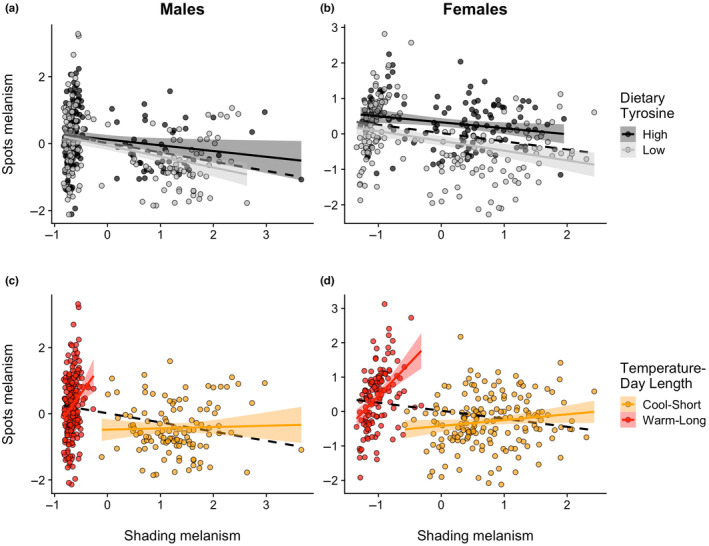
Phenotypic plasticity is the ability of an organism to alter its phenotype in response to environmental cues. This can be adaptive if the cues are reliable predictors of impending conditions and the alterations enhance the organism's ability to capitalize on those conditions. However, since traits do not exist in isolation but as part of larger interdependent systems of traits (phenotypic integration), trade-offs between correlated plastic traits can make phenotypic plasticity non- or maladaptive. We examine this problem in the seasonally plastic wing melanism of a pierid (Order Lepidoptera, Family Pieridae) butterfly, Pieris rapae L. Several wing pattern traits are more melanized in colder than in warmer seasons, resulting in effective thermoregulation through solar absorption. However, other wing pattern traits, the spots, are less melanized during colder seasons than in warmer seasons. Although spot plasticity may be adaptive, reduced melanism of these spots could also be explained by resource-based trade-offs. Theory predicts that traits involved in resource-based trade-offs will be positively correlated when variation among individuals in resource acquisition is greater than variation among individuals in resource allocation strategies, and negatively correlated when variation in allocation is greater than variation in acquisition. Using data from both field studies and laboratory studies that manipulate dietary tyrosine, a melanin precursor, we show that when allocation to thermoregulatory melanism (ventral hindwing, and basal dorsal fore- and hindwing "shading") varies substantially this trait is negatively correlated with spot melanism. However, when there is less variation in allocation to thermoregulatory melanism we find these traits to be positively correlated; these findings are consistent with the resource-based trade-off hypothesis, which may provide a non- or maladaptive hypothesis to explain spot plasticity. We also show that increased dietary tyrosine results in increased spot melanism under some conditions, supporting the more general idea that melanism may involve resource-based costs.
Keywords: butterflies; melanism; phenotypic integration; phenotypic plasticity; seasonal polyphenism; trade‐offs; tyrosine.
© 2024 The Authors. Ecology and Evolution published by John Wiley & Sons Ltd.
Conflict of interest statement
The authors declare no conflicts of interest.
Figures
Similar articles
-
The adaptive significance of alpine melanism in the butterfly Parnassius phoebus F. (Lepidoptera: Papilionidae).Oecologia. 1986 Sep;70(2):205-213. doi: 10.1007/BF00379241. Oecologia. 1986. PMID: 28311659
-
Multiple cues influence multiple traits in the phenotypically plastic melanization of the cabbage white butterfly.Oecologia. 2016 Nov;182(3):691-701. doi: 10.1007/s00442-016-3694-2. Epub 2016 Jul 14. Oecologia. 2016. PMID: 27417547
-
VIABILITY SELECTION ON SEASONALLY POLYPHENIC TRAITS: WING MELANIN PATTERN IN WESTERN WHITE BUTTERFLIES.Evolution. 1995 Oct;49(5):932-941. doi: 10.1111/j.1558-5646.1995.tb02328.x. Evolution. 1995. PMID: 28564878
-
Differences in resource acquisition, not allocation, mediate the relationship between behaviour and fitness: a systematic review and meta-analysis.Biol Rev Camb Philos Soc. 2022 Apr;97(2):708-731. doi: 10.1111/brv.12819. Epub 2021 Dec 2. Biol Rev Camb Philos Soc. 2022. PMID: 34859575
-
Seasonal plasticity: how do butterfly wing pattern traits evolve environmental responsiveness?Curr Opin Genet Dev. 2021 Aug;69:82-87. doi: 10.1016/j.gde.2021.02.009. Epub 2021 Mar 17. Curr Opin Genet Dev. 2021. PMID: 33740694 Review.
References
-
- Atterholt, A. L. , & Solensky, M. J. (2010). Effects of larval rearing density and food availability on adult size and coloration in monarch butterflies (Lepidoptera: Nymphalidae). Journal of Entomological Science, 45(4), 366–377. 10.18474/0749-8004-45.4.366 - DOI
-
- Breheny, P. , & Burchett, W. (2017). Visualization of regression models using visreg. The R Journal, 9(2), 56. 10.32614/RJ-2017-046 - DOI
-
- Britton, S. , & Davidowitz, G. (2022). The effect of diet on melanin pigmentation in animals. Functional Ecology, 37, 14209. 10.1111/1365-2435.14209 - DOI
LinkOut - more resources
Full Text Sources
