


This is a preprint.
A computational account of the development and evolution of psychotic symptoms
- PMID: 38699166
- PMCID: PMC11065053
A computational account of the development and evolution of psychotic symptoms
Update in
-
A Computational Account of the Development and Evolution of Psychotic Symptoms.Biol Psychiatry. 2025 Jan 15;97(2):117-127. doi: 10.1016/j.biopsych.2024.08.026. Epub 2024 Sep 10. Biol Psychiatry. 2025. PMID: 39260466 Free PMC article. Review.
Abstract
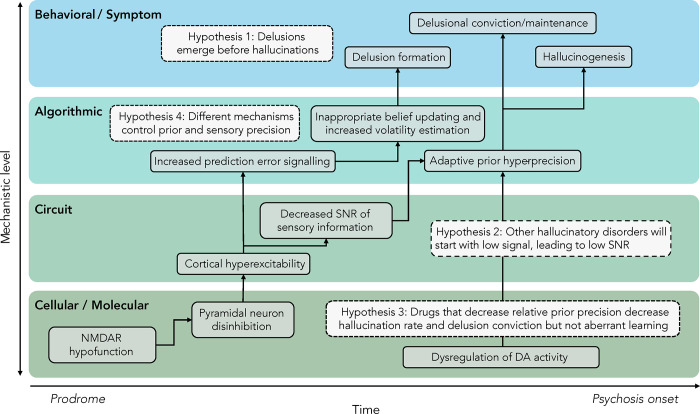
The mechanisms of psychotic symptoms like hallucinations and delusions are often investigated in fully-formed illness, well after symptoms emerge. These investigations have yielded key insights, but are not well-positioned to reveal the dynamic forces underlying symptom formation itself. Understanding symptom development over time would allow us to identify steps in the pathophysiological process leading to psychosis, shifting the focus of psychiatric intervention from symptom alleviation to prevention. We propose a model for understanding the emergence of psychotic symptoms within the context of an adaptive, developing neural system. We will make the case for a pathophysiological process that begins with cortical hyperexcitability and bottom-up noise transmission, which engenders inappropriate belief formation via aberrant prediction error signaling. We will argue that this bottom-up noise drives learning about the (im)precision of new incoming sensory information because of diminished signal-to-noise ratio, causing an adaptive relative over-reliance on prior beliefs. This over-reliance on priors predisposes to hallucinations and covaries with hallucination severity. An over-reliance on priors may also lead to increased conviction in the beliefs generated by bottom-up noise and drive movement toward conversion to psychosis. We will identify predictions of our model at each stage, examine evidence to support or refute those predictions, and propose experiments that could falsify or help select between alternative elements of the overall model. Nesting computational abnormalities within longitudinal development allows us to account for hidden dynamics among the mechanisms driving symptom formation and to view established symptomatology as a point of equilibrium among competing biological forces.
Keywords: computational psychiatry; hallucinations; nosology; perception; psychosis.
Figures
References
-
- Thorwald J (1957): The Century of the Surgeon. New York: : Pantheon.
-
- Bliss M (2011): The Making of Modern Medicine: Turning Points in the Treatment of Disease. University of Chicago Press.
-
- Browning M, Carter C, Chatham C, den Ouden H, Gillan C, Baker J, et al. (n.d.): Realizing the Clinical Potential of Computational Psychiatry: Report from the Banbury Center Meeting, February 2019. - PubMed
Publication types
Grants and funding
LinkOut - more resources
Full Text Sources