Self-perceived oral health and orofacial appearance in older adults - an 18-year follow-up study in Karlskrona, Sweden
- PMID: 38700368
- PMCID: PMC11302640
- DOI: 10.2340/aos.v83.40574
Self-perceived oral health and orofacial appearance in older adults - an 18-year follow-up study in Karlskrona, Sweden
Abstract
Objectives: To analyze whether self-perceived oral health and orofacial appearance change with increasing age.
Methods: This longitudinal study is based on data from a questionnaire used in the Swedish National Study of Aging and Care. The sample comprises 160 participants 60 years of age at baseline 2001-2003. The same participants were re-examined at 66-, 72-, and 78 years of age. To analyze whether perceptions of oral health and orofacial appearance changed with increasing age, Cochran's Q test was conducted. Statistical significance was considered at p ≤ 0.05, and the calculated value Q must be equal to or greater than the critical chi-square value (Q ≥ 7.82). Significance values have been adjusted for the Bonferroni correction for multiple tests.
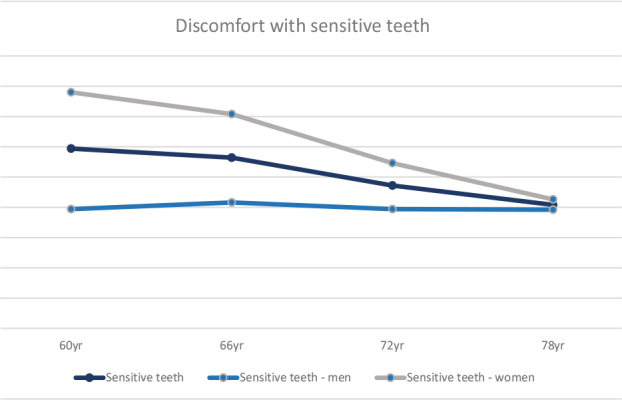
Results: Self-perceived mouth dryness, both day (Q = 7.94) and night (Q = 23.41), increased over the 18-year follow-up. When divided by gender, significant differences were only seen for mouth dryness at nighttime. A decrease in sensitive teeth was perceived with increasing age, and an increase in self-perceived satisfaction with dental appearance, and a decrease in self-perceived problems with dental gaps between the ages of 60 and 78. These changes were, however, not statistically significant. Men experienced a higher proportion of discomfort with discolored teeth at age 78 than at 60 (Q = 9.09).
Conclusions: Self-perceived oral health and orofacial appearance were relatively stable, with few changes over an 18-year follow-up.
Conflict of interest statement
The authors report there are no competing interests to declare.
Figures
References
-
- Griffin SO, Jones JA, Brunson D, et al. Burden of oral disease among older adults and implications for public health priorities. Am J Public Health. 2012;102(3):411–418. https://doi.org/2105/AJPH.2011.300362. - PMC - PubMed
-
- United Nations, Department of Economics and Social Affairs, Population Division . World population ageing 2019. New York, NY: UN; 2020.
-
- Statistics Sweden . After age 60 – a description of older people in Sweden 2020. [Internet]. [cited 20-08-2022]. Available from: http://www.statistikdatabasen.scb.se/
MeSH terms
LinkOut - more resources
Full Text Sources
Medical