


Predicting clinically significant prostate cancer following suspicious mpMRI: analyses from a high-volume center
- PMID: 38702557
- PMCID: PMC11068682
- DOI: 10.1007/s00345-024-04991-6
Predicting clinically significant prostate cancer following suspicious mpMRI: analyses from a high-volume center
Abstract
Purpose: mpMRI is routinely used to stratify the risk of clinically significant prostate cancer (csPCa) in men with elevated PSA values before biopsy. This study aimed to calculate a multivariable risk model incorporating standard risk factors and mpMRI findings for predicting csPCa on subsequent prostate biopsy.
Methods: Data from 677 patients undergoing mpMRI ultrasound fusion biopsy of the prostate at the TUM University Hospital tertiary urological center between 2019 and 2023 were analyzed. Patient age at biopsy (67 (median); 33-88 (range) (years)), PSA (7.2; 0.3-439 (ng/ml)), prostate volume (45; 10-300 (ml)), PSA density (0.15; 0.01-8.4), PI-RADS (V.2.0 protocol) score of index lesion (92.2% ≥3), prior negative biopsy (12.9%), suspicious digital rectal examination (31.2%), biopsy cores taken (12; 2-22), and pathological biopsy outcome were analyzed with multivariable logistic regression for independent associations with the detection of csPCa defined as ISUP ≥ 3 (n = 212 (35.2%)) and ISUP ≥ 2 (n = 459 (67.8%) performed on 603 patients with complete information.
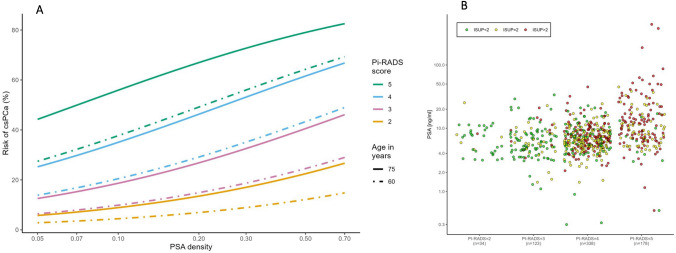
Results: Older age (OR: 1.64 for a 10-year increase; p < 0.001), higher PSA density (OR: 1.60 for a doubling; p < 0.001), higher PI-RADS score of the index lesion (OR: 2.35 for an increase of 1; p < 0.001), and a prior negative biopsy (OR: 0.43; p = 0.01) were associated with csPCa.
Conclusion: mpMRI findings are the dominant predictor for csPCa on follow-up prostate biopsy. However, PSA density, age, and prior negative biopsy history are independent predictors. They must be considered when discussing the individual risk for csPCa following suspicious mpMRI and may help facilitate the further diagnostical approach.
Keywords: Prostate biopsy; Prostate cancer; Risk models; mpMRI.
© 2024. The Author(s).
Conflict of interest statement
Matthias Jahnen, Tanja Hausler, Donna P. Ankerst, Michael W. Kattan, Kathleen Herkommer, Valentin H. Meissner, Jürgen E. Gschwend have nothing to disclose.
Figures
Comment in
-
Letter to the editor for the article "Predicting clinically significant prostate cancer following suspicious mpMRI: analyses from a high-volume center".World J Urol. 2024 Jun 7;42(1):371. doi: 10.1007/s00345-024-05087-x. World J Urol. 2024. PMID: 38847884 No abstract available.
Similar articles
-
Prostate cancer detection rate in men undergoing transperineal template-guided saturation and targeted prostate biopsy.Prostate. 2022 Feb;82(3):388-396. doi: 10.1002/pros.24286. Epub 2021 Dec 16. Prostate. 2022. PMID: 34914121 Free PMC article.
-
Association Between Prostate Imaging Reporting and Data System (PI-RADS) Score for the Index Lesion and Multifocal, Clinically Significant Prostate Cancer.Eur Urol Oncol. 2018 May;1(1):29-36. doi: 10.1016/j.euo.2018.01.002. Epub 2018 May 15. Eur Urol Oncol. 2018. PMID: 31100225
-
PI-RADS in Predicting csPCa: A Comparison Between Academic and Nonacademic Centers.Prostate. 2025 Mar;85(4):337-343. doi: 10.1002/pros.24832. Epub 2024 Dec 22. Prostate. 2025. PMID: 39709541 Free PMC article.
-
What to expect from a non-suspicious prostate MRI? A review.Prog Urol. 2020 Dec;30(16):986-999. doi: 10.1016/j.purol.2020.09.012. Epub 2020 Sep 29. Prog Urol. 2020. PMID: 33008718 Review.
-
Utility of PSA free-to-total ratio for clinically significant prostate cancer in men with a PSA level of <4 ng/mL.BJU Int. 2025 Apr;135(4):550-556. doi: 10.1111/bju.16597. Epub 2024 Nov 28. BJU Int. 2025. PMID: 39607059 Review.
Cited by
-
Letter to the editor for the article "Predicting clinically significant prostate cancer following suspicious mpMRI: analyses from a high-volume center".World J Urol. 2024 Jun 7;42(1):371. doi: 10.1007/s00345-024-05087-x. World J Urol. 2024. PMID: 38847884 No abstract available.
-
Oncological outcomes after radical prostatectomy of localized prostate cancer: stratified by magnetic resonance imaging and risk classification.Prostate Int. 2024 Dec;12(4):224-230. doi: 10.1016/j.prnil.2024.09.003. Epub 2024 Sep 28. Prostate Int. 2024. PMID: 39735202 Free PMC article.
-
Does bladder outflow obstruction obfuscate the traditional clinical factors that are used to assess the risk of prostate cancer at rapid-access diagnostic clinics?BJUI Compass. 2024 Dec 20;6(1):e478. doi: 10.1002/bco2.478. eCollection 2025 Jan. BJUI Compass. 2024. PMID: 39877561 Free PMC article.
References
-
- Arnsrud Godtman R et al (2015) Opportunistic testing versus organized prostate-specific antigen screening: outcome after 18 years in the Göteborg randomized population-based prostate cancer screening trial. Eur Urol 68(3):354–360 - PubMed
-
- Boesen L (2017) Multiparametric MRI in detection and staging of prostate cancer. Dan Med J 64(2):B5327 - PubMed
-
- EAU Guidelines. Edn. presented at the EAU Annual Congress Milan 2023
-
- Monni F et al (2017) Magnetic resonance imaging in prostate cancer detection and management: a systematic review. Minerva Urol Nefrol 69(6):567–578 - PubMed
MeSH terms
LinkOut - more resources
Full Text Sources
Medical
Research Materials
Miscellaneous
