. 2024 May 4;32(2):7.
doi: 10.1007/s10577-024-09752-0.

Meiotic drive against chromosome fusions in butterfly hybrids

Affiliations

Meiotic drive against chromosome fusions in butterfly hybrids

Jesper Boman et al. Chromosome Res. .

Abstract

Species frequently differ in the number and structure of chromosomes they harbor, but individuals that are heterozygous for chromosomal rearrangements may suffer from reduced fitness. Chromosomal rearrangements like fissions and fusions can hence serve as a mechanism for speciation between incipient lineages, but their evolution poses a paradox. How can rearrangements get fixed between populations if heterozygotes have reduced fitness? One solution is that this process predominantly occurs in small and isolated populations, where genetic drift can override natural selection. However, fixation is also more likely if a novel rearrangement is favored by a transmission bias, such as meiotic drive. Here, we investigate chromosomal transmission distortion in hybrids between two wood white (Leptidea sinapis) butterfly populations with extensive karyotype differences. Using data from two different crossing experiments, we uncover that there is a transmission bias favoring the ancestral chromosomal state for derived fusions, a result that shows that chromosome fusions actually can fix in populations despite being counteracted by meiotic drive. This means that meiotic drive not only can promote runaway chromosome number evolution and speciation, but also that it can be a conservative force acting against karyotypic change and the evolution of reproductive isolation. Based on our results, we suggest a mechanistic model for why chromosome fusion mutations may be opposed by meiotic drive and discuss factors contributing to karyotype evolution in Lepidoptera.

Keywords: Leptidea; Chromosomal rearrangements; Karyotype; Lepidoptera; Meiotic drive; Speciation.


Conflict of interest statement

The authors declare no competing interests.

Figures
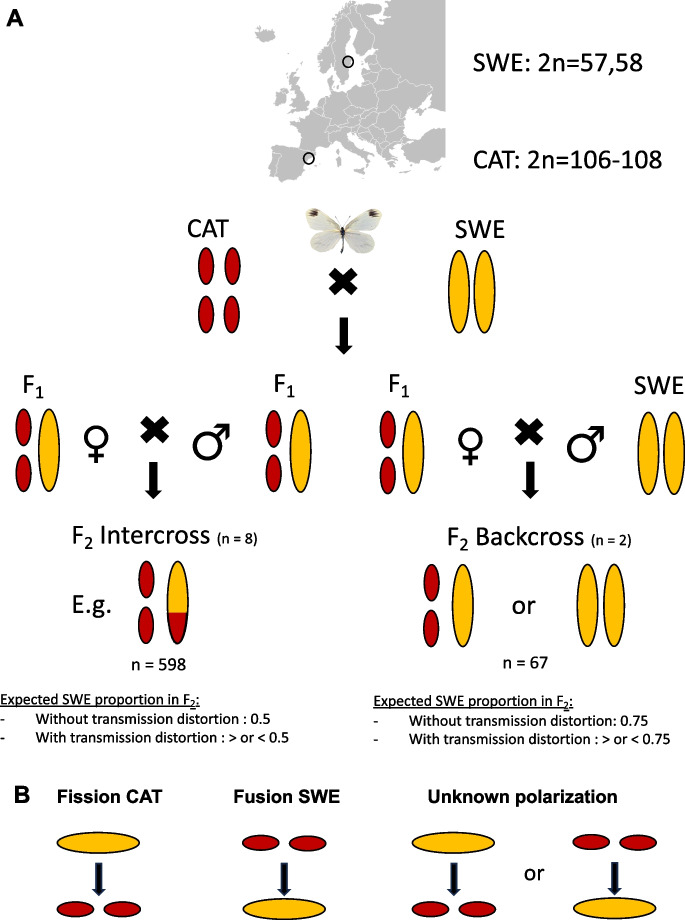
Fig. 1
Fig. 1
Overview of the experimental crosses and rearrangement types. A Crossing design and expected allele frequencies in the presence or absence of transmission distortion. Ovals represent an example of a homologous pair of autosomes. Note that female meiosis in butterflies is achiasmatic, i.e. recombination occurs only in males. Consequently, the F2 backcross is a test for female-specific transmission distortion. B Schematics of different rearrangement types
Fig. 2
Fig. 2
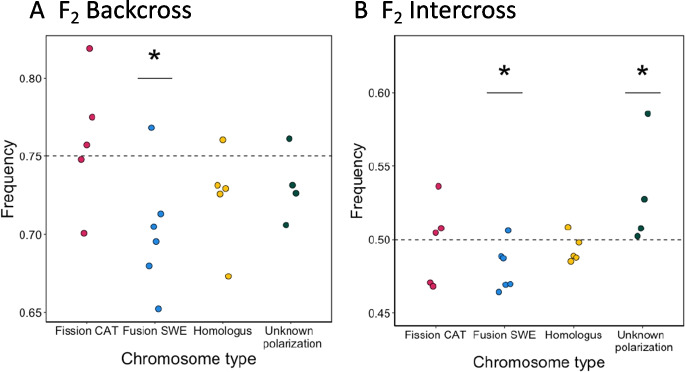
Average allele frequencies at marker loci for each chromosome (or pair of chromosomes for fission/fusion heterozygotes) in the F2 backcross (A) and the F2 intercross (B). In all cases, SWE has the fused state and CAT has the unfused state, except for the homologous (not rearranged) chromosomes, where both populations have the same state. Dashed lines represent the expected allele frequency in each experiment. Points have dodged positions along the x-axis to enhance visibility. Rearrangement types with significant transmission distortion are marked with an asterisk (*)
Fig. 3
Fig. 3
A model that describes how meiotic drive can occur during female achiasmatic meiosis of holokinetic organisms. A A fusion could either form through joining of ends (i) or e.g. non-homologous recombination, leading to loss of heterochromatic sequence at the fusion point (ii). B The loss of heterochromatic sequence could lead to a weaker holocentromere, which results in biased segregation during meiosis, either towards the polar body pole or the egg pole. If this mechanism explains the observed transmission distortion, the probability that the stronger holocentromere (in this case the unfused chromosomes) ends up in the mature oocyte is higher
Fig. 4
Fig. 4
Haploid chromosome number count of 2,499 lepidopteran taxa from 869 genera. The data is from de Vos et al. (2020) with information from two Leptidea species added (Lukhtanov et al. 2011). The dashed vertical line indicates n = 31, the most common karyotype within Lepidoptera. Genera are sorted by maximum chromosome number with points representing individual taxa. Groups i-iv represents rough categories of chromosome number distribution per genus. Group i consists of a few genera with great within-genus variation in chromosome number and many members with n > 31. Group ii genera have high max counts and great within-genus variation, but the distribution is generally skewed towards low numbers. Group iii genera show low within-genus variation, and most members have n = 31. Group iv genera have a max count < 31 with many genera having species with lower numbers. Points have slightly dodged position to enhance visualization of overlapping points. Haploid chromosome numbers are plotted on a log2 scale

References

    1. Akera T, Chmátal L, Trimm E, et al. Spindle asymmetry drives non-Mendelian chromosome segregation. Science. 2017;358:668–672. doi: 10.1126/science.aan0092. - DOI - PMC - PubMed
    1. Akera T, Trimm E, Lampson MA. Molecular strategies of meiotic cheating by selfish centromeres. Cell. 2019;178:1132–1144.e10. doi: 10.1016/j.cell.2019.07.001. - DOI - PMC - PubMed
    1. Augustijnen H, Bätscher L, Cesanek M et al (2023) A macroevolutionary role for chromosomal fusion and fission in Erebia butterflies. bioRxiv 2023.01.16.524200. 10.1101/2023.01.16.524200 - PMC - PubMed
    1. Banno Y, Yutaka K, Koga K, Doira H (1995) Postreductional meiosis revealed in males of the mutant with chromosomal aberration “T (23;25) Nd” of the silkworm Bombyx mori. J Sericultural Sci Japan 64:410–414. 10.11416/kontyushigen1930.64.410
    1. Beuret H (1957) Studien über den Formenkreis Lysandra coridon-hispana-albicans. Ein Beitrag zum Problem der Artbildung (Lep. Lycaenidae) (2. Studie). Mitteilungen der Entomol. Gesellschaft Basel 7 N.F:37–60

Publication types

LinkOut - more resources