. 2024 May 4;15(1):3767.
doi: 10.1038/s41467-024-48086-7.

Giant organelle vesicles to uncover intracellular membrane mechanics and plasticity

Affiliations

Giant organelle vesicles to uncover intracellular membrane mechanics and plasticity

Alexandre Santinho et al. Nat Commun. .

Erratum in

Abstract

Tools for accessing and studying organelles remain underdeveloped. Here, we present a method by which giant organelle vesicles (GOVs) are generated by submitting cells to a hypotonic medium followed by plasma membrane breakage. By this means, GOVs ranging from 3 to over 10 µm become available for micromanipulation. GOVs are made from organelles such as the endoplasmic reticulum, endosomes, lysosomes and mitochondria, or in contact with one another such as giant mitochondria-associated ER membrane vesicles. We measure the mechanical properties of each organelle-derived GOV and find that they have distinct properties. In GOVs procured from Cos7 cells, for example, bending rigidities tend to increase from the endoplasmic reticulum to the plasma membrane. We also found that the mechanical properties of giant endoplasmic reticulum vesicles (GERVs) vary depending on their interactions with other organelles or the metabolic state of the cell. Lastly, we demonstrate GERVs' biochemical activity through their capacity to synthesize triglycerides and assemble lipid droplets. These findings underscore the potential of GOVs as valuable tools for studying the biophysics and biology of organelles.


Conflict of interest statement

No competing interest for M.O., M.C., and J.L.S. A.S. and A.R.T. are founders of Oria Bioscience.

Figures

Fig. 1
Fig. 1. Giant Organelles Vesicles’ recovery and characterization.
a Organelles reshaping into Giant Organelle Vesicles (GOVs) by a hypotonic medium. Confocal microscopy image of a swollen COS-7 cell expressing RFP-KDEL and Mfn2-YFP. Confocal microscopy snapshot showing the release of Giant ER Vesicles (GERVs) after plasma membrane rupture with a micropipette. Cells expressing GPI_2x-mCherry (Plasma Membrane) and RFP-KDEL(ER). Scale bar: 5 µm. Schematic representation of a collected GOV. b Diameter distribution of Giant Organelle Vesicles (GOV). Only vesicles larger than 0.75 µm were measured. For each organelle type, quantifications were done from two independent experiments with hundreds of vesicles quantified from tens of cells. c Confocal images of collected Giant Organelle Vesicles (GOVs) labeled with fluorescence markers representing different organelles. Scale bars: 5 µm. d Plot illustrating the initial membrane tension of Giant Organelle Vesicles (GOVs). For organelles from left to right, the number of independent experiments is N = 6; N = 4; N = 8; N = 4; N = 4; N = 4. Each experimental data point corresponds to a GOV from a different cell and the mean of each replicate is shown. Nested One-Way ANOVA - Multiple comparisons: Fisher LSD test. Individual P values are shown. e The lysis tension of Giant Organelle Vesicles (GOVs). For organelles from left to right, the number of independent experiments is N = 4; N = 4; N = 7; N = 4; N = 4; N = 4. Each experimental data point corresponds to a GOV from a different cell and the mean for each replicate is shown. Nested One-Way ANOVA - Multiple comparisons: Fisher LSD test. Individual P values are shown. f The apparent area expansion modulus of Giant Organelle Vesicles (GOVs). For organelles from left to right, the number of independent experiments is N = 4; N = 6; N = 3; N = 3. Each experimental data point corresponds to a GOV from a different cell and the mean for each replicate is shown. Nested One-Way ANOVA - Multiple comparisons: Fisher LSD test. Individual P values are shown. g Bending rigidity of Giant Organelle Vesicles (GOVs). For organelles from left to right, the number of independent experiments is N = 2; N = 3; N = 3; N = 3, N = 3. Each experimental data point corresponds to a GOV from a different cell and the mean for each replicate is shown. Nested One-Way ANOVA - Multiple comparison: Fisher LSD test. Individual P values are shown.
Fig. 2
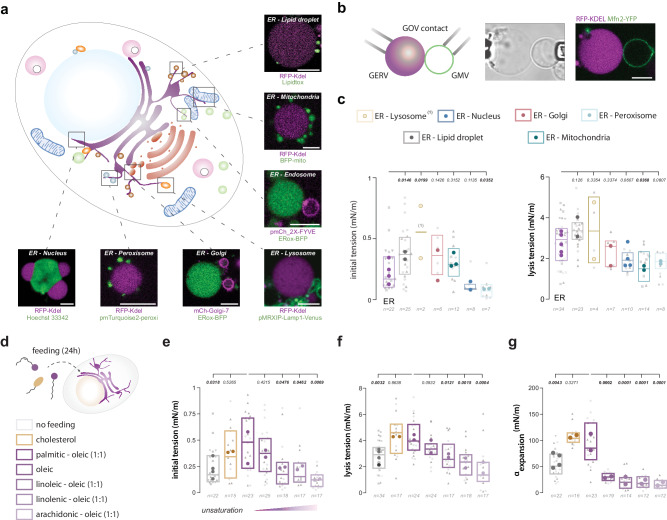
Fig. 2. Biophysical properties of the ER at its contact regions and under different metabolic conditions.
a Diagram representing a cell with highlighted contacts between the ER and other organelles. Each contact is depicted with a confocal microscopy snapshot showing a Giant ER Vesicle (GERV) in contact with other GOVs. Fluorescent proteins used to visualize the contacts are indicated below each snapshot. b Left: Diagram of an isolated contact between a Giant ER Vesicle (GERV) and a Giant Mitochondrial Vesicle (GMV). Right: Confocal microscopy snapshot of a KDEL-based GERV in contact with an Mfn2-based GMV after isolation. The GOVs were immobilized using micropipettes for imaging. Scale bar: 5 µm. c Left: Initial membrane tensions of KDEL-based Giant ER Vesicles (GERVs) in contact with other Giant Organelle Vesicles (GOVs). From left to right, the number of independent experiments is N = 2; N = 2; N = 3; N = 3, N = 2; N = 2; N = 4. Right: Lysis tensions of KDEL-based GERVs in contact with other GOVs. From left to right, the number of independent experiments is N = 2; N = 2; N = 2; N = 2, N = 4; N = 2; N = 4. Only RFP-KDEL and ERox-BFP luminal markers were used to identify the ER. Nested One-Way ANOVA - Multiple comparisons: Fisher LSD test. Individual P values are shown. d Feeding conditions. Following transfection, the cells were loaded with a combination of fatty acids or cholesterol. e Initial membrane tensions of Giant ER Vesicles (GERVs) after 24 hours of feeding. From left to right, the number of independent experiments is N = 4; N = 2; N = 2; N = 2, N = 2; N = 2; N = 2. Each experimental data point corresponds to a Giant Organelle Vesicle (GOV) from a different cell and the mean for each replicate is shown. Nested One-Way ANOVA - Multiple comparisons: Fisher LSD test. Individual P-values are shown. f Lysis tensions of Giant ER Vesicles (GERVs) after 24 hours of feeding. From left to right, the number of independent experiments is N = 4; N = 2; N = 2; N = 2, N = 2; N = 2; N = 2. Each experimental data point corresponds to a GOV from a different cell and the mean for each replicate is shown. Nested One-Way ANOVA - Multiple comparisons: Fisher LSD test. Individual P values are shown. Refer to the Statistical Tests section or Source Data for statistical analysis and data sets. g Apparent area expansion modulus of Giant ER Vesicles (GERVs). From left to right, the number of independent experiments is N = 4; N = 2; N = 2; N = 2, N = 2; N = 2; N = 2. Each experimental data point corresponds to a GOV from a different cell and the mean for each replicate is shown. Nested One-Way ANOVA - Multiple comparisons: Fisher LSD test. Individual P-values are shown. Refer to the Statistical Tests section or Source Data for statistical analysis and data sets.
Fig. 3
Fig. 3. GERVs are functional and accommodate the synthesis of neutral lipids.
a Left: Confocal microscopy of a Giant ER Vesicle (GERV) supplied with Oleoyl-CoenzymeA (OCoA) supplemented with NBD-Oleoyl-Coenzyme A (NBD-OCoA) and diacylglycerol (DAG) at 37 °C for 1 hour. Fluorescence signals at the bottom of the snapshots correspond to the profile indicated by the dotted line on the confocal images. Scale bar: 5 µm. Right: Plot showing the increase in NBD-OCoA fluorescence signal in the GERV membrane during the OCoA supply experiment. For both conditions, the number of independent experiments is N = 2, and the mean for each replicate is shown. A nested t-test was applied with a two-tailed P-value. P-values are shown. b Left: Confocal images of both KDEL-based Giant ER Vesicle (GERV) and GPI-based Giant Plasma Membrane Vesicle (GPMV) after 1 hour of OCoA supply. Fluorescence signals at the right corner correspond to the profile indicated by the dotted line on the confocal images. Scale bars: 5 µm. c Plot displaying the NBD-OCoA fluorescence signal in Giant ER Vesicles (GERVs) and Giant Plasma Membrane Vesicles (GPMVs) after 1 hour of feeding. For both conditions, the number of independent experiments is N = 2, and the mean for each replicate is shown. A nested t-test was applied with a two-tailed P-value. P-values are shown. Refer to Statistical Tests section or Source Data for statistical analysis and data sets. d Giant ER Vesicles were isolated from COS-7 cells overexpressing the DGAT1-EGFP and Sec61ß-mCherry. e Left: Isolated Giant Organelle Vesicles were subjected to the feeding conditions as in a. LipidTox was added to reveal membrane hydrophobicity. Fluorescence signals at the bottom of the images correspond to the profile indicated by the dotted line on the confocal images. Scale bars: 5 µm. Right: Box plot showing the LipidTox fluorescence in vesicles positive (+) or negative (--) for DGAT1. The number of independent experiments is N = 2 and a nested t-test was applied (f). Thin layer chromatography snapshot revealed by UV light indicates TAG-NBD synthesis in GERVs after 1 hour of feeding. Left: Commercial sample of OCoA-NBA; middle: Lipid extract from GERVs fed with OCoA-NBD and DAG; right: Commercial sample of TAG-NBD.
Fig. 4
Fig. 4. GERVs reproduce lipid droplet assembly.
a Confocal microscopy image of harvested Giant ER Vesicles (GERVs) containing seipin/KDEL. Scale bar: 5 µm. b Confocal microscopy image of an isolated Giant ER Vesicles (GERVs) containing seipin/sec61ß. Scale bar: 5 µm. c Top left: Representation of a membrane nanotube extracted from a seipin/sec61ß-based Giant ER Vesicle. The rectangular shape indicates the region of interest. Top right: Confocal microscopy snapshot of the nanotube extracted from the seipin/sec61ß-based Giant ER Vesicle. Middle: Fluorescence profiles drawn perpendicular to the membrane at both the flat region and the nanotube. Intensities are in arbitrary units. d Confocal microscopy image of a nanotube extracted from a seipin-based Giant ER Vesicle (GERV), which was fed with OCoA and DAG five minutes before tube pulling. LipidTox fluorescence is used to report for the hydrophobicity of the membrane. e The membrane tube shown in (d) is pulled to increase its curvature, resulting in the appearance of seipin puncta in the tube. Some seipin puncta are LipidTox-condensed (indicated by yellow arrows), while others lack LipidTox puncta (red arrows). All LipidTox puncta colocalize with seipin spots. Fluorescence profiles indicate the enrichment of LipidTox at specific spots in the tube. f Left: fraction of nucleation events observed following tube pulling and curvature increase. A nucleation event is considered when at least one LipidTox-positive puncta forms in the tubule. Right: Frequency of nascent LipidTox-positive nascent LD colocalization with a seipin cluster. g Confocal microscopy snapshots of a nanotube extracted from a Giant ER Vesicle (GERV) with seipin overexpressed, and supplied with the substrates for triacylglycerol synthesis. LipidTox fluorescence is monitored to visualize the formation of a nascent LD in the tube. Arrows indicate the appearance of an oil lens (t = 10 s) after the formation of a seipin spot (t = 5 s).

References

    1. Voeltz GK, Prinz WA, Shibata Y, Rist JM, Rapoport TA. A class of membrane proteins shaping the tubular endoplasmic reticulum. Cell. 2006;124:573–586. doi: 10.1016/j.cell.2005.11.047. - DOI - PubMed
    1. Wu H, Carvalho P, Voeltz GK. Here, there, and everywhere: The importance of ER membrane contact sites. Science. 2018;361:eaan5835. doi: 10.1126/science.aan5835. - DOI - PMC - PubMed
    1. Valm AM, et al. Applying systems-level spectral imaging and analysis to reveal the organelle interactome. Nature. 2017;546:162–167. doi: 10.1038/nature22369. - DOI - PMC - PubMed
    1. Prinz WA, Toulmay A, Balla T. The functional universe of membrane contact sites. Nat. Rev. Mol. Cell Biol. 2020;21:7–24. doi: 10.1038/s41580-019-0180-9. - DOI - PMC - PubMed
    1. Dimova, R. & Marques, C. The Giant Vesicle Book. (CRC Press, 2019).

Publication types