


Effect of extracorporeal shockwave therapy for rotator cuff tendinopathy: a systematic review and meta-analysis
- PMID: 38704572
- PMCID: PMC11069249
- DOI: 10.1186/s12891-024-07445-7
Effect of extracorporeal shockwave therapy for rotator cuff tendinopathy: a systematic review and meta-analysis
Erratum in
-
Correction: Effect of extracorporeal shockwave therapy for rotator cuff tendinopathy: a systematic review and meta‑analysis.BMC Musculoskelet Disord. 2024 Jul 1;25(1):507. doi: 10.1186/s12891-024-07611-x. BMC Musculoskelet Disord. 2024. PMID: 38951805 Free PMC article. No abstract available.
Abstract
Background: Rotator cuff tendinopathy (RCT) is a widespread musculoskeletal disorder and a primary cause of shoulder pain and limited function. The resulting pain and limited functionality have a detrimental impact on the overall quality of life. The purpose of this study was to perform a systematic review of the effects of extracorporeal shock wave therapy (ESWT) for RCT.
Methods: The literature search was conducted on the following databases from inception to February 20, 2024: PubMed, Web of Science, the Cochrane Library, Scopus, MEDLINE, EMBASE, EBSCO, and China National Knowledge Infrastructure (CNKI) were checked to identify the potential studies exploring the effect of ESWT for the treatment of Rotator cuff tendinopathy (Calcification or non-calcification), control group for sham, other treatments (including placebo), without restriction of date, language. Two researchers independently screened literature, extracted data, evaluated the risk of bias in the included studies, and performed meta-analysis using RevMan 5.3 software.
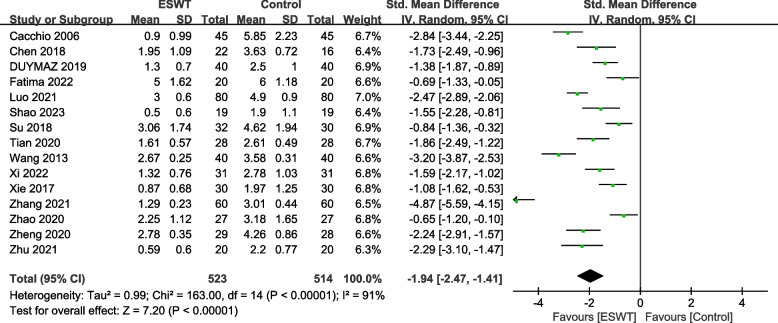
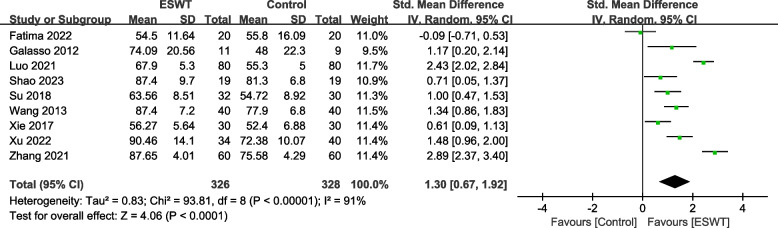
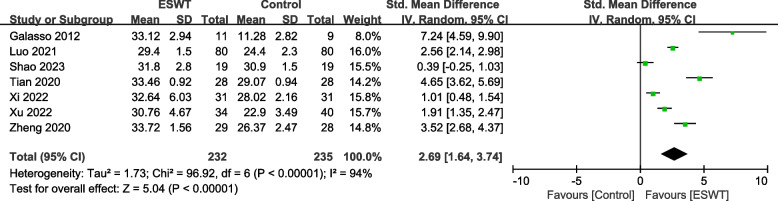
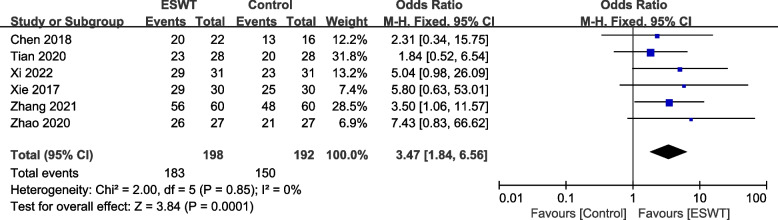
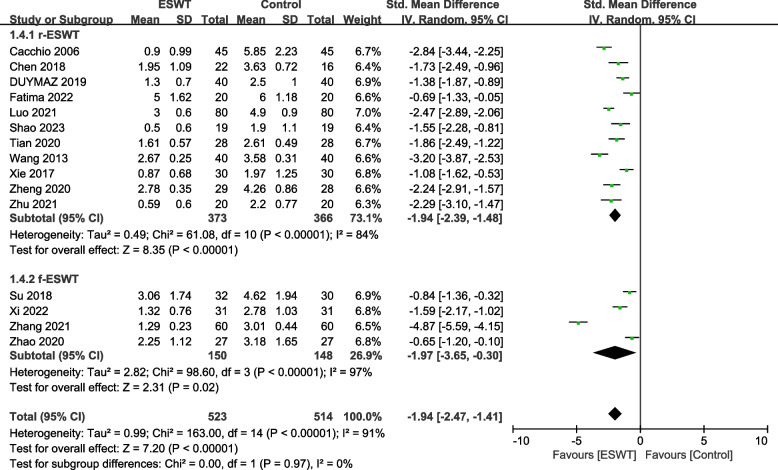
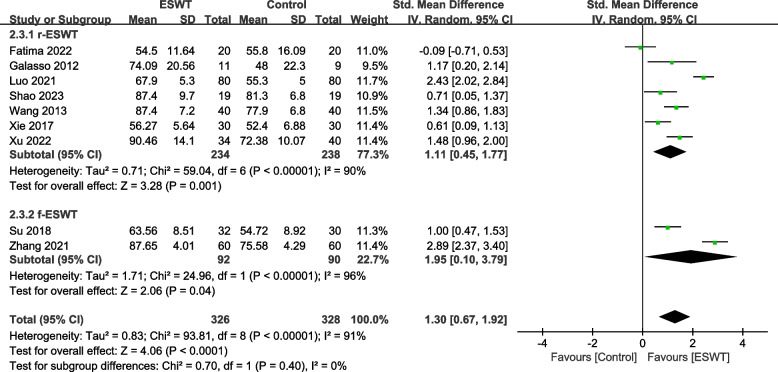
Results: A total of 16 RCTs with 1093 patients were included. The results showed that compared with the control group, ESWT for pain score Visual Analogue Scale/Score (VAS) (SMD = -1.95, 95% CI -2.47, -1.41, P < 0.00001), function score Constant-Murley score (CMS) (SMD = 1.30, 95% CI 0.67, 1.92, P < 0.00001), University of California Los Angeles score (UCLA) (SMD = 2.69, 95% CI 1.64, 3.74, P < 0.00001), American Shoulder and Elbow Surgeons form (ASES) (SMD = 1.29, 95% CI 0.93, 1.65, P < 0.00001), Range of motion (ROM) External rotation (SMD = 1.00, 95% CI 0.29, 1.72, P = 0.02), Total effective rate (TER) (OR = 3.64, 95% CI 1.85, 7.14, P = 0.0002), the differences in the above results were statistically significant. But ROM-Abduction (SMD = 0.72, 95% CI -0.22, 1.66, P = 0.13), the difference was not statistically significant.
Conclusion: Currently limited evidence suggests that, compared with the control group, ESWT can provide better pain relief, functional recovery, and maintenance of function in patients with RCT.
Keywords: ESWT; Extracorporeal shock wave therapy; Meta-analysis; Rehabilitation; Rotator cuff tendinopathy; Shoulder.
© 2024. The Author(s).
Conflict of interest statement
The authors declare no competing interests.
Figures






References
-
- Rhee SM, Youn SM, Park JH, Rhee YG. Biceps Rerouting for Semirigid Large-to-Massive Rotator Cuff Tears. Arthroscopy : the journal of arthroscopic & related surgery : official publication of the Arthroscopy Association of North America and the International Arthroscopy Association. 2021;37(9):2769–2779. - PubMed
-
- Fitzpatrick LA, Atinga A, White L, Henry PDG, Probyn L. Rotator Cuff Injury and Repair. Seminars in musculoskeletal radiology. 2022;26(5):585–596. - PubMed
-
- Rodriguez-Santiago B, Castillo B, Baerga-Varela L, Micheo WF. Rehabilitation Management of Rotator Cuff Injuries in the Master Athlete. Curr Sports Med Rep. 2019;18(9):330–337. - PubMed
Publication types
MeSH terms
Grants and funding
- 2023-A033/Key Laboratory of Sports Medicine of Sichuan Province and the Key Laboratory of The General Administration of Sport of China
- 82172423/National Natural Science Foundation of China
- 7222209/Bejing Municipal Natural Science Foundation
- BYSYDL2022006/Clinical queue construction project of Peking University Third Hospital
LinkOut - more resources
Full Text Sources
Medical
