. 2024 Apr;6(4):269-282.
doi: 10.1038/s42254-024-00707-2. Epub 2024 Mar 19.

Mechanical properties of human tumour tissues and their implications for cancer development

Affiliations

Mechanical properties of human tumour tissues and their implications for cancer development

Andrew Massey et al. Nat Rev Phys. 2024 Apr.

Abstract

The mechanical properties of cells and tissues help determine their architecture, composition and function. Alterations to these properties are associated with many diseases, including cancer. Tensional, compressive, adhesive, elastic and viscous properties of individual cells and multicellular tissues are mostly regulated by reorganization of the actomyosin and microtubule cytoskeletons and extracellular glycocalyx, which in turn drive many pathophysiological processes, including cancer progression. This Review provides an in-depth collection of quantitative data on diverse mechanical properties of living human cancer cells and tissues. Additionally, the implications of mechanical property changes for cancer development are discussed. An increased knowledge of the mechanical properties of the tumour microenvironment, as collected using biomechanical approaches capable of multi-timescale and multiparametric analyses, will provide a better understanding of the complex mechanical determinants of cancer organization and progression. This information can lead to a further understanding of resistance mechanisms to chemotherapies and immunotherapies and the metastatic cascade.


Conflict of interest statement

Competing interests The authors declare no competing interests.

Figures

Fig. 1 |
Fig. 1 |. Remodelling of the cellular cytoskeleton and extracellular matrix is a hallmark of cancer-causing alterations in cellular mechanical properties.
One hallmark of cancer is the excessive remodelling of the extracellular matrix (ECM) (part a). The marked increase in fibrillar collagen deposition within tumour microenvironments during cancer progression is often observed by alignment of the collagen fibrils and their decoration with adhesive ECM proteins including laminin and fibronectin. These ECM collagenous changes are known to markedly increase tumour tissue stiffness. Another critical hallmark of cancer centres around remodelling the cancer cell cytoskeleton. Progressive alterations to the cytoskeletal organization of cancer cells have been associated with numerous modified mechanical properties, including: cellular stiffness (denoted by k; part b), viscosity (denoted by η; part c), tension (denoted by T; part d), cell–ECM adhesion (denoted by Fadh; part e), hydrostatic and osmotic pressures (indicated by the pressure exerted by a fluid against the membrane; denoted by P; part f) and shear stress (indicated by changes in resistance to an applied shear force; denoted by Fs; part g). The individual schematics show the typically observed changes in mechanical behaviour of cells before and after transformation. An arrow with F (denoting force vector) indicates the direction of the applied external mechanical force. Most cancers demonstrate a substantial decrease in all mentioned mechanical properties, except for cellular adhesion. Note that there are conflicting reports showing different trends in mechanical properties for some cancer types and we briefly discuss some of them in this Review. Figure courtesy of Alan Hoofring.
Fig. 2 |
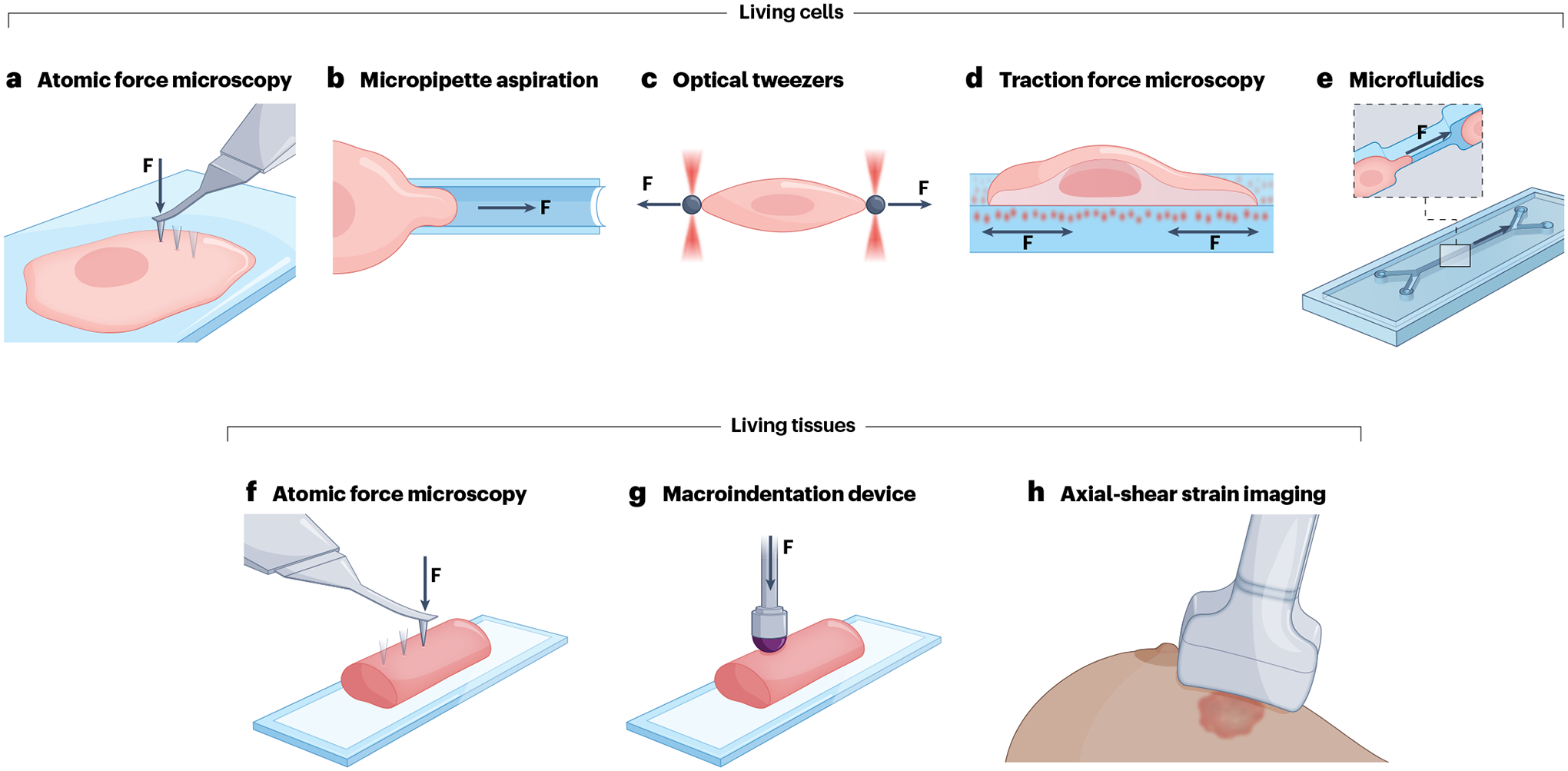
Fig. 2 |. Mechanobiological techniques used to quantify multiple mechanical properties at both the cellular and tissue levels.
a, Atomic force microscopy has been used to determine the following mechanical properties: Young’s modulus, viscoelastic properties (storage and loss moduli), adhesion force, surface tension and hydrostatic pressure of single cancer cells. F denotes applied force. b, Micropipette aspiration has been used to measure the stiffness, viscoelastic properties (stiffness and viscosity), surface tension and hydrostatic pressure of individual cancer cells; it has not been used on tissues. c, Optical tweezers have only been used on single cancer cells to measure the stiffness, adhesion force and intracellular viscoelasticity (storage and loss moduli). d, Traction force microscopy has been used to measure the mechanical pulling and pushing forces that adherent single cancer cells exert on soft extracellular matrix-biomimetic hydrogels and has not been adapted on tissues. e, Microfluidic devices have been used to measure individual cancer cells compliance and stiffness. f, Atomic force microscopy has been used to measure only Young’s modulus on cancerous tissues. g, Macroindentation devices have been used to measure the stiffness and viscosity of cancerous tissues. h, Axial-shear strain imaging had been used to measure the stiffness of in vivo tumour lesions. Figure courtesy of Alan Hoofring.
Fig. 3 |
Fig. 3 |. Diverse changes in intratumoural microenvironmental architecture and mechanical properties for different cancers.
Tumours show different extracellular matrix (ECM) patterns, and cancer cells adopt differing morphologies owing to remodelling of their cytoskeletons, plasma membrane and glycocalyx and corresponding changes in mechanical properties. Summarized here are mechanical properties and structural changes associated with three malignant, highly desmoplastic cancers: breast ductal adenocarcinoma (part a), pancreatic ductal adenocarcinoma (part b) and ovarian cancer (part c). This illustration depicts the architectural, physical and mechanical complexities in each intratumoural microenvironment with progressively acquired changes in cancer cell behaviour and ECM architecture which can affect efficacy of chemotherapy and immunotherapy treatments, as well as enhance tumour progression, aggression and metastasis. Question marks denote that no quantitative results were found in the scientific literature; these are currently open questions. There are currently no comprehensive studies on the material properties of human ovarian tissue comparing normal and cancerous tissue sections. Figure courtesy of Alan Hoofring.

References

    1. Sung H et al. Global Cancer Statistics 2020: GLOBOCAN estimates of incidence and mortality worldwide for 36 cancers in 185 countries. CA Cancer J. Clin 71, 209–249 (2021). - PubMed
    1. Siegel RL, Giaquinto AN & Jemal A Cancer Statistics, 2024. CA Cancer J. Clin 74, 12–49 (2024). - PubMed
    1. Hanahan D & Robert A Weinberg, the hallmarks of cancer. Cell 100, 57–70 (2000). - PubMed
    1. Hanahan D & Robert A Weinberg, hallmarks of cancer: the next generation. Cell 144, 646–674 (2011). - PubMed
    1. Hanahan D Hallmarks of cancer: new dimensions. Cancer Discov. 12, 31–46 (2022). - PubMed

LinkOut - more resources