


Antegrade Aorto-Mesenteric Bypass Using a Prefabricated Bovine Pericardium Tube Graft for the Treatment of Chronic Mesenteric Ischemia Complicated With Intestinal Necrosis and Biliary Peritonitis
- PMID: 38707110
- PMCID: PMC11067987
- DOI: 10.7759/cureus.57530
Antegrade Aorto-Mesenteric Bypass Using a Prefabricated Bovine Pericardium Tube Graft for the Treatment of Chronic Mesenteric Ischemia Complicated With Intestinal Necrosis and Biliary Peritonitis
Abstract
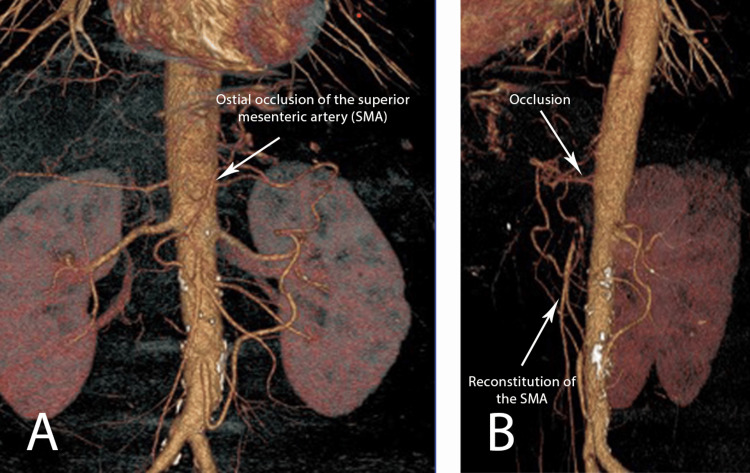
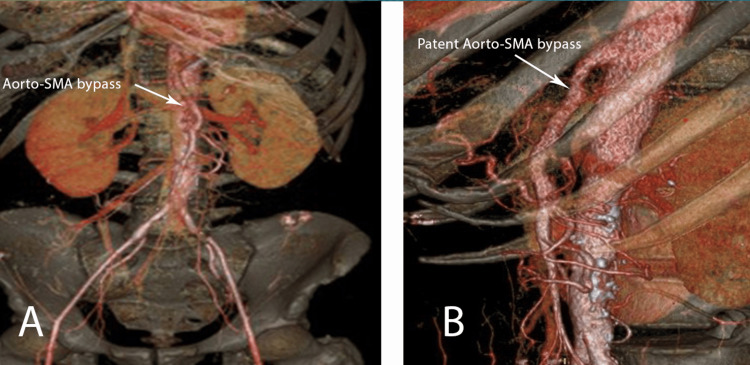
Chronic mesenteric ischemia (CMI) is a vascular disorder primarily caused by atherosclerosis, resulting in intestinal ischemia. While endovascular treatment has become the primary modality for most patients, open mesenteric revascularization remains crucial for complex cases. We present a case of CMI in a patient with critical ischemia, leading to small bowel necrosis, where the endovascular recanalization failed and a surgical approach was needed. A supraceliac antegrade aortomesenteric bypass was performed, and successful revascularization of intestinal circulation was achieved. A novel prefabricated bovine pericardium tube was used as a graft, and the bypass was placed behind the pancreas to ensure maximal isolation from the contaminated abdominal cavity. Despite the intestinal revascularization, in the early postoperative period, the overall condition of the patient worsened with obvious signs of peritonitis. The second look operation revealed a ruptured gallbladder with severe biliary peritonitis, likely caused by the preceding splanchnic ischemia. A cholecystectomy, lavage, and drainage were performed. No further intestinal necrosis was observed, and the bowel passage was restored with latero-lateral jejuno-lejunostomy. The follow-up of the patient showed no signs of graft infection. Despite the complications, the patient's postoperative period was stable, and he was discharged on day sixteen. Regular follow-ups confirmed an excellent patency of the bypass.
Keywords: aorto-mesenteric bypass; bovine pericardium; chronic mesenteric ischemia; compromised operative field; tube graft.
Copyright © 2024, Daskalov et al.
Conflict of interest statement
The authors have declared that no competing interests exist.
Figures
Similar articles
-
Durability of antegrade synthetic aortomesenteric bypass for chronic mesenteric ischemia.J Vasc Surg. 2002 Jun;35(6):1078-84. doi: 10.1067/mva.2002.124377. J Vasc Surg. 2002. PMID: 12042717
-
Direct Retrograde Bypass is Preferable to Antegrade Bypass for Open Mesenteric Revascularization.Ann Vasc Surg. 2020 Jul;66:263-271. doi: 10.1016/j.avsg.2020.01.019. Epub 2020 Jan 10. Ann Vasc Surg. 2020. PMID: 31931133
-
Short-term outcomes for open revascularization of chronic mesenteric ischemia.Ann Vasc Surg. 2012 May;26(4):447-53. doi: 10.1016/j.avsg.2011.11.006. Epub 2012 Jan 27. Ann Vasc Surg. 2012. PMID: 22284770
-
Mesenteric artery bypass: objective patency determination.J Vasc Surg. 1995 May;21(5):729-40; discussion 740-1. doi: 10.1016/s0741-5214(05)80004-7. J Vasc Surg. 1995. PMID: 7769732 Review.
-
Acute mesenteric ischemia as late complication of previous endovascular treatment in young woman. Case report and review of the literature.Ann Ital Chir. 2021 Jun 21;10:S2239253X21033119. Ann Ital Chir. 2021. PMID: 34668486 Review.
References
-
- Open versus endovascular revascularization for chronic mesenteric ischemia: Risk-stratified outcomes. Oderich GS, Bower TC, Sullivan TM, Bjarnason H, Cha S, Gloviczki P. J Vasc Surg. 2009;49:1472–1479. - PubMed
-
- Comparison of clinical outcomes of endovascular versus open revascularization for chronic mesenteric ischemia: A meta-analysis. Cai W, Li X, Shu C, et al. Ann Vasc Surg. 2015;29:934–940. - PubMed
-
- Open surgery for atherosclerotic chronic mesenteric ischemia. Kruger AJ, Walker PJ, Foster WJ, Jenkins JS, Boyne NS, Jenkins J. J Vasc Surg. 2007;46:941–945. - PubMed
-
- Aorto-mesenteric bypass for the treatment of chronic mesenteric ischemia. Mocian A, Russu E, Kaller R, Mureșan A. J Interdiscip Med. 2019;4:101–103.
Publication types
LinkOut - more resources
Full Text Sources