


Role of Interphase FISH Assay on Air-Dried Smears in Identifying Specific Structural Chromosomal Abnormalities among Pediatric Patients with Acute Leukemias
- PMID: 38708148
- PMCID: PMC11065818
- DOI: 10.1007/s12288-023-01699-2
Role of Interphase FISH Assay on Air-Dried Smears in Identifying Specific Structural Chromosomal Abnormalities among Pediatric Patients with Acute Leukemias
Abstract
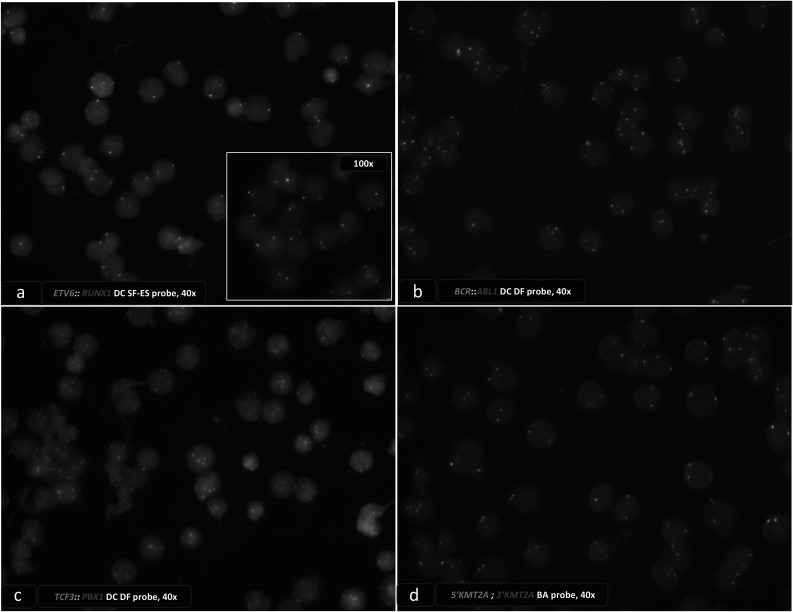
Leukemia-associated structural chromosomal abnormalities (SCA) can be identified either by karyotyping or interphase-fluorescence in-situ hybridization (i-FISH) assays. Both karyotyping and i-FISH on mononuclear cell suspension are time, resource, and manpower-consuming assays. In this study, we have compared the results of specific leukemia-associated SCAs identified by i-FISH on air-dried bone marrow (BM)/peripheral blood (PB) smears and BM karyotyping. The study was conducted among pediatric patients (age ≤ 18 years) diagnosed with acute leukemias between January 2018 to December 2022. The results of i-FISH on air-dried BM/PB smears and BM-karyotyping for our SCA of interest (BCR::ABL1, ETV6::RUNX1, TCF3::PBX1, KMT2A rearrangement, RUNX1::RUNX1T1, CBFB::MYH11, and PML::RARA) were entered in a contingency table and the agreement of results was calculated. The strength of agreement was assessed by Cramer's V test. Among 270 patients, SCA of interest was identified among 26% and 17% of patients by i-FISH on air-dried smears and karyotyping, respectively. Excluding 53 patients with metaphase failure, the remaining 217 patients had 92% agreement (Cramer's V of 0.931 with p < 0.000) between the results for specific SCAs identified by both techniques. On excluding samples with cryptic cytogenetic aberrancies, there was 99% agreement (Cramer's V of 0.953 with p < 0.000) for gross SCA identified by both techniques. In addition, i-FISH on air-dried smears identified SCA in 30% of patients with metaphase failure. I-FISH on air-dried PB/BMA smears is a less-labor and resource-consuming assay. It can be considered an efficient alternative to conventional karyotyping for identifying specific SCA of interest in under-resourced laboratories.
Supplementary information: The online version contains supplementary material available at 10.1007/s12288-023-01699-2.
Keywords: FISH; Karyotyping; Leukemia; Pediatric; Smears.
© The Author(s), under exclusive licence to Indian Society of Hematology and Blood Transfusion 2023. Springer Nature or its licensor (e.g. a society or other partner) holds exclusive rights to this article under a publishing agreement with the author(s) or other rightsholder(s); author self-archiving of the accepted manuscript version of this article is solely governed by the terms of such publishing agreement and applicable law.
Conflict of interest statement
Conflict of interestNo financial or non-financial benefits have been received or will be received from any party related directly or indirectly to the subject of this article. None of the authors have any significant financial interest, consultancy or other relationship with products, manufacturer(s) of products or providers of services related to this manuscript. All authors have agreed to the current version of the manuscript being submitted.
Figures
References
-
- Aydin C, Cetin Z, Manguoglu AE, Tayfun F, Clark OA, Kupesiz A, et al. Evaluation of ETV6/RUNX1 fusion and additional abnormalities involving ETV6 and/or RUNX1 genes using FISH technique in patients with childhood acute lymphoblastic leukemia. Indian J Hematol Blood Transf. 2016;32(2):154–161. doi: 10.1007/s12288-015-0557-7. - DOI - PMC - PubMed
LinkOut - more resources
Full Text Sources
Miscellaneous