


Accuracy of energy and nutrient intake estimation versus observed intake using 4 technology-assisted dietary assessment methods: a randomized crossover feeding study
- PMID: 38710447
- PMCID: PMC11347807
- DOI: 10.1016/j.ajcnut.2024.04.030
Accuracy of energy and nutrient intake estimation versus observed intake using 4 technology-assisted dietary assessment methods: a randomized crossover feeding study
Abstract
Background: Technology-assisted 24-h dietary recalls (24HRs) have been widely adopted in population nutrition surveillance. Evaluations of 24HRs inform improvements, but direct comparisons of 24HR methods for accuracy in reference to a measure of true intake are rarely undertaken in a single study population.
Objectives: To compare the accuracy of energy and nutrient intake estimation of 4 technology-assisted dietary assessment methods relative to true intake across breakfast, lunch, and dinner.
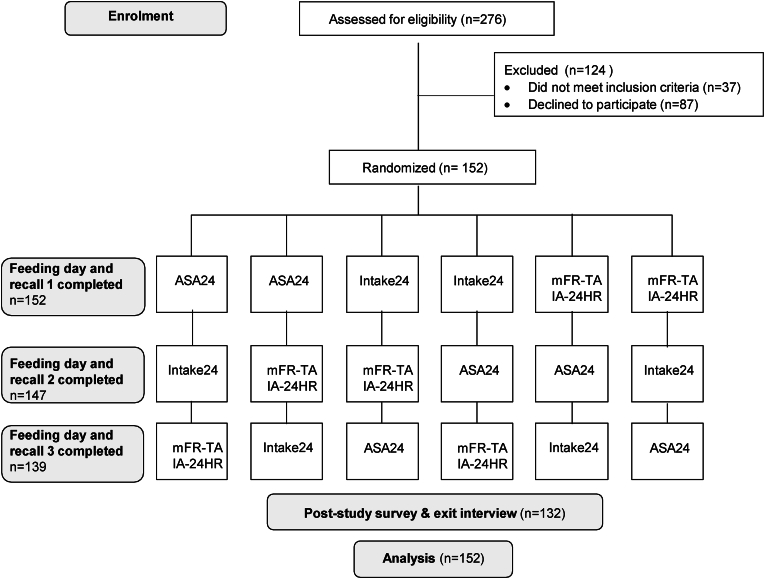
Methods: In a controlled feeding study with a crossover design, 152 participants [55% women; mean age 32 y, standard deviation (SD) 11; mean body mass index 26 kg/m2, SD 5] were randomized to 1 of 3 separate feeding days to consume breakfast, lunch, and dinner, with unobtrusive weighing of foods and beverages consumed. Participants undertook a 24HR the following day [Automated Self-Administered Dietary Assessment Tool-Australia (ASA24); Intake24-Australia; mobile Food Record-Trained Analyst (mFR-TA); or Image-Assisted Interviewer-Administered 24-hour recall (IA-24HR)]. When assigned to IA-24HR, participants referred to images captured of their meals using the mobile Food Record (mFR) app. True and estimated energy and nutrient intakes were compared, and differences among methods were assessed using linear mixed models.
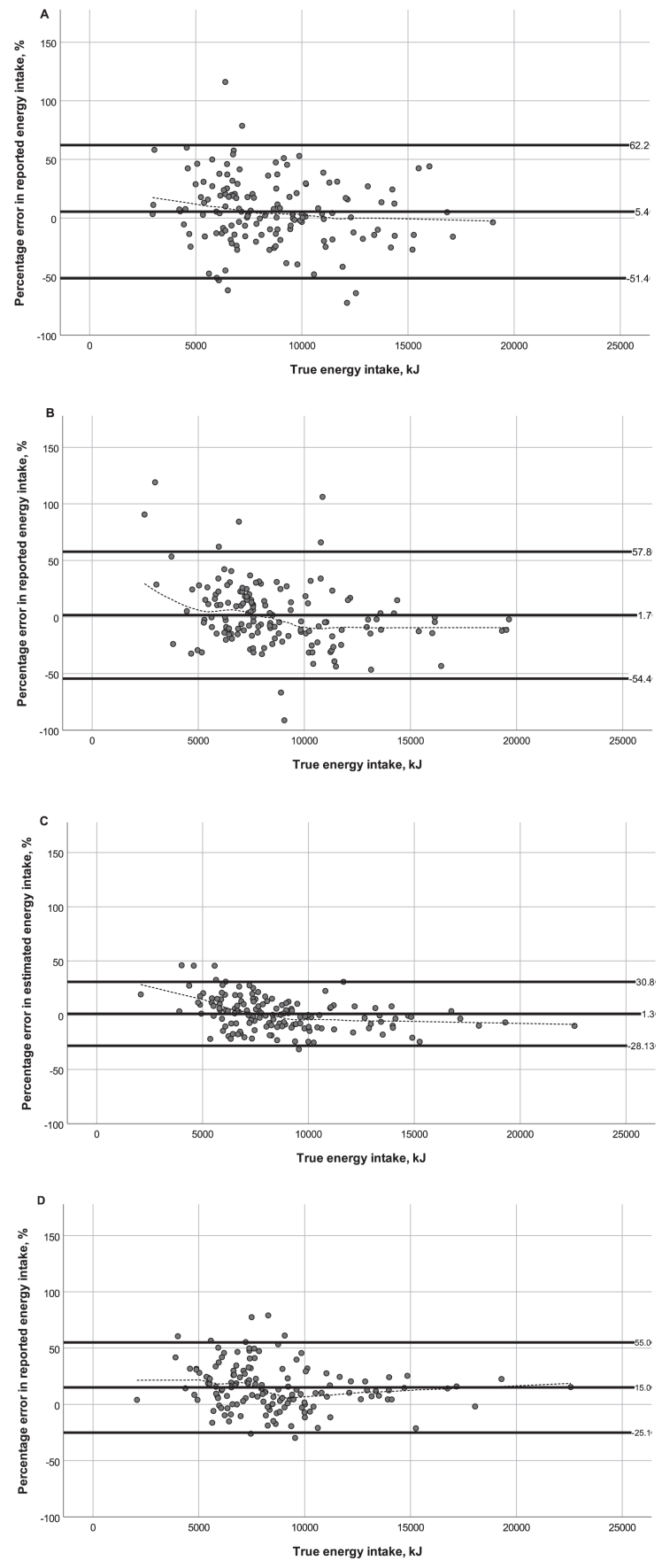
Results: The mean difference between true and estimated energy intake as a percentage of true intake was 5.4% (95% CI: 0.6, 10.2%) using ASA24, 1.7% (95% CI: -2.9, 6.3%) using Intake24, 1.3% (95% CI: -1.1, 3.8%) using mFR-TA, and 15.0% (95% CI: 11.6, 18.3%) using IA-24HR. The variances of estimated and true energy intakes were statistically significantly different for all methods (P < 0.01) except Intake24 (P = 0.1). Differential accuracy in nutrient estimation was present among the methods.
Conclusions: Under controlled conditions, Intake24, ASA24, and mFR-TA estimated average energy and nutrient intakes with reasonable validity, but intake distributions were estimated accurately by Intake24 only (energy and protein). This study may inform considerations regarding instruments of choice in future population surveillance. This trial was registered at Australian New Zealand Clinical Trials Registry as ACTRN12621000209897.
Keywords: Automated Self-Administered Dietary Assessment Tool; Intake24; controlled feeding; dietary assessment; dietary measurement error; image-assisted; interview-administered dietary recall; mobile food record; mobile technology; validation.
Copyright © 2024 The Authors. Published by Elsevier Inc. All rights reserved.
Figures
References
-
- Byers T., Sedjo R. In: Nutritional Epidemiology. 3rd ed. Willet W., editor. Oxford University Press; Oxford, United Kingdom: 2013. Nutrition monitoring and surveillance.
-
- Australian Bureau of Statistics Australian Health Survey: Users’ Guide, 2011-13, cat. no. 4363.0.55.001. 2013 https://www.abs.gov.au/ausstats/abs@.nsf/Lookup/0D6B1FE95EAB8FF3CA257CD2... [Internet] Available from:
-
- Food Surveys Research Group Agricultural Research Service, US Department of Agriculture. AMPM - USDA Automated Multiple-Pass Method. 2019 https://www.ars.usda.gov/northeast-area/beltsville-md-bhnrc/beltsville-h... [Internet] Available from:
-
- Huybrechts I., Aglago E.K., Mullee A., De Keyzer W., Leclercq C., Allemand P., et al. Global comparison of national individual food consumption surveys as a basis for health research and integration in national health surveillance programmes. Proc. Nutr. Soc. 2017;76(4):549–567. doi: 10.1017/s0029665117001161. - DOI - PubMed
Publication types
MeSH terms
Grants and funding
LinkOut - more resources
Full Text Sources
