


Lower vascular conductance responses to handgrip exercise are improved following acute antioxidant supplementation in young individuals with post-traumatic stress disorder
- PMID: 38711207
- PMCID: PMC11140166
- DOI: 10.1113/EP091762
Lower vascular conductance responses to handgrip exercise are improved following acute antioxidant supplementation in young individuals with post-traumatic stress disorder
Abstract
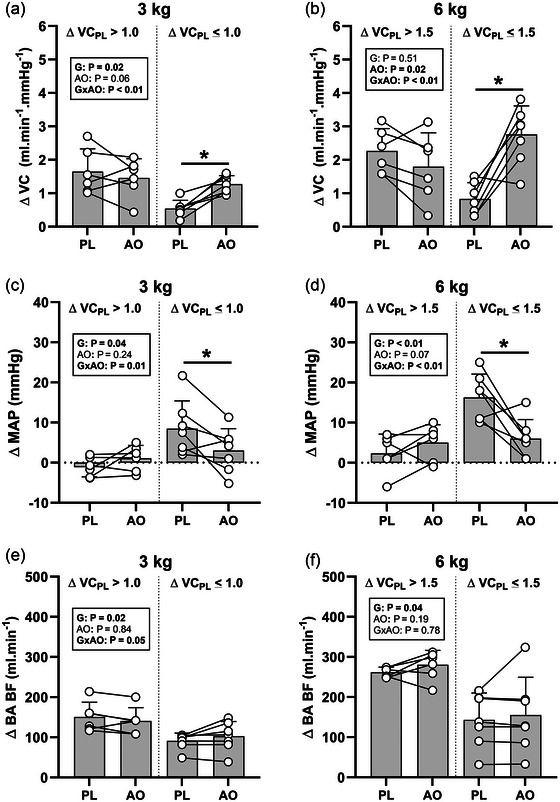
Young individuals with post-traumatic stress disorder (PTSD) display peripheral vascular and autonomic nervous system dysfunction, two factors potentially stemming from a redox imbalance. It is currently unclear if these aforementioned factors, observed at rest, alter peripheral haemodynamic responses to exercise in this population. This study examined haemodynamic responses to handgrip exercise in young individuals with PTSD following acute antioxidant (AO) supplementation. Thirteen young individuals with PTSD (age 23 ± 3 years), and 13 age- and sex-matched controls (CTRL) participated in the study. Exercise-induced changes to arm blood flow (BF), mean arterial pressure (MAP) and vascular conductance (VC) were evaluated across two workloads of rhythmic handgrip exercise (3 and 6 kg). The PTSD group participated in two visits, consuming either a placebo (PL) or AO prior to their visits. The PTSD group demonstrated significantly lower VC (P = 0.04) across all exercise workloads (vs. CTRL), which was significantly improved following AO supplementation. In the PTSD group, AO supplementation improved VC in participants possessing the lowest VC responses to handgrip exercise, with AO supplementation significantly improving VC responses (3 and 6 kg: P < 0.01) by blunting elevated exercise-induced MAP responses (3 kg: P = 0.01; 6 kg: P < 0.01). Lower VC responses during handgrip exercise were improved following AO supplementation in young individuals with PTSD. AO supplementation was associated with a blunting of exercise-induced MAP responses in individuals with PTSD displaying elevated MAP responses. This study revealed that young individuals with PTSD exhibit abnormal, peripherally mediated exercise responses that may be linked to a redox imbalance.
Keywords: antioxidant; autonomic nervous system; mental health; vascular function.
© 2024 The Authors. Experimental Physiology published by John Wiley & Sons Ltd on behalf of The Physiological Society.
Conflict of interest statement
The authors declare they have no conflicts of interest.
Figures

References
-
- Ahmadi, N. , Hajsadeghi, F. , Mirshkarlo, H. B. , Budoff, M. , Yehuda, R. , & Ebrahimi, R. (2011). Post‐traumatic stress disorder, coronary atherosclerosis, and mortality. The American Journal of Cardiology, 108(1), 29–33. - PubMed
-
- Allison, T. G. , Cordeiro, M. A. S. , Miller, T. D. , Daida, H. , Squires, R. W. , & Gau, G. T. (1999). Prognostic significance of exercise‐induced systemic hypertension in healthy subjects. The American Journal of Cardiology, 83(3), 371–375. - PubMed
-
- American Psychiatric Association . (2013). Diagnostic and statistical manual of mental disorders (5th ed.). American Psychiatric Association. 10.1176/appi.books.9780890425596 - DOI
-
- Baker, T. A. , Milstien, S. , & Katusic, Z. S. (2001). Effect of vitamin C on the availability of tetrahydrobiopterin in human endothelial cells. Journal of Cardiovascular Pharmacology, 37(3), 333. - PubMed
Publication types
MeSH terms
Substances
Grants and funding
LinkOut - more resources
Full Text Sources
Medical
Miscellaneous
