


Antimicrobial efficacy of Punica granatum Lythraceae peel extract against pathogens belonging to the ESKAPE group
- PMID: 38711969
- PMCID: PMC11070501
- DOI: 10.3389/fmicb.2024.1383027
Antimicrobial efficacy of Punica granatum Lythraceae peel extract against pathogens belonging to the ESKAPE group
Abstract
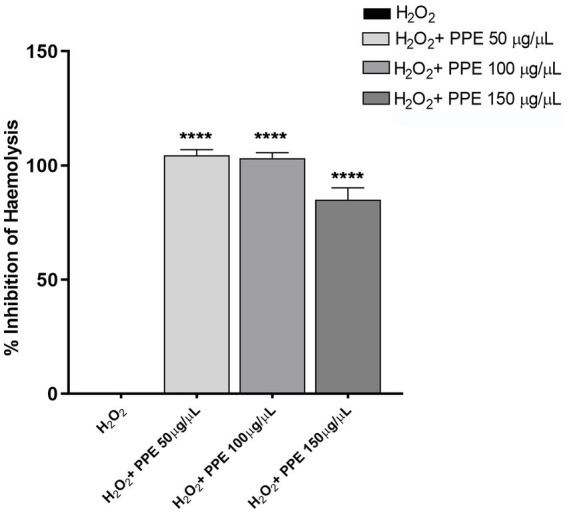
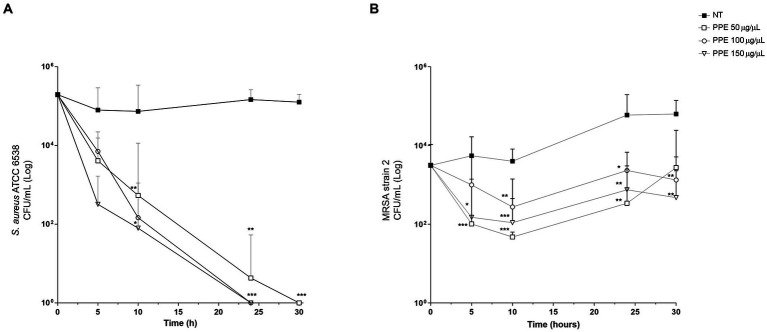
The improper use and abuse of antibiotics have led to an increase in multidrug-resistant (MDR) bacteria resulting in a failure of standard antibiotic therapies. To date, this phenomenon represents a leading public health threat of the 21st century which requires alternative strategies to fight infections such as the identification of new molecules active against MDR strains. In the last 20 years, natural extracts with biological activities attracted scientific interest. Following the One Health Approach, natural by-products represent a sustainable and promising alternative solution. Consistently, the aim of the present study was to evaluate the antimicrobial activity of hydro-alcoholic pomegranate peel extract (PPE) against MDR microorganisms belonging to Enterococcus faecium, Staphylococcus aureus, Klebsiella pneumoniae, Acinetobacter baumannii, Pseudomonas aeruginosa, and Enterobacter spp. "ESKAPE" group pathogens. Through semiquantitative and quantitative methods, the PPE showed effective antimicrobial activity against Gram-positive and Gram-negative MDR bacteria. The kinetics of bactericidal action of PPE highlighted that microbial death was achieved in a time- and dose-dependent manner. High concentrations of PPE exhibited antioxidant activity, providing a protective effect on cellular systems and red blood cell membranes. Finally, we report, for the first time, a significant intracellular antibacterial property of PPE as highlighted by its bactericidal action against the staphylococcal reference strain and its bacteriostatic effect against clinical resistant strain in the HeLa cell line. In conclusion, due to its characterized content of polyphenolic compounds and antioxidant activity strength, the PPE could be considered as a therapeutic agent alone or in conjunction with standard antibiotics against challenging infections caused by ESKAPE pathogens.
Keywords: ESKAPE pathogens; antimicrobial activity; in vitro infection model; intracellular antimicrobial action; multidrug-resistant bacteria; natural by-product; pomegranate peel extract.
Copyright © 2024 Scaglione, Sateriale, Mantova, Di Rosario, Continisio, Vitiello, Pagliarulo, Colicchio, Pagliuca and Salvatore.
Conflict of interest statement
The authors declare that the research was conducted in the absence of any commercial or financial relationships that could be construed as a potential conflict of interest.
Figures
References
-
- Argov-Argaman N., Cohen-Zinder M., Leibovich H., Yishay M., Eitam H., Agmon R., et al. (2020). Dietary pomegranate peel improves milk quality of lactating ewes: emphasis on milk fat globule membrane properties and antioxidative traits. Food Chem. 313:125822. doi: 10.1016/j.foodchem.2019.125822, PMID: - DOI - PubMed
LinkOut - more resources
Full Text Sources
Molecular Biology Databases
Miscellaneous
