


The National Cancer Database Conforms to the Standardized Framework for Registry and Data Quality
- PMID: 38717542
- PMCID: PMC11300494
- DOI: 10.1245/s10434-024-15393-8
The National Cancer Database Conforms to the Standardized Framework for Registry and Data Quality
Abstract
Background: Standardization of procedures for data abstraction by cancer registries is fundamental for cancer surveillance, clinical and policy decision-making, hospital benchmarking, and research efforts. The objective of the current study was to evaluate adherence to the four components (completeness, comparability, timeliness, and validity) defined by Bray and Parkin that determine registries' ability to carry out these activities to the hospital-based National Cancer Database (NCDB).
Methods: Tbis study used data from U.S. Cancer Statistics, the official federal cancer statistics and joint effort between the Centers for Disease Control and Prevention (CDC) and the National Cancer Institute (NCI), which includes data from National Program of Cancer Registries (NPCR) and Surveillance, Epidemiology, and End Results (SEER) to evaluate NCDB completeness between 2016 and 2020. The study evaluated comparability of case identification and coding procedures. It used Commission on Cancer (CoC) standards from 2022 to assess timeliness and validity.
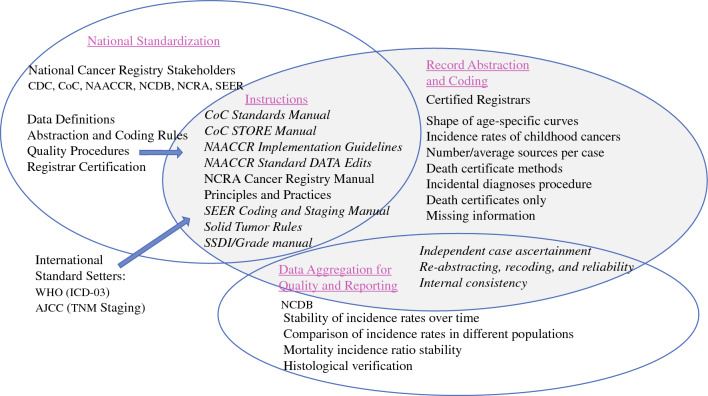
Results: Completeness was demonstrated with a total of 6,828,507 cases identified within the NCDB, representing 73.7% of all cancer cases nationwide. Comparability was followed using standardized and international guidelines on coding and classification procedures. For timeliness, hospital compliance with timely data submission was 92.7%. Validity criteria for re-abstracting, recording, and reliability procedures across hospitals demonstrated 94.2% compliance. Additionally, data validity was shown by a 99.1% compliance with histologic verification standards, a 93.6% assessment of pathologic synoptic reporting, and a 99.1% internal consistency of staff credentials.
Conclusion: The NCDB is characterized by a high level of case completeness and comparability with uniform standards for data collection, and by hospitals with high compliance, timely data submission, and high rates of compliance with validity standards for registry and data quality evaluation.
Keywords: Comparability; Coverage; NCDB; Quality; Registry; Standardization; Timeliness; Validity.
© 2024. The Author(s).
Conflict of interest statement
The findings and conclusions in this article are those of the authors and do not necessarily represent the official position of the Centers for Disease Control and Prevention. Daniel J. Boffa, MD, MBA, FACS, received a stipend to attend a panel discussion from Iovance in May 2022. The remaining authors have no conflicts of interest.
Figures
References
MeSH terms
Grants and funding
LinkOut - more resources
Full Text Sources
Medical
