


Assessment of antimicrobial prescribing patterns, guidelines compliance, and appropriateness of antimicrobial prescribing in surgical-practice units: point prevalence survey in Malaysian teaching hospitals
- PMID: 38720771
- PMCID: PMC11076853
- DOI: 10.3389/fphar.2024.1381843
Assessment of antimicrobial prescribing patterns, guidelines compliance, and appropriateness of antimicrobial prescribing in surgical-practice units: point prevalence survey in Malaysian teaching hospitals
Abstract
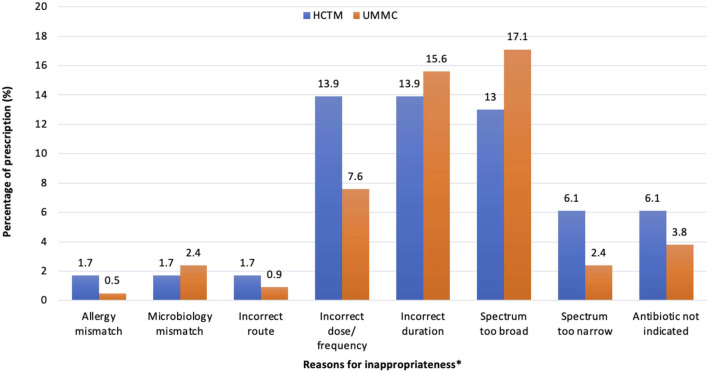
Objectives: This study sought to investigate the quality of antimicrobial prescribing among adult surgical inpatients besides exploring the determinants of non-compliance and inappropriate prescribing to inform stewardship activities. Methods: A cross-sectional point prevalence study employing Hospital National Antimicrobial Prescribing Survey (Hospital NAPS) was conducted in April 2019 at two teaching hospitals in Malaysia. Results: Among 566 surgical inpatients, 44.2% were receiving at least one antimicrobial, for a total of 339 prescriptions. Antimicrobials belonging to the World Health Organization's Watch group were observed in 57.8% of cases. Both hospitals exhibited similar types of antimicrobial treatments prescribed and administration routes. A significant difference in antimicrobial choice was observed between hospitals (p < 0.001). Hospital with electronic prescribing demonstrated better documentation practice (p < 0.001). Guidelines compliance, 32.8% (p = 0.952) and appropriateness, 55.2% (p = 0.561) did not significantly differ. The major contributors of inappropriateness were incorrect duration, (15%) and unnecessary broad-spectrum coverage, (15.6%). Non-compliance and inappropriate prescribing were found to be 2 to 4 times significantly higher with antimicrobial prophylaxis prescription compared to empirical therapy. Conclusion: Antimicrobial stewardship efforts to improve appropriate surgical prescribing are essential. These initiatives should prioritize surgical prophylaxis prescribing, focusing on reducing unnecessarily prolonged use and broad-spectrum antimicrobials, raising awareness among prescribers and promoting proper documentation.
Keywords: antimicrobial prophylaxis; antimicrobial stewardship; appropriateness; guidelines compliance; point prevalence; surgical.
Copyright © 2024 Jamaluddin, Periyasamy, Lau, Ponnampalavanar, Lai, Loong, Tg Abu Bakar Sidik, Ramli, Tan, Kori, Yin, Azman, James, Thursky and Naina Mohamed.
Conflict of interest statement
The authors declare that the research was conducted in the absence of any commercial or financial relationships that could be construed as a potential conflict of interest.
Figures
References
-
- Aghdassi S. J. S., Gastmeier P., Piening B. C., Behnke M., Diaz L. A. P., Gropmann A., et al. (2018). Antimicrobial usage in German acute care hospitals: results of the third national point prevalence survey and comparison with previous national point prevalence surveys. J. Antimicrob. Chemother. 73 (4), 1077–1083. 10.1093/jac/dkx494 - DOI - PubMed
-
- Alahmadi Y. M., Aljabri A. K., Alsaadi F. N., Rizk L. M., Alahmadi R. Y., Aljuhani S. R., et al. (2020). A prospective antibiotic point prevalence survey in two primary referral hospitals during and after pilgrims stay in Madinah, Saudi Arabia. Trop. J. Pharm. Res. 19 (2), 391–399. 10.4314/tjpr.v19i2.23 - DOI
LinkOut - more resources
Full Text Sources
Miscellaneous
