


Multiple obesity indices suggest a close relationship between obesity and constipation: evidence from NHANES
- PMID: 38724957
- PMCID: PMC11084052
- DOI: 10.1186/s12889-024-18647-y
Multiple obesity indices suggest a close relationship between obesity and constipation: evidence from NHANES
Abstract
Objective: This study aims to investigate the relationship between obesity and constipation among American adults.
Methods: Our study leveraged data from the National Health and Nutrition Examination Survey (NHANES). This comprehensive approach enabled us to summarize the weighted prevalence rates of obesity in adults. To further deepen our understanding, we employed a variety of analytical methods. These included multivariable logistic regression, subgroup analysis and restricted cubic splines. Through these methodologies, we were able to effectively evaluate the correlation between various obesity indicators and constipation, offering new insights into this complex relationship.
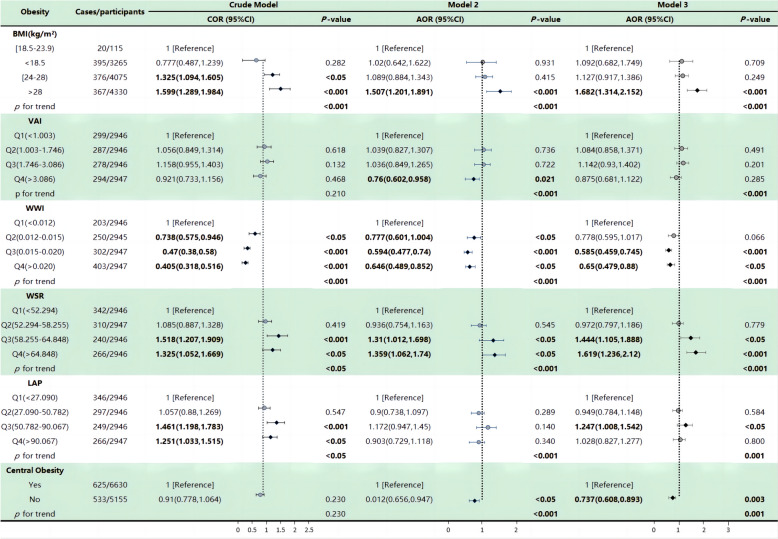
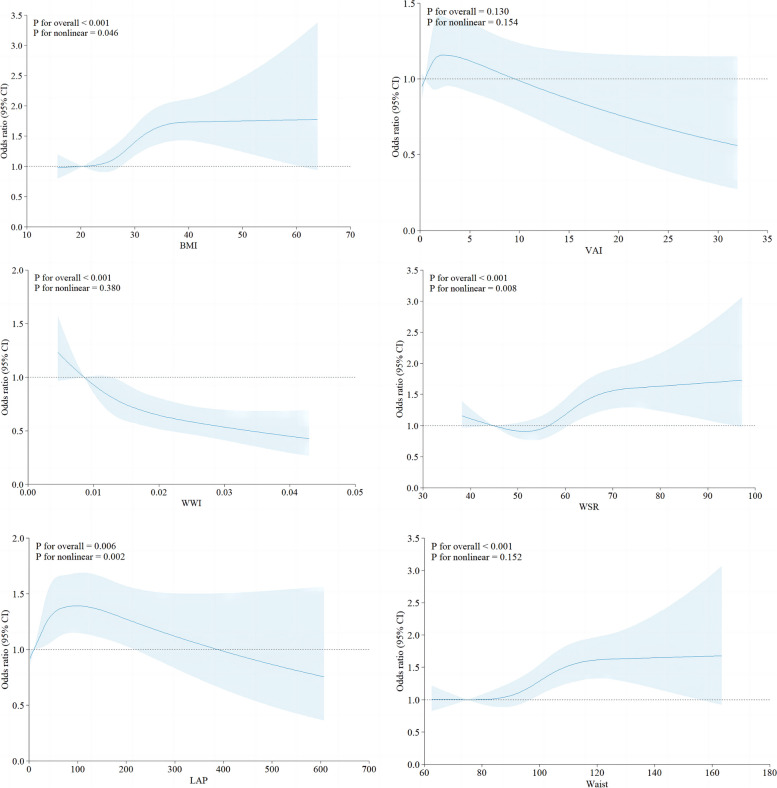
Results: The weighted prevalence of constipation stands at 9.42%. Notably, an increased risk of constipation is linked with a BMI (body mass index) exceeding 28 kg/m2, WSR (waist-stature ratio) that is either between 58.3 and 64.8 or above 64.8, as well as a LAP (lipid accumulation products) ranging from 50.8 to 90.1. In contrast, a reduced risk of constipation is associated with WWI (weight-adjusted-waist index) that falls between 0.015 and 0.020, exceeds 0.020, and without the presence of central obesity (P < 0.05). Restricted cubic spline analysis, a significant non-linear relationship was discerned between BMI, WSR, and LAP in relation to constipation.
Conclusions: This pioneering large-scale study explores the relationship between various obesity indices and constipation. It reveals that reducing the BMI, WSR, LAP and waist circumference can decrease the risk of constipation. Conversely, a higher value of WWI correlates with a lower constipation risk, and this remains true even after adjusting for a wide range of variables.
Keywords: Constipation; NHANES; National Health and Nutrition Examination Survey; Obesity.
© 2024. The Author(s).
Conflict of interest statement
The authors declare no competing interests.
Figures
References
-
- Vincent AD, Wang XY, Parsons SP, Khan WI, Huizinga JD. Abnormal absorptive colonic motor activity in germ-free mice is rectified by butyrate, an effect possibly mediated by mucosal serotonin. Am J Physiol Gastrointest Liver Physiol. 2018;315(5):G896–G907. doi: 10.1152/ajpgi.00237.2017. - DOI - PubMed
-
- Pecora P, Suraci C, Antonelli M, De Maria S, Marrocco W. Constipation and obesity: a statistical analysis. Boll Soc Ital Biol Sper. 1981;57(23):2384–2388. - PubMed
Publication types
MeSH terms
LinkOut - more resources
Full Text Sources
Medical
Research Materials
