Comparison of local massage, steroid injection, and extracorporeal shock wave therapy efficacy in the treatment of lateral epicondylitis
- PMID: 38727119
- PMCID: PMC11128959
- DOI: 10.52312/jdrs.2024.1648
Comparison of local massage, steroid injection, and extracorporeal shock wave therapy efficacy in the treatment of lateral epicondylitis
Abstract
Objectives: This study aimed to compare the clinical outcomes of patients with lateral epicondylitis (LE) treated with local massage, corticosteroid (CS) injection, and extracorporeal shock wave therapy (ESWT).
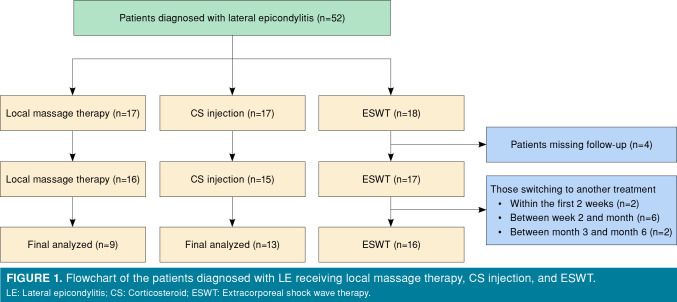
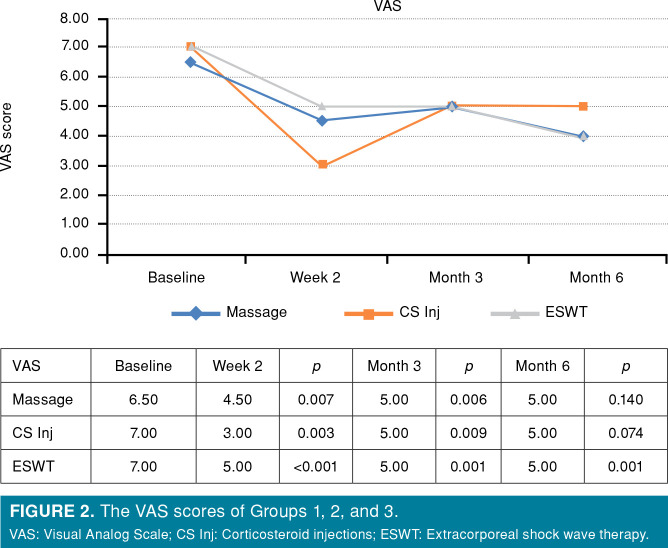
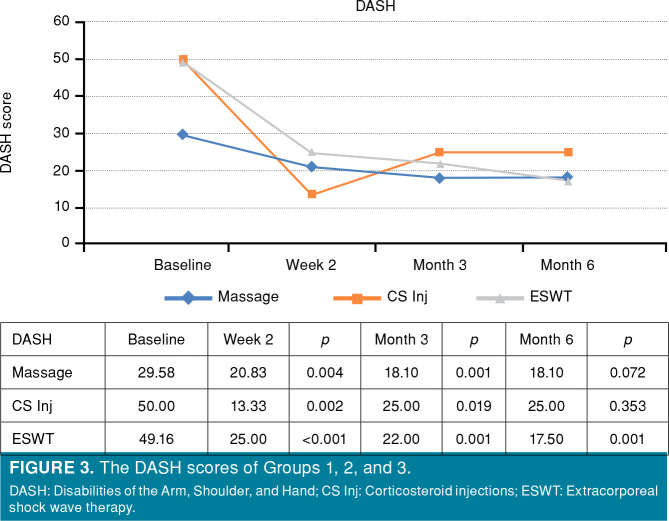
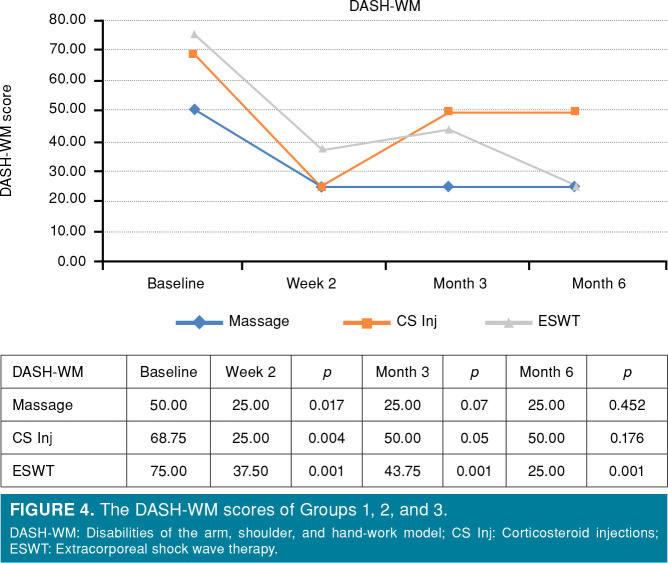
Patients and methods: This randomized prospective study included 52 patients. Patients treated with local massage in Group 1 (n=17; 9 males, 8 females; mean age: 46.1±10.9 years; range, 27 to 64 years), CS injection in Group 2 (n=17; 7 males, 10 females; mean age: 46.0±8.8 years; range, 28 to 63 years), and ESWT in Group 3 (n=18; 12 males, 6 females; mean age: 46.7±11.3 years; range, 28 to 68 years) for LE were evaluated between March 2021 and June 2022. Clinical outcomes were assessed using the Visual Analog Scale (VAS), Disabilities of the Arm, Shoulder, and Hand (DASH), and DASH-Work Model (DASH-WM) scoring systems at the initial examination at the beginning of the study and at two-week, three-month, and six-month follow-up controls.
Results: Similar results were observed between VAS, DASH, and DASH-WM scores measured during LE diagnosis. In the first two weeks of follow-up, statistically significant decreases were observed in VAS, DASH, and DASH-WM scores in all three groups. Compared to baseline values, Group 1 and 2 had significant difference in VAS and DASH scores at three months. Group 3 had a significant difference in all clinical evaluation scores. At six months, no significant difference was observed in Groups 1 and 2 in any of the scoring systems, while Group 3 showed significant improvements in all scoring systems.
Conclusion: Treatment with ESWT was superior to other treatments throughout the study and at the final follow-up. In patients receiving CS injections, the clinical outcomes worsened with time, evidenced by the six-month follow-up. Further studies on combined treatment modalities are needed on this subject.
Conflict of interest statement
Figures
References
-
- Runge F. Zur RF. Genese und behandlung des schreibekramfes. Berlin: Klin Wochenschr. 1873;10:245–248.
Publication types
MeSH terms
Substances
LinkOut - more resources
Full Text Sources
Medical