


Residents underestimate their robotic performance: evaluating resident robotic console participation time
- PMID: 38727932
- PMCID: PMC11087327
- DOI: 10.1007/s11701-023-01790-w
Residents underestimate their robotic performance: evaluating resident robotic console participation time
Abstract
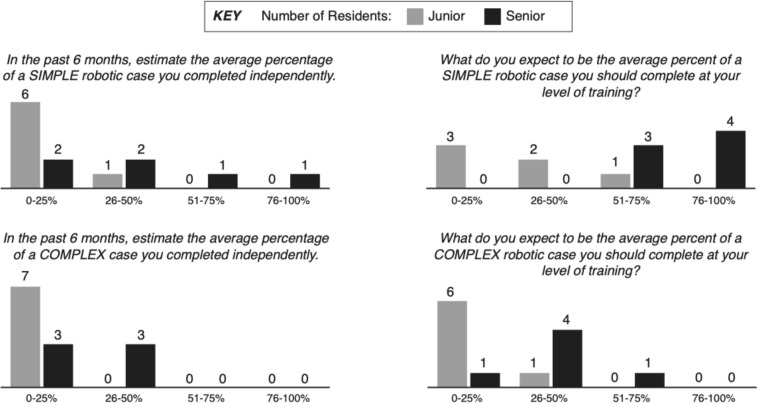
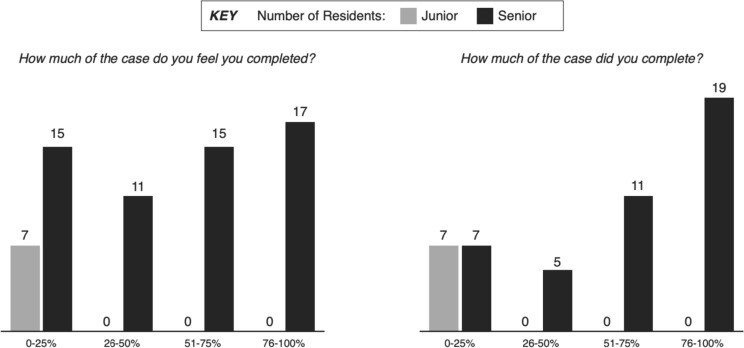
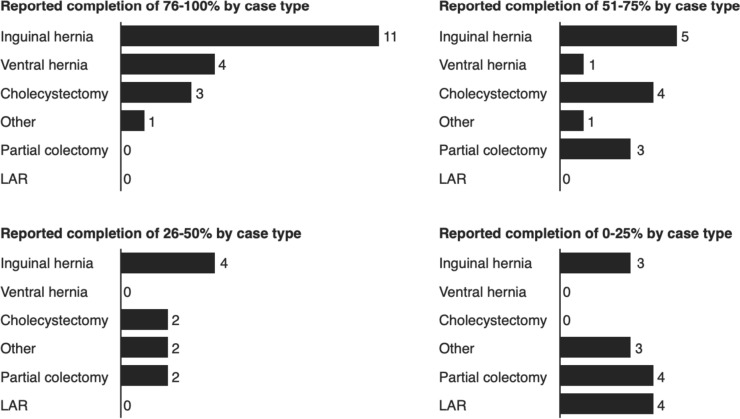
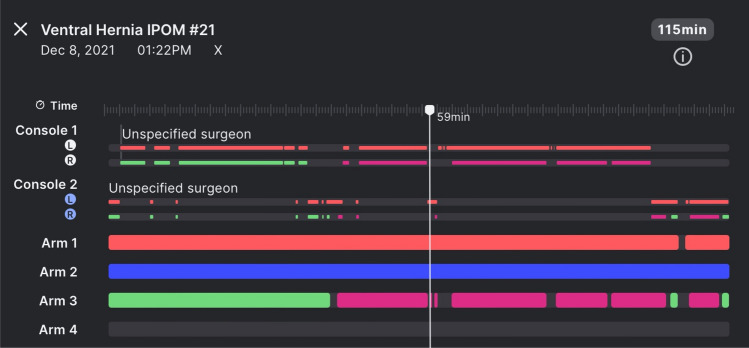
Lack of formal national robotic curriculum results in a void of knowledge regarding appropriate progression of autonomy in robotic general surgery training. One midwestern academic surgical training program has demonstrated that residents expect to independently operate more on the robotic console than they perceive themselves to do. As such, our study sought to evaluate expectations of residents and faculty regarding resident participation versus actual console participation time (CPT) at a community general surgery training program. We surveyed residents and faculty in two phases. Initially, participants were asked to reflect on their perceptions and expectations from the previous six months. The second phase included surveys (collected over six months) after individual cases with subjective estimation of participation versus CPT calculated by the Intuitive Surgical, Inc. MyIntuitive application. Using Mann-Whitney U-Test, we compared resident perceptions of CPT to actual CPT by case complexity and post-graduate year (PGY). Faculty (n = 7) estimated they allowed residents to complete a median of 26-50% of simple and 0-25% of complex cases in the six months prior to the study. They expected senior residents (PGY-4 and PGY-5) to complete more: 51-75% of simple and 26-50% of complex cases. Residents (n = 13), PGY-2-PGY-5, estimated they completed less than faculty perceived (0-25% of simple and 0-25% of complex cases). Sixty-six post-case (after partial colectomy, abdominoperoneal resection, low anterior resection, cholecystectomy, inguinal/ventral hernia repair, and others) surveys were completed. Residents estimated after any case that they had completed 26-50% of the case. However, once examining their MyIntuitive report, they actually completed 51-75% of the case (median). Residents, especially PGY-4 and 5, completed a higher percentage than estimated of robotic cases. Our study confirms that residents can and should complete more of (and increasingly complex) robotic cases throughout training, like the transition of autonomy in open and laparoscopic surgery.
Keywords: Autonomy; General surgery; Resident education; Robotic surgery.
© 2024. The Author(s).
Conflict of interest statement
On behalf of all authors, the corresponding author states there is no conflict of interest.
Figures
References
-
- Tom CM, Maciel JD, Korn A et al (2019) A survey of robotic surgery training curricula in general surgery residency programs: how close are we to a standardized curriculum? Am J Surg 217(2):256–260. 10.1016/j.amjsurg.2018.11.006 - PubMed
-
- Smith R, Patel V, Satava R (2014) Fundamentals of robotic surgery: a course of basic robotic surgery skills based upon a 14-society consensus template of outcomes measures and curriculum development. Int J Med Robot 10(3):379–384. 10.1002/rcs.1559 - PubMed
-
- Azadi S, Green IC, Arnold A et al (2021) Robotic surgery: the impact of simulation and other innovative platforms on performance and training. J Minim Invasive Gynecol 28(3):490–495. 10.1016/j.jmig.2020.12.001 - PubMed
-
- Green CA, Chern H, O’Sullivan PS (2018) Current robotic curricula for surgery residents: a need for additional cognitive and psychomotor focus. Am J Surg 215(2):277–281. 10.1016/j.amjsurg.2017.09.040 - PubMed
MeSH terms
LinkOut - more resources
Full Text Sources
Research Materials
